Leopoldo Marechal - Adam Buenosayres
Здесь есть возможность читать онлайн «Leopoldo Marechal - Adam Buenosayres» весь текст электронной книги совершенно бесплатно (целиком полную версию без сокращений). В некоторых случаях можно слушать аудио, скачать через торрент в формате fb2 и присутствует краткое содержание. Год выпуска: 2015, Издательство: McGill-Queen's University Press, Жанр: Классическая проза, на английском языке. Описание произведения, (предисловие) а так же отзывы посетителей доступны на портале библиотеки ЛибКат.
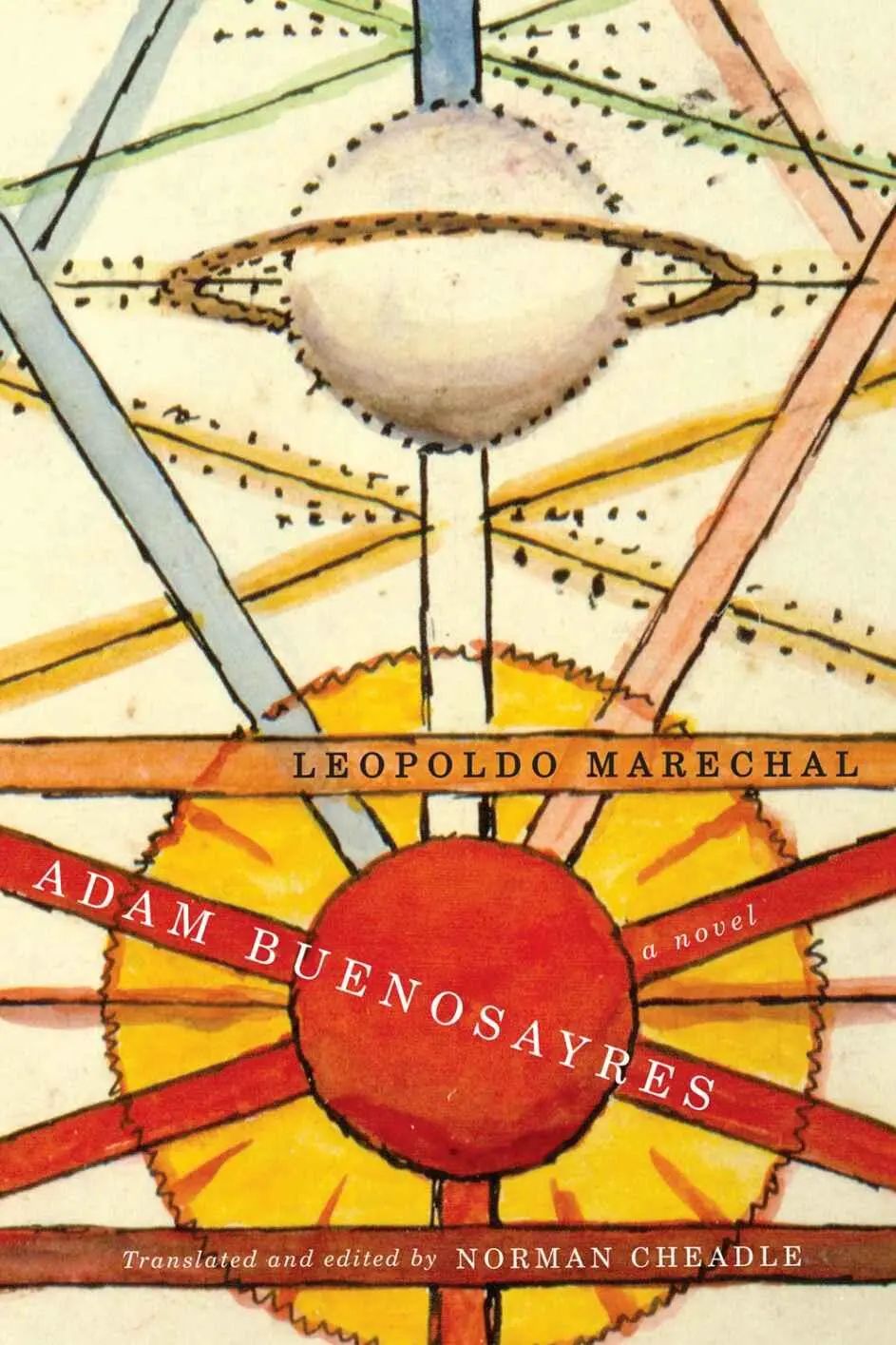
- Название:Adam Buenosayres
- Автор:
- Издательство:McGill-Queen's University Press
- Жанр:
- Год:2015
- ISBN:нет данных
- Рейтинг книги:5 / 5. Голосов: 1
-
Избранное:Добавить в избранное
- Отзывы:
-
Ваша оценка:
Adam Buenosayres: краткое содержание, описание и аннотация
Предлагаем к чтению аннотацию, описание, краткое содержание или предисловие (зависит от того, что написал сам автор книги «Adam Buenosayres»). Если вы не нашли необходимую информацию о книге — напишите в комментариях, мы постараемся отыскать её.
Adam Buenosayres — читать онлайн бесплатно полную книгу (весь текст) целиком
Ниже представлен текст книги, разбитый по страницам. Система сохранения места последней прочитанной страницы, позволяет с удобством читать онлайн бесплатно книгу «Adam Buenosayres», без необходимости каждый раз заново искать на чём Вы остановились. Поставьте закладку, и сможете в любой момент перейти на страницу, на которой закончили чтение.
Интервал:
Закладка:
He looked toward the parlour. Through the cigarette smoke he could make out the silhouettes of seven or eight figures vaguely gesturing. But he heard with clarity the hubbub of voices: the tertulia had grown livelier, and the tinkle of girlish laughter was joined by the sudden clangour of disputatious voices and the clucking of matrons. Mister Chisholm felt isolated in his sky of blood. He took a swig from his glass and found it dry; he sucked on his pipe, but it was cold. Alone. Mister Chisholm was alone among his blue birds. Desolate? Perhaps. But the fact was, legions of island-men like him were opportunely distributed across the globe, sustaining the most formidable empire this world had ever seen. At this thought, Mister Chisholm stood up straight on his ladder, his eyes instinctively seeking the sea.
Just then, the horde irrupted into the vestibule — Luis Pereda, Franky Amundsen, Del Solar, and the pipsqueak Bernini. 19Four individuals already illustrious in the annals of partying and folklore, they hit the vestibule like a windstorm. The first to enter was Luis Pereda; short-sighted, rowdy, he hazarded a few steps and bumped into the stepladder. Mister Chisholm swayed perilously in the heights.
— Hello, Mister Chisholm! Franky Amundsen shouted in English.
— Excuse me, sir! Pereda boomed, also in English, and passed on like a blind boar.
— Savages! muttered Mister Chisholm, teeth clenched around his pipe.
The four inimitable heroes entered the parlour and were received with cries of joy. Suddenly, Bernini stopped his comrades mid-room.
— Look! he told them, pointing at the diverse groupings. Just as I told you. Men on one side and women on the other. The disjunction of the sexes. Buenos Aires’s great problem!
But Franky, Del Solar, and Pereda continued toward the liquor table; once there, at the udder of the milch-cow, they abundantly replenished the vigour they’d expended on who knows what generous adventures. The pipsqueak Bernini, making no secret of his demographic concerns, headed for the metaphysical sector where he was received with open arms. Not that the three drinkers despised the sort of profound matters Bernini had just raised; on the contrary, once the libations required by their fervent devotion to Mercury had been duly executed, they again took up the inquiry they were racking their brains over. Namely, what was the exact nature of the Compadrito mil novecientos , the Turn-of-the-Century Dude? And what changes had this amazing human type undergone as a result of the influx, since 1900, of new racial contingents to the Great Capital of the South? Leading the discussion was none other than Luis Pereda, undisputed authority on this difficult subject. Brandishing a vinyl disk recorded in 1903 for the department store Gath y Chaves, 20he was about to demonstrate a thesis that at the moment was encountering serious resistance.
— So let’s hear that record, proposed Del Solar. He was sucking at an ivory cigarette holder about half a mile long that looked like it belonged in the boudoir of some cocotte .
But Franky Amundsen was one of those sterile fellows who always have to spit their skepticism on the virgin rose of any enthusiasm. His intellectual baggage, acquired exclusively from detective stories and pirate novels, not only disqualified him for any legitimate intercourse in the field of literature and the arts but was also responsible for his proclivity to erupt in totally anachronistic oaths and curses, thanks to which, in his understanding, he cut the figure of a buccaneer from the Tortuga Islands. 21
— By the beard of the Prophet! growled Franky. If that isn’t a stupid disk, may I be eaten alive by ants!
Franky’s curse notwithstanding, the three champions made for the phonograph in a corner of the parlour. Franky, with ironic elegance, wound up the antiquated machine, while Luis Pereda rooted around anxiously in a welter of records, very much as a wild boar uses his snout to snuffle in the earth for some succulent tuber.
— Here it is! he cried at last. The taita of 1900, the genuine article!
With trembling hand, he removed the record from its sleeve, placed it on the turntable, and lowered the armature. The phonograph emitted a twangy voice:
Comin’ down the line
was an Anglo-Argentine tram
when it came upon a wagon
with its wheels jammed in the track.
“Hey Bud, get outta the road!”
said the tram-driver to the wagoner. 22
Impossible to convey in words Luis Pereda’s ecstasy when the second-last line was wailed.
— Listen to that voice! he said triumphantly. It’s the original malevo , the gaucho who’s just come into the city. Not a trace of Italian influence yet!
“If they don’t bring a rope,
my wagon’s gonna be stuck
in the tracks all day long!”
The tram-driver, gettin’ mad
shouts back: “How ’bout a knuckle sandwich
big mouth!”
At this point Pereda’s ecstasy gave way to a wave of pugnacity that shook him right down to his toes.
— Atta boy! he shouted and laughed, swaggering like a taita ready to take on an army. 23
Franky watched him with a kind of glacial melancholy.
— Terrific! he said, pointing at Pereda. They send him to study Greek at Oxford, literature at the Sorbonne, and philosophy in Zurich. And when he comes home to Buenos Aires, he goes soft in the head over record-industry criollismo , poor sod!
The nasal twang from the phonograph was getting more excited:
The wagoner
parries the knife-thrust
and after a couple more
goes hard for the tram-driver
who, had he not been nimble
and stopped the blow in mid-air
woulda had his guts sliced open
like a field watermelon.
Pereda was laughing so hard, it hurt the eardrums.
— He’s out of his mind! scolded Franky. If this ain’t a case of mental masturbation, the ants can eat me alive!
But at that moment, from the metaphysical sector of the tertulia, an irate voice was heard.
— What does he want? asked Pereda, turning a nobly aggressive mug toward the metaphysicals.
— Shut that goddam phonograph up! Samuel Tesler answered.
Franky Amundsen turned off the machine and went over to the philosopher of Villa Crespo, his two buddies naturally following hard on his heels.
— What’s up, what’s the matter? he said melliflously, patting the back of Samuel’s neck as though soothing a furious cat.
The philosopher pointed at Lucio Negri with an index digit that ended in a long, doleful fingernail.
— I need absolute silence! he demanded. I’m trying to flush a vestige of metaphysical intelligence out of this man.
— Any luck? asked Franky.
— Negative.
— I feared as much.
Taking his eyes off the sky-blue divan, Lucio showed signs of wanting to speak. But Franky stopped him with an authoritarian gesture.
— Silence! he ordered. I’ll bet our philosopher dared demonstrate in public the immortality of the soul.
— You’ve got it, laughed Lucio.
— That’s right, said Señor Johansen, sensing in Franky a new and powerful ally.
Franky Amundsen looked from one to the other pessimistically, then turned to the philosopher:
— I’ll bet, he said, pointing at Lucio, that the young medico has just publicly denied the immortality of the soul.
— Immortality? groaned Samuel. He denies the very existence of the soul.
— Soulless wretch! exclaimed Franky, leveling an accusing index finger at Lucio.
Passing a nostalgic gaze around the room, he added:
— Belly of the whale! To think that my ancestral home has degenerated into a philosophical bordello!
He turned around abruptly and faced the group, a fanatical gleam in his eye.
Читать дальшеИнтервал:
Закладка:
Похожие книги на «Adam Buenosayres»
Представляем Вашему вниманию похожие книги на «Adam Buenosayres» списком для выбора. Мы отобрали схожую по названию и смыслу литературу в надежде предоставить читателям больше вариантов отыскать новые, интересные, ещё непрочитанные произведения.










Обсуждение, отзывы о книге «Adam Buenosayres» и просто собственные мнения читателей. Оставьте ваши комментарии, напишите, что Вы думаете о произведении, его смысле или главных героях. Укажите что конкретно понравилось, а что нет, и почему Вы так считаете.