Leopoldo Marechal - Adam Buenosayres
Здесь есть возможность читать онлайн «Leopoldo Marechal - Adam Buenosayres» весь текст электронной книги совершенно бесплатно (целиком полную версию без сокращений). В некоторых случаях можно слушать аудио, скачать через торрент в формате fb2 и присутствует краткое содержание. Год выпуска: 2015, Издательство: McGill-Queen's University Press, Жанр: Классическая проза, на английском языке. Описание произведения, (предисловие) а так же отзывы посетителей доступны на портале библиотеки ЛибКат.
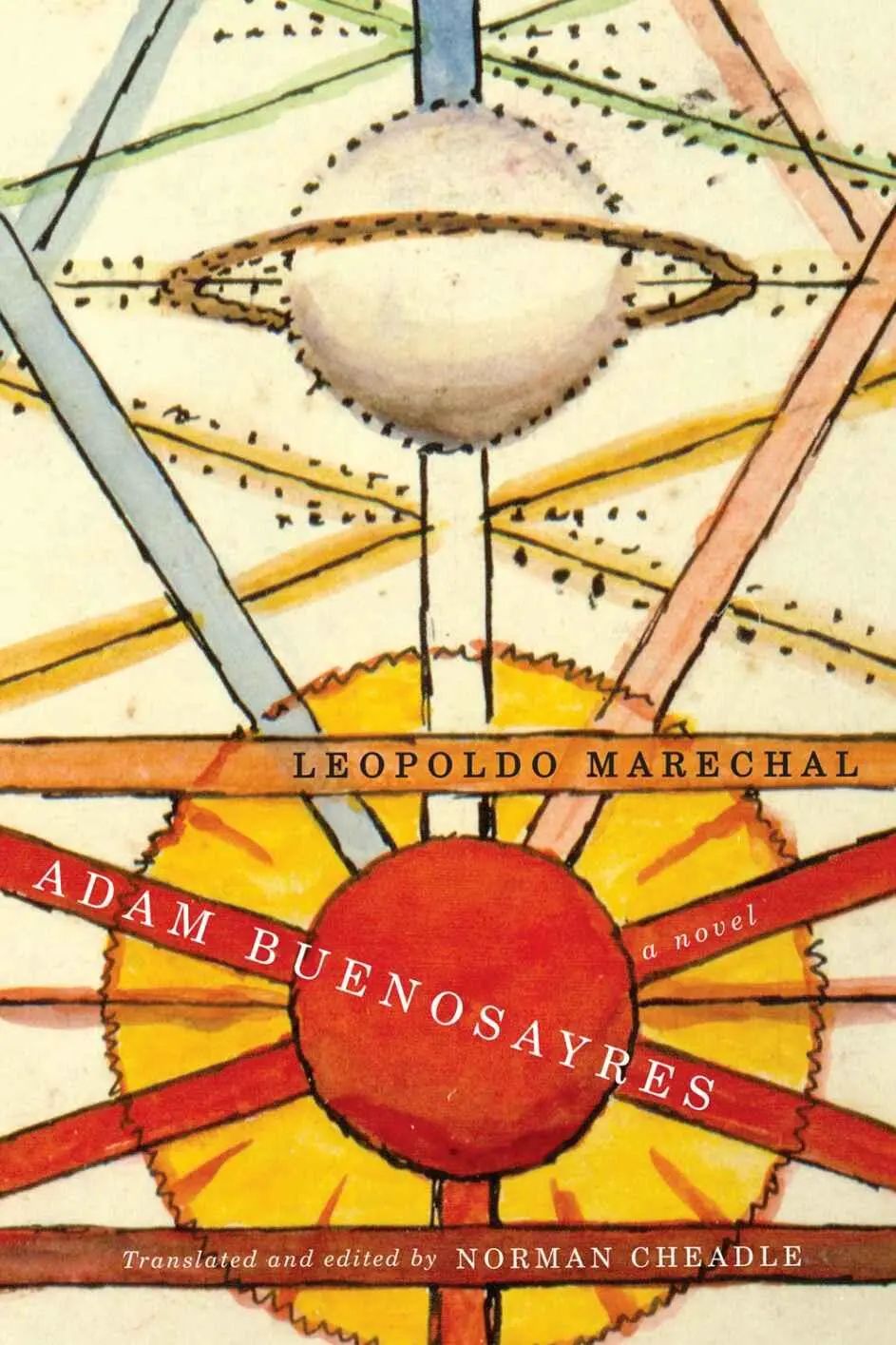
- Название:Adam Buenosayres
- Автор:
- Издательство:McGill-Queen's University Press
- Жанр:
- Год:2015
- ISBN:нет данных
- Рейтинг книги:5 / 5. Голосов: 1
-
Избранное:Добавить в избранное
- Отзывы:
-
Ваша оценка:
Adam Buenosayres: краткое содержание, описание и аннотация
Предлагаем к чтению аннотацию, описание, краткое содержание или предисловие (зависит от того, что написал сам автор книги «Adam Buenosayres»). Если вы не нашли необходимую информацию о книге — напишите в комментариях, мы постараемся отыскать её.
Adam Buenosayres — читать онлайн бесплатно полную книгу (весь текст) целиком
Ниже представлен текст книги, разбитый по страницам. Система сохранения места последней прочитанной страницы, позволяет с удобством читать онлайн бесплатно книгу «Adam Buenosayres», без необходимости каждый раз заново искать на чём Вы остановились. Поставьте закладку, и сможете в любой момент перейти на страницу, на которой закончили чтение.
Интервал:
Закладка:
There they all were, together and distinct, at one end of the sky-blue divan. Their vein of laughter exhausted, the first to speak was Marta Ruiz.
— I see, she said to Solveig, that your Adam Buenosayres has come back to us.
— The fugitive poet! chimed in Haydée. It’s the first time we’ve seen him since that famous Thursday.
— He looks kind of lugubrious, said Marta. He’s another strange bird. Like that ghost Schultz and that hypnotist engineer. 5
— The Amundsen Lunatic Asylum is at full capacity, observed Haydée, passing a benevolent gaze over the tertulia.
Marta Ruiz had become pensive. To be sure, none of those fellows with fevered brains was the kind of man who could fulfil a woman’s destiny. Intellectuals? Bah! Weak creatures, frozen men. And Marta Ruiz was a live coal amid ashes.
— A real man, she sighed abstractedly, as if invoking a utopian dream. A real, honest-to-goodness man, with strong muscles, and his feet firmly on the ground!
— A cave man? Haydée asked.
— No, not that! protested Marta.
And no, that wasn’t it at all. A female Diogenes, Marta Ruiz was looking for a true man, searching with no other lantern than her treacherous eyes.
— I’m talking about a man who has the delicacy of a gentleman and the energy of a wrestler. A man with instincts! Someone like John Taylor in Jungle Inferno .
— John Taylor? exclaimed Haydée scornfully. A brute! He always plays the stupid macho with silly women wanting to get whipped. John Taylor!
— He has character, said Marta.
— What? shot back Haydée. Would you put up with a barbarian like him?
— Put up with him, no. I’d stand up to him, clarified Marta, fire amid ashes.
Yes, Marta Ruiz would stand up to him, even if he thrashed her black and blue or dragged her by the hair through an absurdly sumptuous living room. Marta’s soul was a lightning rod, her calling was to be a breakwater, and she longed to give herself over to the realm of untamed forces, although, let it be understood, not without a struggle. Marta was a “character.” And wasn’t History full of similar characters? In that fat volume on mythology, furtively devoured not long ago at the school library, Europa, Leda, Pasiphae, Aegina had all filed by. To be sure, Leda’s adventure with the swan didn’t impress her all that much. But Pasiphae with the young bull! The white bull, at high noon! What a strange stratagem! It was too much. The abyss of dark desire! Don’t look too deep! Marta Ruiz didn’t want to look all the way down, but her nostrils were flaring now, she’d caught a whiff of the fiery region. A live coal amid ashes, she snapped eyelids shut to conceal eyes that were giving her away.
But Haydée could not accept it.
— There’s something abnormal about it, she said pensively. Why can’t a man and a woman get together without war?
— Life is war, Marta declared sententiously, half opening her eyes.
Fortunately, Haydée hated serious subjects. And so her changeable humour, spinning like a weather vane, now showed a face full of mischief. It would be difficult, though one searched lantern in hand, to find a happier cage-full of birds than the one Haydée Amundsen had for a head.
— As for me, I’m happy with my philosopher, she announced. No complications, please.
— Merciful God! wailed Marta. That caricature of a man? Isn’t that even worse than war?
— Bah! said Haydée. Between my suitor and me, war is philosophically impossible.
— What d’you mean?
— According to my suitor, I’m not a woman, declared Haydée with mysterious air.
— So what the devil are you?
— Primordial Matter!
Marta gazed at her for a moment in astonishment.
— What’s that supposed to mean?
— Don’t ask me! He says I’m a ghost, the shadow of a shadow, pure smoke.
— He’s crazy.
— So you see, concluded Haydée, war just isn’t possible with my suitor. You can’t give a ghost a thrashing.
The two young women fell back laughing, their heads flouncing against the sky-blue cushions. Haydée’s laughter sang, Marta’s wept. Meanwhile, Solveig kept quiet and smiled, applying herself to the two only operations that befitted her mystery: she smiled to reveal herself, she stayed silent to hide. With one foot still in childhood and the other in the dance of the world, 6Solveig listened to adult chatter as if to a language still strange but whose general sense she was beginning to glimpse. And the most incredible things were happening in her, oh wonder! Just yesterday she was a little girl, a child nobody noticed. Then suddenly something beautiful and awesome had happened to her. Solveig had begun to sprout firm buds that kept growing; her whole body was breaking out in flowers and fruits, as though an enchanted season were dawning beneath her clothes. And then, oh my God, what was this? Half frightened, half amazed, she confided in her mother, who sighed, stroked her hair, shed a few tears: Spring has arrived for you, dear. It was Solveig’s springtime, that was all. But no, that wasn’t all! Solveig was discovering around her a world transfigured. Different eyes looked at her now, formerly silent lips sang her praises, hitherto anonymous wills paid her homage. She sensed the birth of new power within her, and vague daydreams of conquest wended their way through her imagination. Left alone in the house one night, she’d tried on her sister Ethel’s dress, a long black dress adorned with silver. She’d walked solemn as a great lady in front of the mirror, responding with a slight nod to the bowing and scraping of an invisible court of admirers. And she certainly didn’t understand Marta Ruiz’s taste for violence. What pleased her in Lucio was something quite different, the way he flattered her with his adoring gaze, and the timid tremor in his voice when he spoke to her. And every time he danced with her, he trembled all over and let his eyes half close. Just like her dog Nero, that afternoon at siesta time when she’d been lying on the ram’s skin that Mister Chisholm had brought back from Patagonia, and she had rubbed Nero’s smooth, warm tummy. For Solveig sensed in Lucio a certain diffidence; and if things kept going in the direction they were headed now, she would know how to direct his talent, arouse his ambition, make a man of him, turn him into a “someone” — her, a mere girl! And Adam Buenosayres? Incomprehensible. Why did he leave her that Blue-Bound Notebook? She didn’t understand; she wasn’t an “intellectual” like her sister Ethel.
— Beethoven? Schultz rejoined. A tin-eared banjo-banger. Grieg? A squeeze-box from the sticks. They’ve stuffed human ears with vaseline, ears meant to listen to the music of the spheres! 7
But Ethel Amundsen was having none of it. She shook her strong, Palas-like head, the light flashing from her curls as from a warrior’s helmet. She turned to Ruty Johansen, whose solid Valkyrian body shared the other sector of the sky-blue divan with Ethel.
— This crazy Schultz is quite hopeless, Ethel said.
And as she warbled these words, her friendly hand fell on Schultz’s thigh, oh, but lightly! Punishment or caress?
In either case, the astrologer Schultz received it in a speculative spirit: there was no denying that the gross manifestation of his individuality had just responded pleasurably to the brush of that hand. However, thanks to the gods, the astrologer’s subtle manifestation remained free of terrestrial fluids, his astral body perfectly intact.
Once he had reassured himself on that score, a colourless smile moulded itself on his plaster-of-Paris face:
— Stupid-making music, he added. Music for the deaf. Look, how many notes fit into the classical five-line staff? Just seven. Bah! I’ve designed a staff that handles twenty-eight. 8
Читать дальшеИнтервал:
Закладка:
Похожие книги на «Adam Buenosayres»
Представляем Вашему вниманию похожие книги на «Adam Buenosayres» списком для выбора. Мы отобрали схожую по названию и смыслу литературу в надежде предоставить читателям больше вариантов отыскать новые, интересные, ещё непрочитанные произведения.











Обсуждение, отзывы о книге «Adam Buenosayres» и просто собственные мнения читателей. Оставьте ваши комментарии, напишите, что Вы думаете о произведении, его смысле или главных героях. Укажите что конкретно понравилось, а что нет, и почему Вы так считаете.