Leopoldo Marechal - Adam Buenosayres
Здесь есть возможность читать онлайн «Leopoldo Marechal - Adam Buenosayres» весь текст электронной книги совершенно бесплатно (целиком полную версию без сокращений). В некоторых случаях можно слушать аудио, скачать через торрент в формате fb2 и присутствует краткое содержание. Год выпуска: 2015, Издательство: McGill-Queen's University Press, Жанр: Классическая проза, на английском языке. Описание произведения, (предисловие) а так же отзывы посетителей доступны на портале библиотеки ЛибКат.
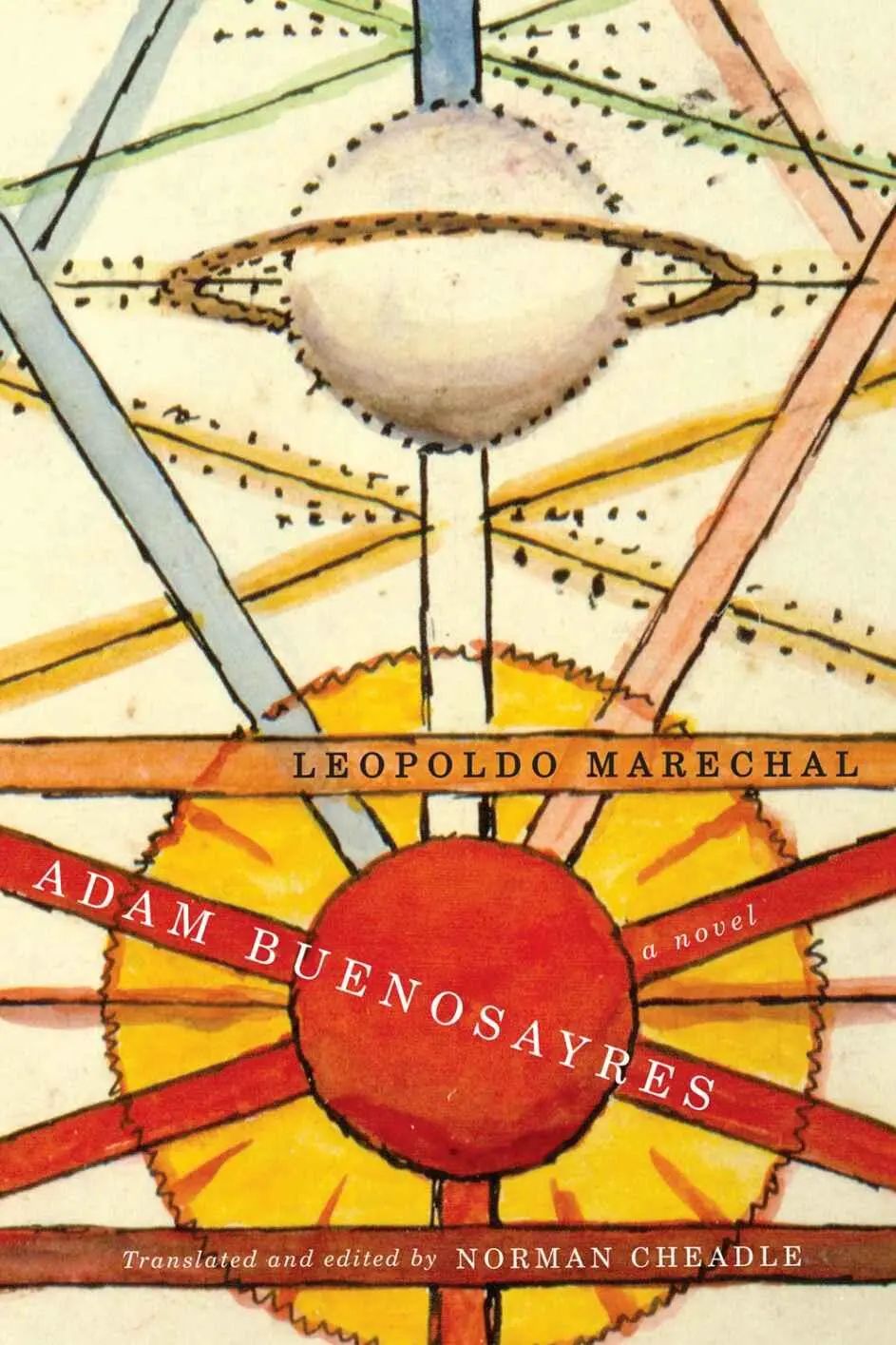
- Название:Adam Buenosayres
- Автор:
- Издательство:McGill-Queen's University Press
- Жанр:
- Год:2015
- ISBN:нет данных
- Рейтинг книги:5 / 5. Голосов: 1
-
Избранное:Добавить в избранное
- Отзывы:
-
Ваша оценка:
Adam Buenosayres: краткое содержание, описание и аннотация
Предлагаем к чтению аннотацию, описание, краткое содержание или предисловие (зависит от того, что написал сам автор книги «Adam Buenosayres»). Если вы не нашли необходимую информацию о книге — напишите в комментариях, мы постараемся отыскать её.
Adam Buenosayres — читать онлайн бесплатно полную книгу (весь текст) целиком
Ниже представлен текст книги, разбитый по страницам. Система сохранения места последней прочитанной страницы, позволяет с удобством читать онлайн бесплатно книгу «Adam Buenosayres», без необходимости каждый раз заново искать на чём Вы остановились. Поставьте закладку, и сможете в любой момент перейти на страницу, на которой закончили чтение.
Интервал:
Закладка:
Whether because of the music, the emotion of the subject, or the second double whisky she was finishing off, Señora Amundsen, her eyes on the portrait of the captain, felt a knot forming in her throat. Then she looked at her three daughters reclining on the sky-blue divan and whimpered:
— If only the Captain could see them now!
— The captain was a great man! Señora Johansen affirmed solemnly.
— A man with backbone, seconded Señora Ruiz. Going down with his ship, when he could have saved himself. That’s what I call backbone. (Drunken old bag! she said to herself, looking furtively at Señora Amundsen. It’s that skinful of bad whisky makes her weepy. If only Doctor Aguilera would show her what that cursèd drink does to her liver!)
— The law of the sea! explained Señora Johansen in a fateful tone.
With a dainty handkerchief, Señora Amundsen dried her eyes and then proceeded to blow her freckled nose.
— You have no idea, she sobbed, what it’s like to be widowed at such a young age, with three small children and another on the way! I don’t know what would have become of me if it weren’t for poor Mister Chisholm.
— Mister Chisholm is such a good man! Señora Johansen clucked, glaring at Señora Ruiz.
— I’d say he was a God-send, asserted Señora Ruiz. (The incredible cheek of that Englishman, taking over the widow, her children, and the Captain’s pension. I suppose that’s what they call “British phlegm.” Poor Captain!)
A burble of dark laughter stirred in her body and tickled her throat. But she snuffed it out immediately, remembering that laughter too is excitement, and Doctor Aguilera had forbidden excitement. So she arranged her bones in the armchair and took a look around the room, sharp as slander, poisonous as envy.
Insular in body and soul, far from the tertulia, Mister Chisholm was working alone, re-papering the vestibule. He’d just finished the front wall and was perched on top of a small step-ladder, pipe in his right hand and drink in his left, listening with utter indifference to the hubbub from the parlour. His grey eyes, as if entranced, were passing over the brand new wallpaper design: a flurry of green birds in flight across a blood-red sky. Strident voices from the parlour snapped him out of his reverie.
“The natives are arguing again,” Mister Chisholm said to himself. “Shouting and arguing is all they know how to do. About their so-called problems. Poppycock! They think they move of their own free will, but who pulls the strings? Rule, Britannia!”
And he thought:
“Only England knows how to colonize. A unique style. Let the natives fantasize all they want: Britannia makes the wheels turn, the Empire’s solid. All right! But what about…”
Here Mister Chisholm felt a pang of anxiety, though only a very slight one, as behooves an Englishman:
“What about our cousins to the West?”
Two or three lines creased Mister Chisholm’s forehead, then quickly faded away.
“Bah!” he reflected. “Yankee-land! They’ve got no style, they’ve only just learned to walk on their hind legs. Barbarians! They make a mess of everything, starting with the English language.”
Calm now, Mister Chisholm climbed down the steps of the ladder, sucked back the rest of his double whisky, and stirred the bucket of paste, still smoking his pipe newly replenished with tobacco and optimism.
Who was responsible for spoiling Mister Chisholm’s imperial cogitations? In one corner of the parlour — to the right and down-stage for the reader — a singular polemic had just broken out between Samuel Tesler, metaphysician, and Lucio Negri, doctor of medicine. Lord and master of an easy chair, Samuel Tesler had positioned himself at the very corner of the room. To his left sat the melancholy effigy of Adam Buenosayres, troubadour. To Samuel’s right stood the statuesque figure of Lucio Negri, who with amorous strategy offered his finest profile to the girls seated upon the sky-blue divan, without for a moment losing sight of the philosopher who was attacking him ruthlessly. Near Adam Buenosayres, Señor Johansen — fat, pink, neat and tidy — looked on gravely. His tame little eyes went back and forth as each contestant spoke, and Señor Johansen seemed to be wrestling deeply with doubt, as if weighing the words of the two on an untrustworthy scale.
— What in the world has Genesis got to do with anything? protested Lucio, sneaking a glance at the girls. Are you going to tell me the little tales told in Genesis contain even a speck of scientific knowledge?
Samuel Tesler smiled indulgently.
— According to my grandfather Maimonides, 2he answered, Genesis is a treatise on physics. Naturally, my granddad Maimonides, who also happened to be a sawbones, was versed in the language of symbols.
— Hegel dismisses the Scriptures for their lack of verisimilitude, retorted Lucio.
At this point, the philosopher leapt up as if a German trumpet had just blasted him in the ear.
— Hegel? he exclaimed. A strutting peacock! He rejects everything that can’t comfortably fit into his German professor’s skull. A cranium uninhabitable by Metaphysics!
— Of course, said Lucio, you know more than Hegel does.
— Much more! agreed the philosopher, enfolding himself in the flowing tunic of his dignity.
Unruffled, Lucio Negri turned to the melancholy effigy of Adam Buenosayres.
— A flake! he exclaimed, pointing at Tesler and exchanging a smile with Solveig Amundsen, who was watching him from a distance.
Adam Buenosayres hadn’t missed that little exchange, a look for a smile. He would have liked to stay out of the futile argument and given himself over to his melancholy thoughts, especially now that he had to reckon with a new disappointment in love. However, he could see Lucio Negri looking at him, inviting him to intervene in the debate. “Careful,” he warned himself, “don’t say anything inappropriate.”
— In Villa Crespo, he began reluctantly, there’s an old Italian woman I’ve dubbed Clotho. Sometimes I see her in the San Bernardo Church, kneeling at the high altar. And looking at her, I wonder if Clotho doesn’t know more than all the philosophy in the world.
— Don’t worry, confirmed Tesler, she does know more.
Señor Johansen, who was following closely, did not look happy at this.
— Sounds like nonsense to me, he proffered timidly. Although I don’t know anything about philosophy.
— If you don’t know anything, why are you butting in? Samuel reprimanded him acridly.
Señor Johansen blushed red to the roots of his hair — which, truth be told, no longer amounted to much. He wanted to remind those present that he was a free man and had a right to his opinion. He cleared his throat two or three times, anxious to vindicate himself on the spot. But Samuel Tesler’s basilisk eyes bore down and seemed to hypnotize him.
— It is nonsense, Lucio Negri confirmed. How can an old woman down on her knees know more than a philospher seated in his study?
— That’s what I say! How? grumbled Señor Johansen, itching to get his own back.
Adam again felt burdened by the futility of the discussion.
— Truth is infinite, he said. It seems to me there are two ways of approaching it. One is the way of the seer; when he realizes the impotence of his own finitude before the infinite, he asks to be assimilated into the infinite through the virtue of the Other and the death of his ego. (“My Blue-Bound Notebook!”) The other is the way of the blind man; he attempts to encompass the infinite within his own finitude, which is mathematically impossible.
Lucio Negri exchanged an eloquent look with Señor Johansen.
— Bah! he scolded. Who, nowadays, can swallow that cocktail of finites and infinites?
Читать дальшеИнтервал:
Закладка:
Похожие книги на «Adam Buenosayres»
Представляем Вашему вниманию похожие книги на «Adam Buenosayres» списком для выбора. Мы отобрали схожую по названию и смыслу литературу в надежде предоставить читателям больше вариантов отыскать новые, интересные, ещё непрочитанные произведения.






Обсуждение, отзывы о книге «Adam Buenosayres» и просто собственные мнения читателей. Оставьте ваши комментарии, напишите, что Вы думаете о произведении, его смысле или главных героях. Укажите что конкретно понравилось, а что нет, и почему Вы так считаете.