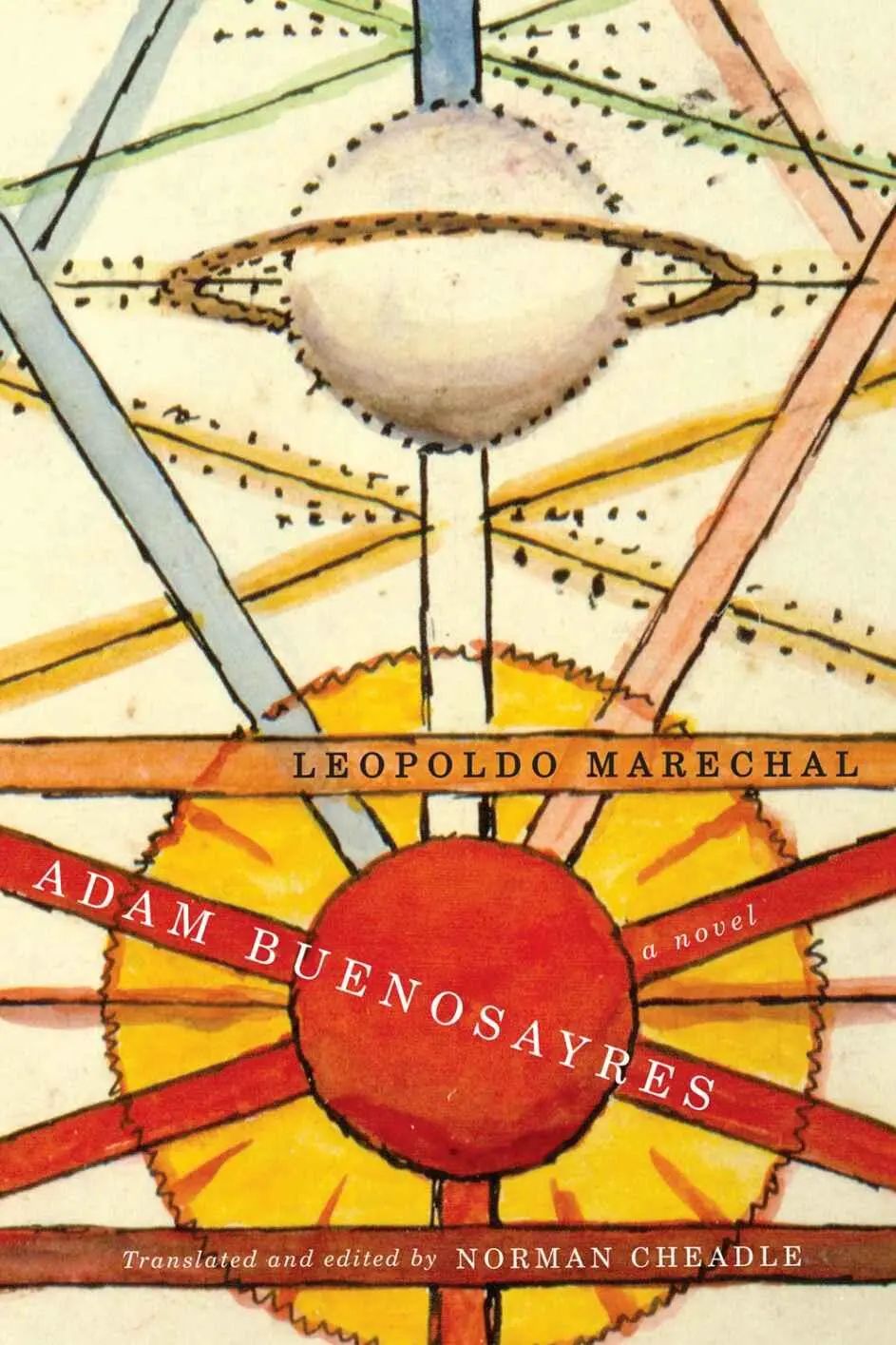
Leopoldo Marechal - Adam Buenosayres
Здесь есть возможность читать онлайн «Leopoldo Marechal - Adam Buenosayres» весь текст электронной книги совершенно бесплатно (целиком полную версию без сокращений). В некоторых случаях можно слушать аудио, скачать через торрент в формате fb2 и присутствует краткое содержание. Год выпуска: 2015, Издательство: McGill-Queen's University Press, Жанр: Классическая проза, на английском языке. Описание произведения, (предисловие) а так же отзывы посетителей доступны на портале библиотеки ЛибКат.
- Название:Adam Buenosayres
- Автор:
- Издательство:McGill-Queen's University Press
- Жанр:
- Год:2015
- ISBN:нет данных
- Рейтинг книги:5 / 5. Голосов: 1
-
Избранное:Добавить в избранное
- Отзывы:
-
Ваша оценка:
Adam Buenosayres: краткое содержание, описание и аннотация
Предлагаем к чтению аннотацию, описание, краткое содержание или предисловие (зависит от того, что написал сам автор книги «Adam Buenosayres»). Если вы не нашли необходимую информацию о книге — напишите в комментариях, мы постараемся отыскать её.
Adam Buenosayres — читать онлайн бесплатно полную книгу (весь текст) целиком
Ниже представлен текст книги, разбитый по страницам. Система сохранения места последней прочитанной страницы, позволяет с удобством читать онлайн бесплатно книгу «Adam Buenosayres», без необходимости каждый раз заново искать на чём Вы остановились. Поставьте закладку, и сможете в любой момент перейти на страницу, на которой закончили чтение.
Интервал:
Закладка:
“Koriskos salutes me,” thought Adam, “with salvos from the artillery!”
Now used to the dark, his eyes discerned the layout of room number five. In front of him, a rectangular window was protected by a heavy curtain against the assault of light. To his right, the baleful face of a mirror. On his left, what looked like written characters traced in white chalk against a background of absolute black. He began to register shreds of an unknown perfect whiteness, then the spectrum of greys, and later the corpulence of furniture lurking in the corners of the room like domestic beasts. Sure, now, of the terrain he was invading, the visitor headed for the window and yanked open the curtain, opening the floodgates to the light. Turning his eyes back to the cave’s interior, he saw Samuel Tesler on his bed in a laterally recumbent position and intelligently oriented toward the earth’s magnetic pole. Samuel’s eyelids flapped against the sudden sunlight, strong as acid, and an enormous sigh seemed to deflate his entire body. He frowned. He smacked his lips as if tasting a drop of vinegar. Then, with a heave of his mountainous hip beneath the dismal covers, he rolled over and continued snoring, backside to the day.
(Although none of the philosopher’s written doctrine confirms this, the oral tradition preserved by his disciples maintains that Samuel Tesler lived in the world as if in a deplorable hotel where — he sadly alleged — he was taking a total-rest cure in an attempt to recover from the fatigue of having been born. When queried as to the origin of this evidently intractable fatigue, the philosopher put it down to the cumulative effect of his numerous reincarnations, beginning with the partition of the original Hermaphrodite. He solemnly declared he’d been a fakir in Calcutta, a eunuch in Babylon, a dog-shearer in Tyre, a flautist in Carthage, a priest of Isis in Memphis, a whore in Corinth, a moneylender in Rome, and an alchemist in medieval Paris. He was once asked, in a Villa Crespo café called Las Rosas, if a job wouldn’t assuage the tedium of so many different transmigrations. Samuel Tesler answered that work was not an “essential” virtue of human nature; the almighty Elohim had created man only for otium poeticum , 4he maintained, and work was an “accidental” impairment to our nature brought about by the wilful “separated rib”; and seeing as how he, Samuel Tesler, was a man who kept his conduct grounded in the essential, he was not about to lower himself to a chance accident that reminded him of that unpleasant episode in Paradise. Another time, it is told, on the terrace of Ciro Rossini’s restaurant, a bedspread salesman engaged Samuel Tesler in the tired old debate of the Cricket versus the Ant. The philosopher, not without first expressing his disdain for both invertebrate animals and bedspread salesmen, heroically defended the Cricket, to whose health he drank three glasses of Sicilian wine. And since the salesman insisted on knowing what he thought to be the ideal economy, Samuel Tesler replied that it was the economy of the bird, the only terrestrial animal that can convert ten grains of bird-seed into three hours of music and a milligram of manure.)
Adam Buenosayres couldn’t bring himself to wake up the sleeping man. Instead, he looked at the clutter surrounding him. On the table lay a large book, wide open like a mouth. In front of the austere mirror, four chairs faced one another in a bizarre arrangement, as though a conclave of ghosts had been sitting in them the night before. A notebook lying open on the floor exhibited the dragon’s vigorous handwriting. Over here, a couple of discarded socks still held the form of the human foot; over there, a faded rag blindfolded the lone eye of the bedside lamp. And books were everywhere, in piles on the floor, stacked up against walls. Monographs strewn as if by a lion’s paw. Tomes whose rent bindings bled knowledge. Folio-sized volumes groaning like beasts of burden. A blackboard set up by the window seemed to redeem the decorum of the lair; on its surface Adam Buenosayres could now read the characters that had looked mysterious in the dark:
APRIL 27
1 p.m. — A brilliant idea about catharsis in ancient tragedy. The aestheticizers at Ciro’s will shit bricks.
2:20 p.m. — The laundry woman brings me a paltry bill ($1.75). I perform a dialectical miracle and revive her wilted hopes that she’ll collect. She’s Galician Spanish, 5a race given to lyricism: she’s dreaming if she thinks she’ll get the better of me!
3 p.m. — Sexual discomfort and fleeting sublimation of the quo usque tandem 6 (preventive reading of Plato).
3:30 p.m. — Is Plato’s Demiurge a poor Italian construction worker or the hypostasis of the Divinity manifesting itself as the efficient cause of Creation?
4 p.m. — Melancholy for unknown reasons, maybe hunger (must keep a couple of chocolate bars on hand).
4:45 p.m. — If I take the yod out of the word Avir , it becomes Aor . (How the greasy beards in the Synagogue would tremble if they knew!) 7
There was nothing more on the blackboard, so Adam Buenosayres turned his eyes to the master of so much wisdom and studied him with renewed interest. It must be said that Samuel Tesler slept without visible signs of pride, but without undue modesty either. His face was expressionless, like that of an extinguished streetlamp or a dead man, its entire expanse shiny with an oily sweat produced, no doubt, by the exertion of sleep. Two clear lines were sketched across a forehead as broad as a hemisphere. One was sinuous, denoting a sea voyage. The other was the straight line of benign malice. The arcs of his eyebrows pointed menacingly at his enormous nose (custom-built, according to Samuel, for breathing the divine pneuma ); the proboscis, as if intimidated, looked like wanting to take leave of its face, perhaps for a landscape more accommodating of its sierra-like grandeur. From his half-open mouth, snorting and musical, the dragon’s breath coursed like an invisible torrent between twin rows of gold-filled teeth.
“Koriskos snores,” said Adam to himself. “But he must perforce awaken. He is summoned by the day, by reality, by the blackboard.”
Putting hesitation behind him, he shook Samuel by the shoulders:
— Wake up!
Samuel Tesler blinked with the dazed air of a fish hauled up from great depths.
— Eh? he sputtered between sighs. What?
— Get up, illustrious professor of sleep!
Samuel Tesler struggled to sit up, still not quite awake, and clamped foggy eyes on his interpellator. Upon recognizing Adam, he fell back against the gutted cushions.
— Quit messing around, he begged. I’m dog tired!
Without insisting further, Adam Buenosayres waited for Samuel to come around. And he didn’t have to wait long, for the dragon, yawning noisily, gave himself a good stretch until his bones achieved a euphonious crack.
— What time is it? he finally asked in resignation.
— Twelve o’clock on the nose, Effendi, replied a ceremonious Adam.
— It can’t be!
— Eye of Baal, that’s the exact time!
— Hmm! What day is it?
— Thursday, Sahib.
As Adam Buenosayres, laughing, flung open the two window panes, the philosopher sat up again, flattered by the Oriental honorifics, music to his ears, no doubt. The bedcovers receded like the waters of the sea, at once revealing the dragon’s incredible torso, which in turn was swaddled by an even more unbelievable Chinese kimono, and released a whiff of rank jungle beast.
(“Twice only does the just man bathe: at birth and at death.” Thus, the rigorous doctrine professed by Samuel Tesler on the subject of hygiene. Concerning his own case, he claimed to live in perfect peace with his conscience, for he did not in the least doubt that his pious progenitors had complied with the first ritual bath, nor that his kith and kin would perform the second one, lest they annoy Elohim. As for prenuptial washing, the philosopher made no objection, even though in his opinion the just man ought to be content, in vexatious matters of this sort, with the abstract odour of decency. It once happened that a few of Samuel’s adepts visited his cubicle and saw there a green-, yellow-, and blue-striped bathrobe. Shocked and alarmed, they suspected apostasy. But the philosopher set their minds at ease, telling them that just as the ascetics of old used to contemplate a skull to disabuse themselves of worldly illusions, so he put before his eyes that useless garment as a reminder of the dishonour incurred when ablutions are performed in adulation of the human body. He felt a religious dread for water and kept himself at a reverential distance, for he considered it divine, the third offspring of impalpable Ether. Hence, its use for menial purposes he found painfully profanatory. Asked if it was permissible to drink water, Samuel Tesler held that only the gods could rightfully imbibe that venerable liquid, and that man, lowly insect of the earth, ought to limit himself to wine, beer, mead, and other humble products of human industry.)
Читать дальшеИнтервал:
Закладка:
Похожие книги на «Adam Buenosayres»
Представляем Вашему вниманию похожие книги на «Adam Buenosayres» списком для выбора. Мы отобрали схожую по названию и смыслу литературу в надежде предоставить читателям больше вариантов отыскать новые, интересные, ещё непрочитанные произведения.








Обсуждение, отзывы о книге «Adam Buenosayres» и просто собственные мнения читателей. Оставьте ваши комментарии, напишите, что Вы думаете о произведении, его смысле или главных героях. Укажите что конкретно понравилось, а что нет, и почему Вы так считаете.