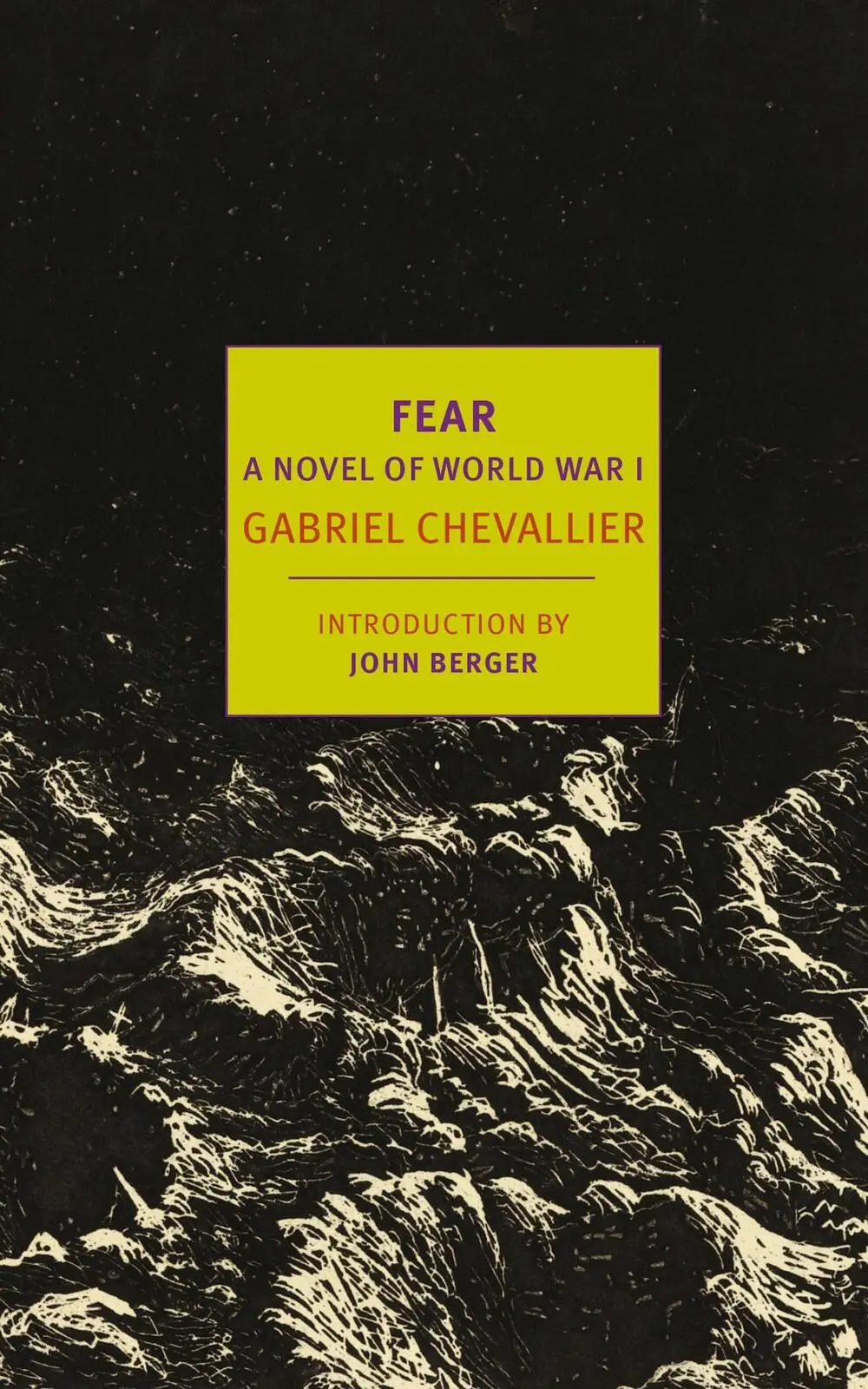
Gabriel Chevallier - Fear
Здесь есть возможность читать онлайн «Gabriel Chevallier - Fear» весь текст электронной книги совершенно бесплатно (целиком полную версию без сокращений). В некоторых случаях можно слушать аудио, скачать через торрент в формате fb2 и присутствует краткое содержание. Город: New York, Год выпуска: 2014, Издательство: New York Review Books, Жанр: Классическая проза, на английском языке. Описание произведения, (предисловие) а так же отзывы посетителей доступны на портале библиотеки ЛибКат.
- Название:Fear
- Автор:
- Издательство:New York Review Books
- Жанр:
- Год:2014
- Город:New York
- ISBN:нет данных
- Рейтинг книги:3 / 5. Голосов: 1
-
Избранное:Добавить в избранное
- Отзывы:
-
Ваша оценка:
Fear: краткое содержание, описание и аннотация
Предлагаем к чтению аннотацию, описание, краткое содержание или предисловие (зависит от того, что написал сам автор книги «Fear»). Если вы не нашли необходимую информацию о книге — напишите в комментариях, мы постараемся отыскать её.
1915: Jean Dartemont heads off to the Great War, an eager conscript. The only thing he fears is missing the action. Soon, however, the vaunted “war to end all wars” seems like a war that will never end: whether mired in the trenches or going over the top, Jean finds himself caught in the midst of an unimaginable, unceasing slaughter. After he is wounded, he returns from the front to discover a world where no one knows or wants to know any of this. Both the public and the authorities go on talking about heroes — and sending more men to their graves. But Jean refuses to keep silent. He will speak the forbidden word. He will tell them about fear.
John Berger has called
“a book of the utmost urgency and relevance.” A literary masterpiece, it is also an essential and unforgettable reckoning with the terrible war that gave birth to a century of war.
Fear — читать онлайн бесплатно полную книгу (весь текст) целиком
Ниже представлен текст книги, разбитый по страницам. Система сохранения места последней прочитанной страницы, позволяет с удобством читать онлайн бесплатно книгу «Fear», без необходимости каждый раз заново искать на чём Вы остановились. Поставьте закладку, и сможете в любой момент перейти на страницу, на которой закончили чтение.
Интервал:
Закладка:
Then I remembered I had dropped out of the column during the night and completed the march on a wagon. Arriving after everyone else and not knowing where to shelter, I lay down by the track, under a bridge which protected me from the rain, not imagining a train could come this far.
Having survived this latest peril, I looked around me. My battalion was in shelters on the slopes and I found my squad without any difficulty.
The bombardment had become tremendously intense. Invisible guns were firing on all sides, and on top of that we were soon deafened by the armoured train. Aeroplanes flew very low overhead, under the grey clouds. Observation balloons, ‘sausages’, which had moved forwards by a few kilometres, loomed above us. Everywhere there was feverish activity. The attack had been underway for several hours. In some of the villages, on camouflaged roads, the cavalry was hidden, ready to move forward. Crossing the slope, I reached the neighbouring woods. They were full of men, all waiting their turn to march forward. We were certainly there in force. But we had to leave others, down below, the time to launch the first blows, to open the breeches where the army could go into action. Our own future depended on the success of our brothers-in-arms.
All day we waited anxiously, but no news came. Just rumours: the attack was advancing, the artillery was ready to follow. The sun broke through for a few hours then hid its face sadly. We despaired at knowing nothing and our immobility seemed a bad sign. It was already quite obvious that we would not get to Douai so easily.
We were supplied with a new kind of grenade, known as a racket bomb: a tin box attached to a wooden paddle, with a percussion detonator which you released by pulling a string with a kind of curtain ring at the end. This ring tended to slip off the nail which held it in place and dangle freely: I found the things terrifying and refused to touch the two I was given by our corporal. Instead of arguing, he simply took them himself and secured them beneath the flap on the top of my pack.
As evening fell, it started raining again. By now we had little faith left in the success of the offensive. At last we moved forward. Beyond Mont-Saint-Éloi, the battlefield, shrouded in smoke and fog, spread out before us on a gentle slope. We could make out red flames in the distance, and hear the terrible roaring, punctuated by diabolic machine guns. Silent and fearful, we all knew that was our destination. The sight of the wounded deepened our misery. Cadaverous and caked in mud, they had lost most of their kit and looked like fugitives; there was a glint of madness in their eyes, the madness that comes from proximity to death. They staggered away in groaning groups, holding each other up. We could not take our eyes off the white patches of field dressings, with blood seeping through. Blood still dripped from them, marking their trail. Next came the silent stretchers, from which hung white, contorted hands. Four medical orderlies transported on their shoulders one unfortunate whose arm had been torn apart, exposing the frayed muscles. His screams were terrible, rising up to the impassive heavens, enough to shame God.
The captain passed along the column:
‘Courage, lads! It seems the new helmets really do protect the head and they’ve already saved a lot of lives.’
That was the best he could find to say to us! We knew for sure then the attack was faltering and that our task down there in the fog would be a very hard one.
Shortly after, a shell burst just ahead of the column. We were ordered to take to the trenches. As we jumped down, one soldier cried out in pain. ‘I’ve sprained my ankle!’ ‘What perfect timing!’ muttered someone beside me.
It became very hard to advance at all. Trampled by thousands of men, the ground had turned into slippery dough, in which we kept getting stuck. We had to pull our feet out with every step forward. We also had to pass units going back to the rear. These encounters were a real torture, in trenches too narrow for two men to stand side by side, and where everyone was laden with packs which made them even bulkier. The two columns became entangled and we had to pull ourselves out of the ensuing crush. Suffering enough already, men lost their patience, cursed, even struck out at each other. Then, with horror, I remembered my grenades. I was carrying two potential explosions right beside my neck, which would be set off by a tug on a piece of string. In this melée, all it would need would be for a rifle barrel to bang into one of those wretched curtain rings to finish things off. So I was forced to march sideways, thus reducing the chances of an accident, and watch every move of anyone who bumped into me. And even so some uncontrollable, sneering voice in my brain kept repeating: ‘Look where your head’s going to be rolling!’
Night came. When it did, we got lost, as usual. The front had become a bit quieter. The two armies were tallying up the results of their first day and preparing for the morrow. After marching for two or three hours, we halted. We took over old dugouts, groping our way in the dark. Mine was waterlogged. Before settling down, I opened my pack and dumped my two grenades on the trench parapet, telling myself that I would surely find plenty of similar devices at the front line.
We were starting to fall asleep when the order came to set off again. It was a very dark night, streaked with rockets in the distance, too far off for us to see their flash, but which left mournful haloes in the sky. We came out on to a road cluttered with military transport. We encountered strange vehicles, like rubbish carts, full of stiffened debris, standing out against the sky, which we recognised with a shudder: ‘Corpses!’ So they were withdrawing our predecessors from the morning, the first waves of the unstoppable offensive that had come to a standstill ahead of us. They were cleaning the battlefield. ‘A fine turn-out by the hearse section,’ said one wag. Each cart carried grief to a score of families.
We came into a ruined village. My section took shelter in a cellar. There was very little room so we sat upright, squeezed between all our kit, leaning on our packs. A sergeant had stuck a candle on the point of a bayonet. The feeble light lent a tragic expression to our faces. One man expressed what we were all feeling:
‘It doesn’t look like this attack is working.’
‘Seems to me it’s the same old shit as always.’
‘Brothers, our duty is to die!’ sneered a pale corporal.
‘Shut your mouth!’ growled everyone.
Men were snoring, twitching and whimpering, struggling with nightmares less terrible than reality. Outside high explosive shells started coming in. We heard them fall near us, relentless in their attack on this wounded village, pounding it, shattering it all over again, tearing apart the very last walls, the very last wooden beams, showering brick and rubble over the paths. Sometimes their hot breath roared down into our cellar, extinguishing the candle, and the explosion shook everything. Then silence and darkness. ‘Anyone hit?’ asked a sergeant. ‘No — no — no one!’ came the response from the men on the steps, in turn, as they recovered from the shock. And so the candle was lit again, its yellow flame sealing us off, dulling the noise from outside.
‘A pity that the only time these fools give us a rest is in the middle of a bombardment!’
‘It’s never any different!’
A man ran up and shouted down the steps: ‘Get ready!’
‘Where are we going?’
But the runner was already gone, shouting into other cellars.
‘What’s the time?’ asked one of the sergeants.
‘Three o’clock…’
‘There’ll be no sleep for us tonight.’
We were all ready, waiting for a lull, and for orders. We waited a long time. We had taken off our packs and sat down again. Shells still rained down. Then suddenly, blasting apart our drowsiness like a shell, came the short, imperative shout from outside:
Читать дальшеИнтервал:
Закладка:
Похожие книги на «Fear»
Представляем Вашему вниманию похожие книги на «Fear» списком для выбора. Мы отобрали схожую по названию и смыслу литературу в надежде предоставить читателям больше вариантов отыскать новые, интересные, ещё непрочитанные произведения.






Обсуждение, отзывы о книге «Fear» и просто собственные мнения читателей. Оставьте ваши комментарии, напишите, что Вы думаете о произведении, его смысле или главных героях. Укажите что конкретно понравилось, а что нет, и почему Вы так считаете.