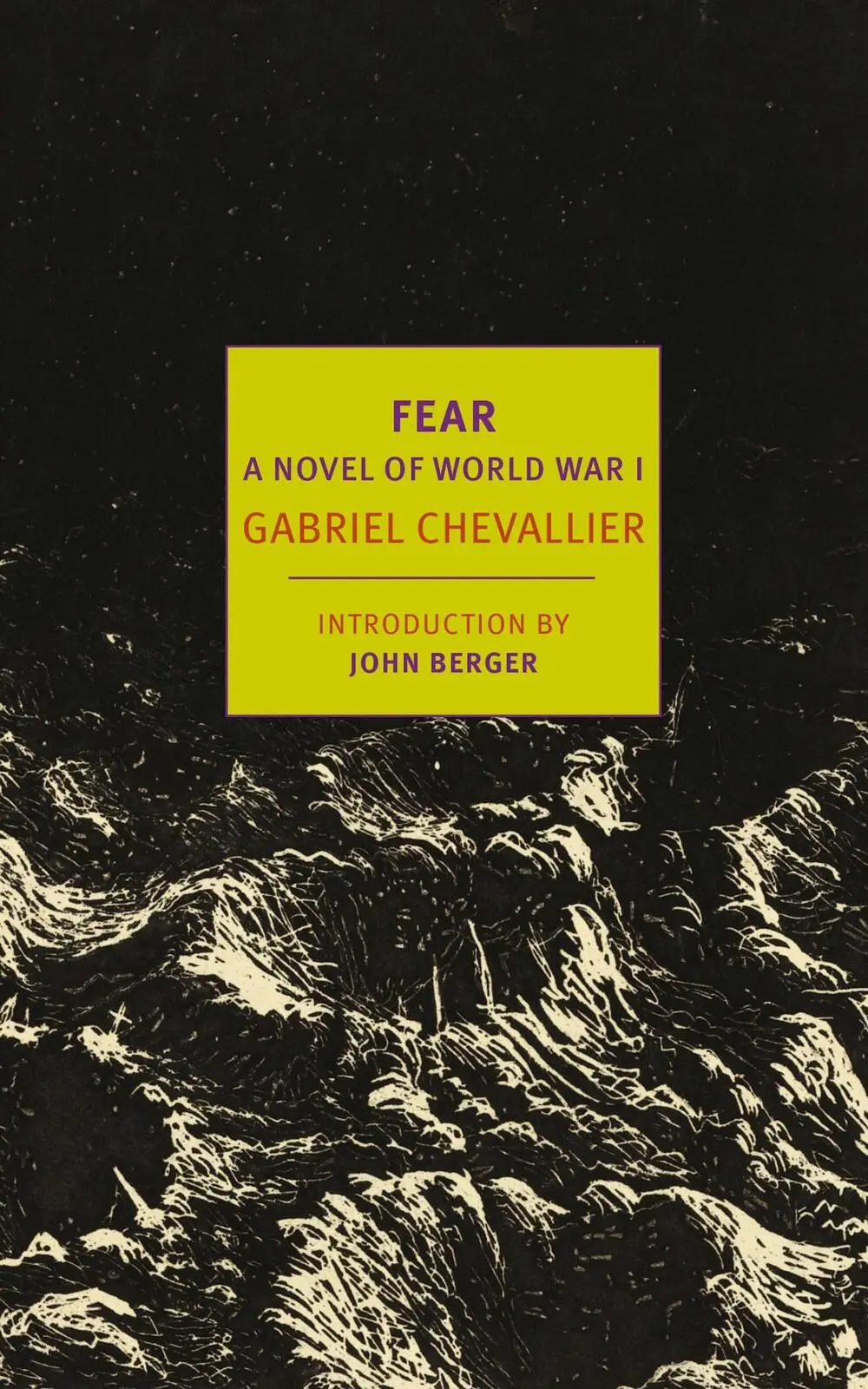
Gabriel Chevallier - Fear
Здесь есть возможность читать онлайн «Gabriel Chevallier - Fear» весь текст электронной книги совершенно бесплатно (целиком полную версию без сокращений). В некоторых случаях можно слушать аудио, скачать через торрент в формате fb2 и присутствует краткое содержание. Город: New York, Год выпуска: 2014, Издательство: New York Review Books, Жанр: Классическая проза, на английском языке. Описание произведения, (предисловие) а так же отзывы посетителей доступны на портале библиотеки ЛибКат.
- Название:Fear
- Автор:
- Издательство:New York Review Books
- Жанр:
- Год:2014
- Город:New York
- ISBN:нет данных
- Рейтинг книги:3 / 5. Голосов: 1
-
Избранное:Добавить в избранное
- Отзывы:
-
Ваша оценка:
Fear: краткое содержание, описание и аннотация
Предлагаем к чтению аннотацию, описание, краткое содержание или предисловие (зависит от того, что написал сам автор книги «Fear»). Если вы не нашли необходимую информацию о книге — напишите в комментариях, мы постараемся отыскать её.
1915: Jean Dartemont heads off to the Great War, an eager conscript. The only thing he fears is missing the action. Soon, however, the vaunted “war to end all wars” seems like a war that will never end: whether mired in the trenches or going over the top, Jean finds himself caught in the midst of an unimaginable, unceasing slaughter. After he is wounded, he returns from the front to discover a world where no one knows or wants to know any of this. Both the public and the authorities go on talking about heroes — and sending more men to their graves. But Jean refuses to keep silent. He will speak the forbidden word. He will tell them about fear.
John Berger has called
“a book of the utmost urgency and relevance.” A literary masterpiece, it is also an essential and unforgettable reckoning with the terrible war that gave birth to a century of war.
Fear — читать онлайн бесплатно полную книгу (весь текст) целиком
Ниже представлен текст книги, разбитый по страницам. Система сохранения места последней прочитанной страницы, позволяет с удобством читать онлайн бесплатно книгу «Fear», без необходимости каждый раз заново искать на чём Вы остановились. Поставьте закладку, и сможете в любой момент перейти на страницу, на которой закончили чтение.
Интервал:
Закладка:
One day, while we were thus occupied, a time-shell burst just over our squad, enveloping us in its hot breath and a chorus of shrill whistles. Shrapnel fell all around but, miraculously, no one was hit. It felt like I had been struck a blow on the neck and my head resounded with a painful, metallic vibration, as if someone had drilled into my skull. Instinctively, and too late, we had jumped down into the cellar. Then we gathered the shards of shell casing, still burning hot, and the way they were driven into the ground gave me an idea of their velocity.
One night while we were working behind the front line, repairing a trench that had been smashed by artillery fire, we were caught in an enfilade by two artillery batteries, to left and right. The Germans, having spotted the damage to our position, correctly assumed we were repairing it. Their gunfire alternated with perfect regularity. But they were ‘shooting long’ in both directions, so that we kept running to escape explosions first at one end then at the other. When we heard their guns fire, we hit the ground in a shameful heap of panting bodies, waiting for the explosion so we could breathe again, unclench our stomachs, and run further off. The artillery played with us in this way for an hour and forced us to roll in the mud. I was furious at being compelled to adopt such a posture and several times refused to ‘bow’ to the shells. Once they had stopped firing, a rocket revealed a sergeant on the planks over a latrine beside the trench, slowly pulling up his trousers.
‘Here’s another one they missed!’ he called to us cheerfully.
His calm composure brought back our smiles.
But when we all reassembled I saw that all the old hands had vanished, and the corporal wasn’t surprised. We found them further on, in the cellar, where some were already asleep.
On yet another occasion we endured a very fierce bombardment. All afternoon we had worked recklessly on a support trench, throwing the earth we dug over the parapet. The sun had just gone down, a perfect calm had descended over the battlefield, and we were rolling cigarettes while waiting for the relief section. Shells shattered the silence in an instant. They came in rapid succession, targeted right on us, landing within fifty metres. Sometimes they were so close that we were showered with earth and breathed in the smoke. Men who had been laughing were now nothing more than hunted prey, undignified animals whose bodies only moved instinctively. I saw my ashen-faced comrades jostling and huddling together so that they weren’t struck alone, jerking about like puppets in spasms of fear, hugging the ground, pushing their faces into the mud. The explosions were so continuous that their hot, acrid breath raised the temperature of the trench and we poured with sweat which froze on us yet still did not know whether this cold was not in fact heat. Our nerves contracted with every little scratch and bruise and more than one person believed he’d been hit and truly felt the terrible laceration of his flesh that fear made him imagine.
In this torment I was sustained by my reason, however wrong it was. I do not know where I had got the notion that field guns have a very straight trajectory. Which would mean that shells fired at us from in front could not land in the trench and it was only a matter of enduring the dreadful noise they made. This idiotic theory calmed me down and I suffered less than the others.
At last the relief arrived. But the shellfire pursued us. We ran and I found myself the last in the line. Shells came over very low, above my head, and exploded just a little further on. At the first turning, I came upon two men lying in their own blood, appealing with the expressions of beaten, imploring children that you see on people whom misfortune has suddenly struck, and I stepped over them shuddering at their awful cries. Since I could do nothing for them, I ran even faster to get away. Outside the shelters, their names were called out: Michard and Rigot, two young men we knew from the same class as us. The war had stopped being a game…
At night we were often woken up by runners shouting at the entrance to our cellar:
‘Alert! Everybody out!’
We lit our candle, took our packs and rifles and grudgingly climbed up the stairs behind our corporal. Outside, we were caught in a tornado of explosions. We came out into the main thoroughfare, now swarming with armed shadows, trying not to get mixed up, calling each other and heading to the support positions. The cold air woke us up, as did the clattering of bullets, thousands of which were smashing into the walls, deafening us with their sharp slaps. All the stray bullets from the German fusillade were converging on the ruins, and, if we had emerged from the trenches, nothing would have remained of this subterranean army that had suddenly filled the night. Ahead of us, on the front lines, grenades crackled like sparks on some piece of electrical equipment. Heavy shells, with no warning this time, burst at random, with a red flash, shaking us with their foetid breath, surrounding us with torrents of metal and stones, which sometimes reached our ranks. Long human screams would suddenly cut through the rest of the din, echoing in us in waves of horror and reminding us, enough to make us tremble, of the lamentable frailty of our flesh, amidst this eruption of steel and fire. Then the staccato frenzy of machine guns tore through the voices of the dying, riddled the night, pierced it with a stipple of bullets and sounds. Impossible to make oneself heard without shouting, to be seen except in the boreal light of rockets, to move forward except by squeezing into these trenches choked with men, all gripped with the same anxiety: was it an attack? Were we going to fight? For in the months before this sector had been fought over day and night with grenade and bayonet from one barricade to another, one house to another, one room to another in the same house. There was not a single metre of conquered ground that wasn’t paved with a corpse, not a hectare than had not cost a battalion.
Was the butchery beginning again?
At last we reached a trench in front of the village, outside the range of shells, peaceful as a suburb. With our loaded rifles on the parapet, awaiting the order to aim and fire, we watched the line of attack light up with bursts of flame, like embers in a hearth stoked back to life. We wondered what would become of us in this darkness, how we would distinguish attackers from our own soldiers falling back, and we tried to remember how to defend ourselves if, by chance, it soon became necessary. The bullets wove their whistling web, like the mesh of an aerial net that had been stretched over us and we kept our heads down. Little by little, we felt the cold and we yawned. Imperceptibly, shadows filled the corners of the horizon, the sky darkened, and the explosions became rare. We went back.
Once our corporal asked me: ‘You weren’t too scared?’
‘Oh,’ replied an old hand, ‘I was behind him and he never stopped whistling.’
This was true. I do not enjoy being suddenly woken up. So I brought to these alerts the ill humour of a man whose routine has been upset and who absolutely refuses to get interested in a spectacle that he blames for the disturbance. My whistling, which had so astonished the veteran, expressed my contempt for a war which prevented people from sleeping and made such a lot of racket for such small results. The conviction that my destiny was not to find its end on a battlefield had still not been shaken. I had not yet taken the war (I thought: their war ) seriously, judging it absurd in all its manifestations which I had assumed would be quite different. There was too much squalor, too many lice, too much drudgery and too much excrement; too much destruction for what purpose? Finding the whole business so badly organised, I sulked. Sulking gave me strength and a kind of courage.
Читать дальшеИнтервал:
Закладка:
Похожие книги на «Fear»
Представляем Вашему вниманию похожие книги на «Fear» списком для выбора. Мы отобрали схожую по названию и смыслу литературу в надежде предоставить читателям больше вариантов отыскать новые, интересные, ещё непрочитанные произведения.







Обсуждение, отзывы о книге «Fear» и просто собственные мнения читателей. Оставьте ваши комментарии, напишите, что Вы думаете о произведении, его смысле или главных героях. Укажите что конкретно понравилось, а что нет, и почему Вы так считаете.