Tony Waters - Process Gas Chromatographs
Здесь есть возможность читать онлайн «Tony Waters - Process Gas Chromatographs» — ознакомительный отрывок электронной книги совершенно бесплатно, а после прочтения отрывка купить полную версию. В некоторых случаях можно слушать аудио, скачать через торрент в формате fb2 и присутствует краткое содержание. Жанр: unrecognised, на английском языке. Описание произведения, (предисловие) а так же отзывы посетителей доступны на портале библиотеки ЛибКат.
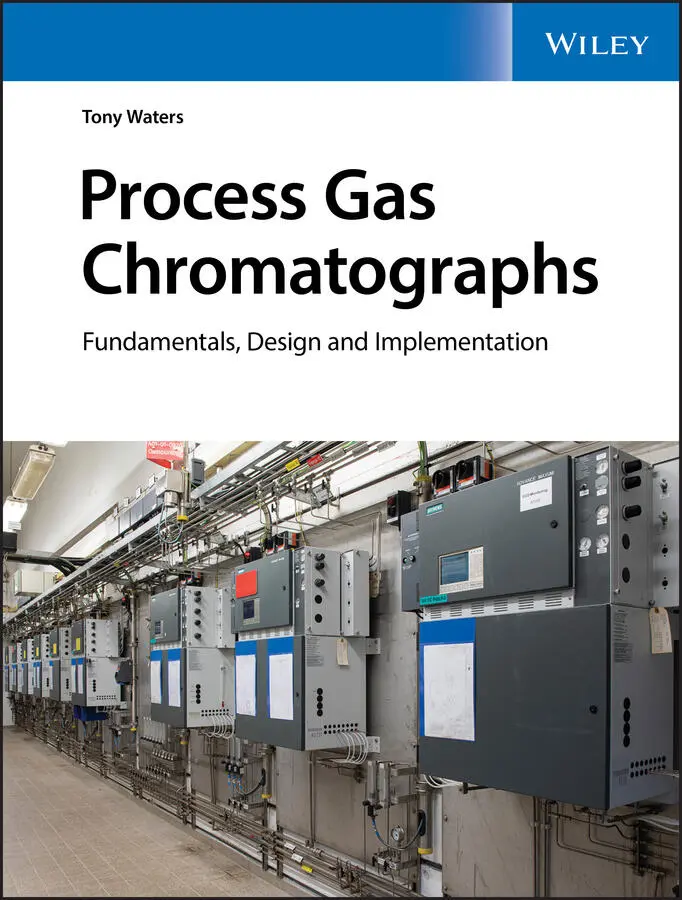
- Название:Process Gas Chromatographs
- Автор:
- Жанр:
- Год:неизвестен
- ISBN:нет данных
- Рейтинг книги:3 / 5. Голосов: 1
-
Избранное:Добавить в избранное
- Отзывы:
-
Ваша оценка:
Process Gas Chromatographs: краткое содержание, описание и аннотация
Предлагаем к чтению аннотацию, описание, краткое содержание или предисловие (зависит от того, что написал сам автор книги «Process Gas Chromatographs»). Если вы не нашли необходимую информацию о книге — напишите в комментариях, мы постараемся отыскать её.
Process Gas Chromatographs:
Fundamentals, Design and Implementation
Describes practical procedures for design and troubleshooting Contains concise chapters that provide a structured course for advanced students in process engineering Reviews the fundamentals of applied gas chromatography Details the operation and maintenance of process gas chromatographs Offers a summary, and self-assessment questions, for every chapter Is written by an international expert in the field with extensive industry knowledge and teaching experience in courses on process sampling systems and gas chromatography Written for process analyzer engineers and technicians, application engineers, and industrial environmental engineers, offers an essential guide to the basics of gas chromatography and reviews the applications of process gas chromatographs in industry today.
Process Gas Chromatographs — читать онлайн ознакомительный отрывок
Ниже представлен текст книги, разбитый по страницам. Система сохранения места последней прочитанной страницы, позволяет с удобством читать онлайн бесплатно книгу «Process Gas Chromatographs», без необходимости каждый раз заново искать на чём Вы остановились. Поставьте закладку, и сможете в любой момент перейти на страницу, на которой закончили чтение.
Интервал:
Закладка:
2 Q2. In a gas chromatograph, which one of the gases listed below would not suitable as the carrier gas?Select the one correct answer:OxygenNitrogenHydrogenHelium
3 Q3. In a gas‐liquid chromatograph, which one of the materials listed below might be the stationary phase?Select the one correct answer:An inert gasA granular adsorbent solidA volatile liquidA non‐volatile liquid
4 Q4. In a gas‐liquid chromatograph, what really causes the separation?Select the one best answer:The carrier gas causes the separation.The mobile phase causes the separation.The stationary phase causes the separation.The chromatogram causes the separation.
5 Q5. In a gas chromatograph, what do the columns do?Select the one best answer:They convert all the components into peaks.They separate the analytes from all other components and from each other.They separate all the components of the sample.They allow only measured components to enter each detector.
6 Q6. In a gas chromatograph, what does a detector do?Select the one best answer:It provides a continuous flat baseline as a reference for measuring the peaks.It generates a signal proportional to the instantaneous number of component molecules leaving the column.It measures either the area or the height of each peak.It converts each component of the sample to a concentration.
7 Q7. Why is the chromatogram so important?Select the one best answer:It shows the baseline used for measuring the peaks.It shows the shape of each peak.It shows the separation between peaks.All of the above.Check your SAQ answers with those given at the end of the book.
Student evaluation test: SET 01
Your instructor will provide the answers to these test questions.
1 S1. In gas‐liquid chromatography, what is the physical state of the mobile phase?Select the one best answer:GasGas or liquidLiquidSolid
2 S2. In gas‐liquid chromatography, what is the physical state of the stationary phase?Select the one best answer:GasGas or liquidLiquidSolid
3 S3. In gas‐liquid chromatography, what is the physical state of the injected sample?Select the one best answer:GasGas or liquidLiquidSolid
4 S4. According to the chapter text, what is a typical number of analyses done per day by a process gas chromatograph, relative to the number done by a laboratory gas chromatograph?Select the one best answer:About 80 times as manyAbout 120 times as manyAbout 240 times as manyAbout 720 times as many
5 S5. According to the chapter text, what is the main function of a housekeeping column?Select the one best answer:To separate all the measured components.To separate only the unmeasured components.To allow strongly‐retained components to quickly exit the column system.To permanently absorb one or more unmeasured components.
6 S6. Imagine you are changing a PGC from liquid sample injection to gas sample injection and the gas sample will be at atmospheric pressure. If the previous liquid sample volume was 1 μL, what new gas sample volume would you install to get about the same peak heights?Select the one best answer:0.001 mL0.3 mL0.9 mL3.0 mL
7 S7. PGC detectors may not respond to every analyte. Consider the statements below; which statements are correct?Select all of the correct statements and none of the incorrect statements:No detector can respond to hydrogen sulfide, H2S.The thermal conductivity detector does not respond to hydrocarbons.The flame ionization detector is very sensitive and can measure low concentrations of carbon dioxide, CO2.The flame photometric detector does not respond to carbon monoxide, CO.
8 S8. What is a chromatogram, and why is it important?From the list below, select all the correct statements and none of the incorrect statements:The chromatogram is a graphical plot of the detector signal against elapsed time.On a chromatogram, the horizontal axis represents elapsed time, which always increases from left to right, with the zero‐time marker on the far left.On the chromatogram from a modern process gas chromatograph, the vertical axis represents the concentration of the analytes and is scaled from zero to 100 %.Chromatographic faults produce symptoms visible on the chromatogram that an expert user can diagnose.
9 S9. How is each analyte peak on the chromatogram measured?From the list below, select all the correct statements and none of the incorrect statements:Most modern PGCs measure the peak height, but a few measure the peak area.To calculate the concentration of an analyte, the PGC multiplies the analyte peak height or peak area by a stored calibration factor.The calibration factor depends on the detector in use but is the same for each analyte in the sample.The calibration factors come from the analysis of a calibration sample containing known concentrations of the analytes.
References
Cited
1 Ettre, L.S. (2008). Chapters in the Evolution of Chromatography (ed. J.V. Hinshaw). London, UK: Imperial College Press.
2 Harvey, D. (2017). Gas chromatography. In: LibreTexts, Section 2.4 (updated July 28, 2017), accessed October 23, 2018 at https://chem.libretexts.org
3 Rahman, M.M., El‐Aty, A.A., Choi, J., Shin, H., Shin, S.C., and Shim, J. (2015). Basic overview on gas chromatography columns. In: Analytical Separation Science (eds. J.L. Anderson, A. Berthod, V. Pino, and A.M. Stalcup), 823–834. Verlag, Germany: Wiley‐VCH. doi:10.1002/9783527678129.assep024
4 Waters, T. (2017). The fine art of chromatogram reading. Proceedings of the 2017 Analysis Division Symposium, Pasadena, California (April 24–26, 2017). Research Triangle Park, NC, USA: International Society of Automation.
Figures
1 1.1 A Classic PGC
2 1.2 A Basic Gas Chromatograph
3 1.3 Typical Gas Sample Injector Valve
4 1.4 Typical Chromatographic Columns
5 1.5 A Simple Column Switching System
6 1.6 Three Kinds of Capillary Column
7 1.7Typical Strip‐Chart ChromatogramTypical On‐Screen Chromatogram
8 1.8 A Real Chromatogram
New technical terms
When first introduced, these words and phrases were in bold type. You should now know the meaning of these technical terms. If still in doubt, consult the Glossary at the end of the book:
1 active‐solid column
2 analysis time
3 analyte
4 application engineering
5 atmospheric referencing
6 autosampler
7 baseline
8 calibration factor
9 capillary column
10 carrier gas
11 chromatogram
12 chromatogram signal
13 chromatograph
14 chromatography
15 column
16 column oven
17 column valve
18 component
19 detector
20 elute
21 flame ionization detector
22 flame photometric detector
23 gas chromatograph
24 gas chromatography
25 gas‐liquid chromatography
26 gas‐solid chromatography
27 housekeeping column
28 inert support
29 liquid chromatography
30 liquid loading
31 liquid‐phase column
32 mobile phase
33 molecule
34 open‐tubular column
35 packed column
36 peak
37 peak area
38 peak height
39 PLOT column
40 retention time
41 sample
42 sample conditioning
43 sample injector valve
44 SCOT column
45 separation
46 stationary phase
47 supercritical fluid
48 temperature programming
49 thermal conductivity detector
50 volatile liquid
51 WCOT column
In addition, we introduced several chemical names and you need to know what they are. If you are not familiar with chemical names, refer to the SCI‐FILE: On Chemical Names in Chapter 4. You can also look up individual chemical names in the Glossary.
Note
1 1There are some exceptions to the principle of instant vaporization that are beyond the scope of this introductory text.
Читать дальшеИнтервал:
Закладка:
Похожие книги на «Process Gas Chromatographs»
Представляем Вашему вниманию похожие книги на «Process Gas Chromatographs» списком для выбора. Мы отобрали схожую по названию и смыслу литературу в надежде предоставить читателям больше вариантов отыскать новые, интересные, ещё непрочитанные произведения.










Обсуждение, отзывы о книге «Process Gas Chromatographs» и просто собственные мнения читателей. Оставьте ваши комментарии, напишите, что Вы думаете о произведении, его смысле или главных героях. Укажите что конкретно понравилось, а что нет, и почему Вы так считаете.