Tony Waters - Process Gas Chromatographs
Здесь есть возможность читать онлайн «Tony Waters - Process Gas Chromatographs» — ознакомительный отрывок электронной книги совершенно бесплатно, а после прочтения отрывка купить полную версию. В некоторых случаях можно слушать аудио, скачать через торрент в формате fb2 и присутствует краткое содержание. Жанр: unrecognised, на английском языке. Описание произведения, (предисловие) а так же отзывы посетителей доступны на портале библиотеки ЛибКат.
- Название:Process Gas Chromatographs
- Автор:
- Жанр:
- Год:неизвестен
- ISBN:нет данных
- Рейтинг книги:3 / 5. Голосов: 1
-
Избранное:Добавить в избранное
- Отзывы:
-
Ваша оценка:
Process Gas Chromatographs: краткое содержание, описание и аннотация
Предлагаем к чтению аннотацию, описание, краткое содержание или предисловие (зависит от того, что написал сам автор книги «Process Gas Chromatographs»). Если вы не нашли необходимую информацию о книге — напишите в комментариях, мы постараемся отыскать её.
Process Gas Chromatographs:
Fundamentals, Design and Implementation
Describes practical procedures for design and troubleshooting Contains concise chapters that provide a structured course for advanced students in process engineering Reviews the fundamentals of applied gas chromatography Details the operation and maintenance of process gas chromatographs Offers a summary, and self-assessment questions, for every chapter Is written by an international expert in the field with extensive industry knowledge and teaching experience in courses on process sampling systems and gas chromatography Written for process analyzer engineers and technicians, application engineers, and industrial environmental engineers, offers an essential guide to the basics of gas chromatography and reviews the applications of process gas chromatographs in industry today.
Process Gas Chromatographs — читать онлайн ознакомительный отрывок
Ниже представлен текст книги, разбитый по страницам. Система сохранения места последней прочитанной страницы, позволяет с удобством читать онлайн бесплатно книгу «Process Gas Chromatographs», без необходимости каждый раз заново искать на чём Вы остановились. Поставьте закладку, и сможете в любой момент перейти на страницу, на которой закончили чтение.
Интервал:
Закладка:
Gas chromatography works because each component to be separated has a different solubility in the liquid phase. We shall see that the less soluble peaks move quickly through the column while the more soluble peaks take longer to get through.
This is the process of separation. It's all about solubility.
Chemists call the liquid phase a solventand each dissolved component a solute. But no real chemistry is involved. If a chemical reaction occurred, it might destroy some of the molecules that we are trying to measure and likely would cause a gradual and irreversible deterioration of the column itself.
Before moving on, a quick reminder. The discussion in this chapter focuses on the most common kind of column; one that has a liquid stationary phase. As noted earlier, another kind of column uses a solid stationary phase. The solute molecules can't dissolve in a solid, but they can and do adhere to its solid surface, and the final outcome is much the same.
Troubleshooting tips
The household examples used above may provide some valuable help with troubleshooting and are worth remembering:
When a column works at higher temperature, gas solubility is reduced, and all the peaks come out earlier on the chromatogram, thereby reducing their separation. For an easy way to remember this, recall the heated water!
When a column works at higher pressure, gas solubility is increased and all the peaks come out later on the chromatogram, thereby increasing their separation. For an easy way to remember this, recall the bubbly champagne!
These troubleshooting tips assume that the carrier gas flow rate is held constant. Later chapters discuss the effect of other variables.
The rest of this chapter explains how solubility causes the classic peak shape. The following chapter examines how a difference in solubility will cause the peaks to become separated from each other.
How peaks form
Forming an equilibrium
To examine the interaction between a gas and a liquid, consider a small enclosed space that's internally divided into a gas space and a liquid space, as in Figure 2.3a. For explanatory purposes, the diagrams in Figure 2.3show the gas space and liquid space as deep layers that would not work in practice. In a real column, the gas and liquid layers are very shallow, so the sample molecules can move quickly between them.
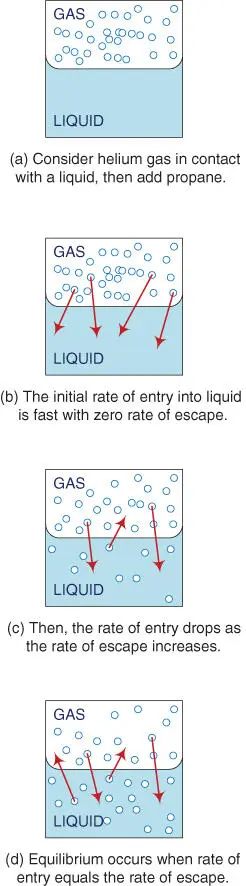
Figure 2.3Forming an Equilibrium.
Let's assume that the gas space in Figure 2.3a is full of helium. This is equivalent to the carrier gas in a column; it's always there. The helium molecules contact the liquid phase, and a few of them dissolve in it. Since helium is always there, the amount dissolved soon becomes constant and can be ignored.
Now consider what happens when a small sample of (say) propane is injected into the helium gas in the enclosed space. To keep it simple, let's say there are only 32 propane molecules. The same logic applies to 32 trillion molecules, or to any other number of them. This is shown in Figure 2.3b.
The propane molecules move randomly in the gas phase and soon encounter the liquid surface where some of them dissolve. Initially, all the propane molecules are in the gas phase, so they frequently collide with the liquid surface and their rate of entry into the liquid is high. Then, as more of the molecules dissolve in the liquid, there are less of them in the gas phase, and their rate of entry declines.
The dissolved propane molecules move slowly in the liquid phase and eventually encounter the gas‐liquid surface, where some of them have enough energy to escape back into the gas phase. Initially, there are no propane molecules dissolved in the liquid phase, so none can escape; their rate of escape is zero. As more and more propane molecules dissolve, their rate of escape increases, as in Figure 2.3c.
With the rate of entry falling and the rate of escape rising, there must soon come a time when the two rates become equal. At this instant and beyond, every molecule that dissolves replaces one that escapes. The number of molecules in the gas phase is then constant, as is the number of molecules in the liquid phase. They will stay that way forever, as long as the operating conditions don't change.
This balancing act between two opposing and dependent processes is common in chemistry. Chemists call it a dynamic equilibrium.
There is nothing in our example that specifies the number of propane molecules in the gas phase and in the liquid phase once equilibrium has been achieved. That would depend on the solubility of propane in the selected liquid phase and would vary with different chemical compounds. To make it easy, though, let's assume that 50 % of the propane dissolves. Then, after reaching equilibrium, half of the molecules will be in the liquid phase, and the other half will be in the gas phase. This is the situation shown in Figure 2.3d.
Actually, it's reasonable to assume the propane solubility is 50 %, as that would generate a pretty good chromatogram. Yes, we can predict the position of peaks on the chromatogram from their solubility! You'll soon see how that works out.
In practice, it would not be difficult to set the propane solubility to exactly 50 %. We already know that the solubility of a given substance in a given liquid depends on temperature and pressure. So, to adjust the propane solubility simply change the temperature. It really is that simple. In fact, that's one way you can optimize the performance of a column.
The effect of movement
So far, the discussion about equilibrium cannot explain chromatography. There is something missing from Figure 2.3, something that is essential for chromatography to occur. Figure 2.3starts to explain what happens in a column, but it's not enough.
What is missing?
The gas phase is not moving! Recall that chromatography occurs when something moves across something that doesn't move. And in a gas chromatograph, it's the carrier gas that moves.
When the carrier gas moves, any propane molecules that happen to be in the gas phase are carried along with it, as illustrated in Figure 2.4a. In this figure, fresh carrier gas enters from the left and pushes the propane molecules out to the right replacing them with pure helium. In Figure 2.4b, the 50 % propane molecules are gone from the gas phase, and the other 50 % are stuck in the liquid phase. Pure helium now occupies the gas space, upsetting the original equilibrium.
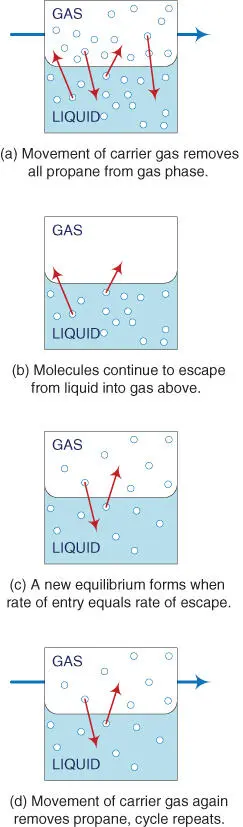
Figure 2.4The Carrier Gas Moves.
Let's see what happens next. Imagine the small enclosed space is again sealed. The absence of propane molecules in the gas phase doesn't affect the behavior of the molecules trapped in the liquid. They continue to escape from the liquid into the clean helium above, as they did before. See Figure 2.4b. It should come as no surprise that as soon as some of the molecules reenter the gas phase, they start to dissolve in the liquid again, quickly forming the new equilibrium in Figure 2.4c.
Of course, it doesn't stop there. When the carrier gas again moves it disrupts the equilibrium of Figure 2.4c and the cycle starts again, as shown in Figure 2.4d – but with fewer molecules this time.
Pause for a moment to reflect. Figure 2.4suggests that the carrier gas moves, then stops until a new equilibrium forms, then moves again. Clearly, this is not true. Chromatography is a smooth process, not a jerky one. But the jerky model is very useful for explaining what happens inside a column. It's a bit like taking a movie of the process and then looking at each frame in turn.
Читать дальшеИнтервал:
Закладка:
Похожие книги на «Process Gas Chromatographs»
Представляем Вашему вниманию похожие книги на «Process Gas Chromatographs» списком для выбора. Мы отобрали схожую по названию и смыслу литературу в надежде предоставить читателям больше вариантов отыскать новые, интересные, ещё непрочитанные произведения.












Обсуждение, отзывы о книге «Process Gas Chromatographs» и просто собственные мнения читателей. Оставьте ваши комментарии, напишите, что Вы думаете о произведении, его смысле или главных героях. Укажите что конкретно понравилось, а что нет, и почему Вы так считаете.