Samprit Chatterjee - Handbook of Regression Analysis With Applications in R
Здесь есть возможность читать онлайн «Samprit Chatterjee - Handbook of Regression Analysis With Applications in R» — ознакомительный отрывок электронной книги совершенно бесплатно, а после прочтения отрывка купить полную версию. В некоторых случаях можно слушать аудио, скачать через торрент в формате fb2 и присутствует краткое содержание. Жанр: unrecognised, на английском языке. Описание произведения, (предисловие) а так же отзывы посетителей доступны на портале библиотеки ЛибКат.

- Название:Handbook of Regression Analysis With Applications in R
- Автор:
- Жанр:
- Год:неизвестен
- ISBN:нет данных
- Рейтинг книги:3 / 5. Голосов: 1
-
Избранное:Добавить в избранное
- Отзывы:
-
Ваша оценка:
Handbook of Regression Analysis With Applications in R: краткое содержание, описание и аннотация
Предлагаем к чтению аннотацию, описание, краткое содержание или предисловие (зависит от того, что написал сам автор книги «Handbook of Regression Analysis With Applications in R»). Если вы не нашли необходимую информацию о книге — напишите в комментариях, мы постараемся отыскать её.
andbook and reference guide for students and practitioners of statistical regression-based analyses in R
Handbook of Regression Analysis
with Applications in R, Second Edition
The book further pays particular attention to methods that have become prominent in the last few decades as increasingly large data sets have made new techniques and applications possible. These include:
Regularization methods Smoothing methods Tree-based methods In the new edition of the
, the data analyst’s toolkit is explored and expanded. Examples are drawn from a wide variety of real-life applications and data sets. All the utilized R code and data are available via an author-maintained website.
Of interest to undergraduate and graduate students taking courses in statistics and regression, the
will also be invaluable to practicing data scientists and statisticians.
Handbook of Regression Analysis With Applications in R — читать онлайн ознакомительный отрывок
Ниже представлен текст книги, разбитый по страницам. Система сохранения места последней прочитанной страницы, позволяет с удобством читать онлайн бесплатно книгу «Handbook of Regression Analysis With Applications in R», без необходимости каждый раз заново искать на чём Вы остановились. Поставьте закладку, и сможете в любой момент перейти на страницу, на которой закончили чтение.
Интервал:
Закладка:
The  ‐statistic to test the overall significance of the regression is a special case of this construction (with restriction
  ), as is each of the individual
  ‐statistics that test the significance of any variable (with restriction
  ). In the latter case
  .
.
2.2.2 COLLINEARITY
Recall that the importance of a predictor can be difficult to assess using  ‐tests when predictors are correlated with each other. A related issue is that of collinearity(sometimes somewhat redundantly referred to as multicollinearity), which refers to the situation when (some of) the predictors are highly correlated with each other. The presence of predicting variables that are highly correlated with each other can lead to instability in the regression coefficients, increasing their standard errors, and as a result the
  ‐statistics for the variables can be deflated. This can be seen in Figure 2.1. The two plots refer to identical data sets, other than the one data point that is lightly colored. Dropping the data points down to the
  plane makes clear the high correlation between the predictors. The estimated regression plane changes from

in the top plot to

in the bottom plot; a small change in only one data point causes a major change in the estimated regression function.
Thus, from a practical point of view, collinearity leads to two problems. First, it can happen that the overall  ‐statistic is significant, yet each of the individual
  ‐statistics is not significant (more generally, the tail probability for the
  ‐test is considerably smaller than those of any of the individual coefficient
  ‐tests). Second, if the data are changed only slightly, the fitted regression coefficients can change dramatically. Note that while collinearity can have a large effect on regression coefficients and associated
  ‐statistics, it does not have a large effect on overall measures of fit like the overall
  ‐test or
  , since adding unneeded variables (whether or not they are collinear with predictors already in the model) cannot increase the residual sum of squares (it can only decrease it or leave it roughly the same).
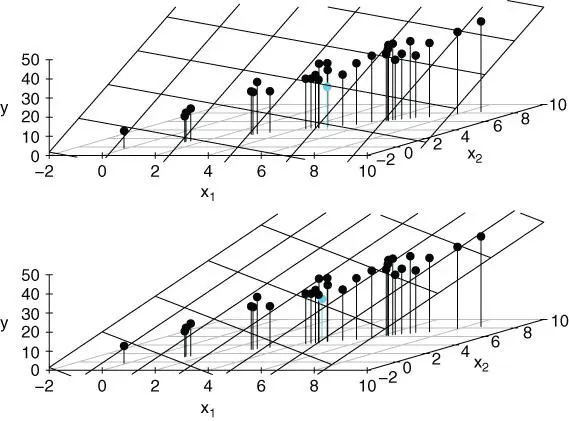
FIGURE 2.1: Least squares estimation under collinearity. The only change in the data sets is the lightly colored data point. The planes are the estimated least squares fits.
Another problem with collinearity comes from attempting to use a fitted regression model for prediction. As was noted in Chapter 1, simple models tend to forecast better than more complex ones, since they make fewer assumptions about what the future will look like. If a model exhibiting collinearity is used for future prediction, the implicit assumption is that the relationships among the predicting variables, as well as their relationship with the target variable, remain the same in the future. This is less likely to be true if the predicting variables are collinear.
How can collinearity be diagnosed? The two‐predictor model

provides some guidance. It can be shown that in this case
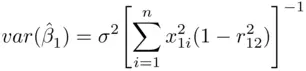
and
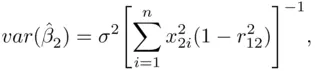
where  is the correlation between
  and
and  . Note that as collinearity increases (
  ), both variances tend to
  . This effect is quantified in Table 2.1.
Table 2.1: Variance inflation caused by correlation of predictors in a two‐predictor model.
 |
Variance inflation |
 |
 |
 |
 |
 |
 |
 |
 |
 |
 |
 |
 |
 |
 |
 |
 |
 |
 |
 |
 |
This ratio describes by how much the variances of the estimated slope coefficients are inflated due to observed collinearity relative to when the predictors are uncorrelated. It is clear that when the correlation is high, the variability (and hence the instability) of the estimated slopes can increase dramatically.
Читать дальшеИнтервал:
Закладка:
Похожие книги на «Handbook of Regression Analysis With Applications in R»
Представляем Вашему вниманию похожие книги на «Handbook of Regression Analysis With Applications in R» списком для выбора. Мы отобрали схожую по названию и смыслу литературу в надежде предоставить читателям больше вариантов отыскать новые, интересные, ещё непрочитанные произведения.






Обсуждение, отзывы о книге «Handbook of Regression Analysis With Applications in R» и просто собственные мнения читателей. Оставьте ваши комментарии, напишите, что Вы думаете о произведении, его смысле или главных героях. Укажите что конкретно понравилось, а что нет, и почему Вы так считаете.