Efstratios N. Pistikopoulos - Multi-parametric Optimization and Control
Здесь есть возможность читать онлайн «Efstratios N. Pistikopoulos - Multi-parametric Optimization and Control» — ознакомительный отрывок электронной книги совершенно бесплатно, а после прочтения отрывка купить полную версию. В некоторых случаях можно слушать аудио, скачать через торрент в формате fb2 и присутствует краткое содержание. Жанр: unrecognised, на английском языке. Описание произведения, (предисловие) а так же отзывы посетителей доступны на портале библиотеки ЛибКат.
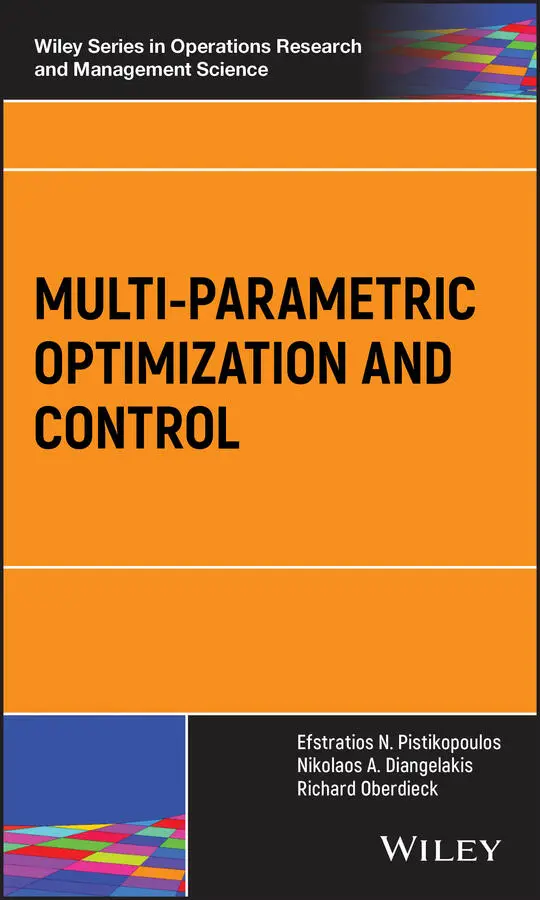
- Название:Multi-parametric Optimization and Control
- Автор:
- Жанр:
- Год:неизвестен
- ISBN:нет данных
- Рейтинг книги:5 / 5. Голосов: 1
-
Избранное:Добавить в избранное
- Отзывы:
-
Ваша оценка:
Multi-parametric Optimization and Control: краткое содержание, описание и аннотация
Предлагаем к чтению аннотацию, описание, краткое содержание или предисловие (зависит от того, что написал сам автор книги «Multi-parametric Optimization and Control»). Если вы не нашли необходимую информацию о книге — напишите в комментариях, мы постараемся отыскать её.
ecent developments in multi-parametric optimization and control
Multi-Parametric Optimization and Control Researchers and practitioners can use the book as reference. It is also suitable as a primary or a supplementary textbook. Each chapter looks at the theories related to a topic along with a relevant case study. Topic complexity increases gradually as readers progress through the chapters. The first part of the book presents an overview of the state-of-the-art multi-parametric optimization theory and algorithms in multi-parametric programming. The second examines the connection between multi-parametric programming and model-predictive control—from the linear quadratic regulator over hybrid systems to periodic systems and robust control.
The third part of the book addresses multi-parametric optimization in process systems engineering. A step-by-step procedure is introduced for embedding the programming within the system engineering, which leads the reader into the topic of the PAROC framework and software platform. PAROC is an integrated framework and platform for the optimization and advanced model-based control of process systems.
Uses case studies to illustrate real-world applications for a better understanding of the concepts presented Covers the fundamentals of optimization and model predictive control Provides information on key topics, such as the basic sensitivity theorem, linear programming, quadratic programming, mixed-integer linear programming, optimal control of continuous systems, and multi-parametric optimal control An appendix summarizes the history of multi-parametric optimization algorithms. It also covers the use of the parametric optimization toolbox (POP), which is comprehensive software for efficiently solving multi-parametric programming problems.
Multi-parametric Optimization and Control — читать онлайн ознакомительный отрывок
Ниже представлен текст книги, разбитый по страницам. Система сохранения места последней прочитанной страницы, позволяет с удобством читать онлайн бесплатно книгу «Multi-parametric Optimization and Control», без необходимости каждый раз заново искать на чём Вы остановились. Поставьте закладку, и сможете в любой момент перейти на страницу, на которой закончили чтение.
Интервал:
Закладка:
(2.7) 
Based on Eq. (2.7), the following Lemmata result:
Lemma 2.1
Every critical region is uniquely defined by its active set.
Proof
By inspection of Eq. (2.7), it is clear that the differences between any two critical regions are the values of  ,
,  , and
, and  , respectively, which only depend on the active set
  . Thus, the set of active constraints
  uniquely defines the critical region
  , which completes the proof.
Lemma 2.2
The maximum number of critical regions,  , for problem 2.2is given by
(2.8) 
Proof
Consider  . Then an optimal solution of the resulting LP problem is guaranteed to lie in a vertex, thus featuring
  active constraints. However, as the equality constraints have to be fulfilled for all
  , the number of active inequality constraints is given by
  , where
  is the number of equality constraints. As the number of critical regions is uniquely defined by the active set, it is bound by above by all possible combinations of active sets, which is given by
  , which completes the proof.
2.1.2 Global Properties
The solution properties described in Chapter 2.1.1hold for any feasible point  and thus the following theorem can be formulated:
Theorem 2.1 (The Solution of mp‐LP Problems)
Consider the mp‐LP problem ( 2.2). Then the set of feasible parameters  is convex, the optimizer
  is continuous and piecewise affine, and the optimal objective function
 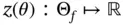 is continuous, convex, and piecewise affine.
Proof
The two key statements that need to be proven are the convexity of  and
and  . Consider two generic parameter values
  and let
  ,
,  and
and  and
and  be the corresponding optimal objective function values and optimizers. Additionally, let
  and define
  and
and  . Then, since
  ,
,  , and
, and  are feasible and satisfy the constraints
  and
and  . As these constraints are affine, they can be linearly combined to obtain
  , and therefore
  is feasible for the optimization problem ( 2.2). Since a feasible solution
  exists at
  , an optimal solution exists at
  and thus
  is convex.
Интервал:
Закладка:
Похожие книги на «Multi-parametric Optimization and Control»
Представляем Вашему вниманию похожие книги на «Multi-parametric Optimization and Control» списком для выбора. Мы отобрали схожую по названию и смыслу литературу в надежде предоставить читателям больше вариантов отыскать новые, интересные, ещё непрочитанные произведения.



Обсуждение, отзывы о книге «Multi-parametric Optimization and Control» и просто собственные мнения читателей. Оставьте ваши комментарии, напишите, что Вы думаете о произведении, его смысле или главных героях. Укажите что конкретно понравилось, а что нет, и почему Вы так считаете.