Robert Bartoszynski - Probability and Statistical Inference
Здесь есть возможность читать онлайн «Robert Bartoszynski - Probability and Statistical Inference» — ознакомительный отрывок электронной книги совершенно бесплатно, а после прочтения отрывка купить полную версию. В некоторых случаях можно слушать аудио, скачать через торрент в формате fb2 и присутствует краткое содержание. Жанр: unrecognised, на английском языке. Описание произведения, (предисловие) а так же отзывы посетителей доступны на портале библиотеки ЛибКат.
- Название:Probability and Statistical Inference
- Автор:
- Жанр:
- Год:неизвестен
- ISBN:нет данных
- Рейтинг книги:4 / 5. Голосов: 1
-
Избранное:Добавить в избранное
- Отзывы:
-
Ваша оценка:
Probability and Statistical Inference: краткое содержание, описание и аннотация
Предлагаем к чтению аннотацию, описание, краткое содержание или предисловие (зависит от того, что написал сам автор книги «Probability and Statistical Inference»). Если вы не нашли необходимую информацию о книге — напишите в комментариях, мы постараемся отыскать её.
Probability and Statistical Inference, Third Edition
Probability and Statistical Inference
Probability and Statistical Inference — читать онлайн ознакомительный отрывок
Ниже представлен текст книги, разбитый по страницам. Система сохранения места последней прочитанной страницы, позволяет с удобством читать онлайн бесплатно книгу «Probability and Statistical Inference», без необходимости каждый раз заново искать на чём Вы остановились. Поставьте закладку, и сможете в любой момент перейти на страницу, на которой закончили чтение.
Интервал:
Закладка:
Theorem 3.4.1 Let  be positive integers such that
  . The number of ways a set of
  elements can be partitioned into
  subsets of sizes
  equals
(3.26) 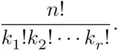
Proof : A partition above can be accomplished in steps: First, we choose  out of
  elements to form the first subset of the partition. Next, we choose
  elements out of the remaining
  elements, and so on, until we have
  elements, from which we choose
  to form the next‐to‐last subset. The remaining
  elements form the last subset This can be accomplished, in view of Theorem 3.2.2, in
(3.27) 
ways. Simple algebra shows that formula ( 3.27) is the same as formula ( 3.26).
The ratio ( 3.26) is called multinomial coefficient and is denoted by
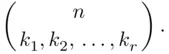
As a generalization of Newton's binomial formula, we have
Theorem 3.4.2 For every integer  ,
,
(3.28) 
where the summation is extended over all subsets 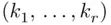 of nonnegative integers with
  .
.
Proof : In the product  , one term is taken from each factor so that the general term of the sum has the form
  with
with  . From Theorem 3.4.1, it follows that the number of times the product
  appears equals ( 3.26).
In an analogy with a formula ( 3.17), the sum of all multinomial coefficients equals  , which follows by substituting
  in ( 3.28).
The theorem is illustrated by the following example:
Example 3.14
Suppose that one needs the value of the coefficient of  in the expression
  . One could argue that in the multiplication
  there are 10 factors, and each term will contain one component from each set of parentheses. Thus, choosing
  from 2 out of 10 pairs of parentheses,
  from 3 out of 10, and so on, amounts to partitioning 10 pairs of parentheses into four classes, with sizes
  and
and  . The total number of ways such a partition can be accomplished is the coefficient of
  , and equals
  .
.
Интервал:
Закладка:
Похожие книги на «Probability and Statistical Inference»
Представляем Вашему вниманию похожие книги на «Probability and Statistical Inference» списком для выбора. Мы отобрали схожую по названию и смыслу литературу в надежде предоставить читателям больше вариантов отыскать новые, интересные, ещё непрочитанные произведения.








Обсуждение, отзывы о книге «Probability and Statistical Inference» и просто собственные мнения читателей. Оставьте ваши комментарии, напишите, что Вы думаете о произведении, его смысле или главных героях. Укажите что конкретно понравилось, а что нет, и почему Вы так считаете.