Robert Bartoszynski - Probability and Statistical Inference
Здесь есть возможность читать онлайн «Robert Bartoszynski - Probability and Statistical Inference» — ознакомительный отрывок электронной книги совершенно бесплатно, а после прочтения отрывка купить полную версию. В некоторых случаях можно слушать аудио, скачать через торрент в формате fb2 и присутствует краткое содержание. Жанр: unrecognised, на английском языке. Описание произведения, (предисловие) а так же отзывы посетителей доступны на портале библиотеки ЛибКат.
- Название:Probability and Statistical Inference
- Автор:
- Жанр:
- Год:неизвестен
- ISBN:нет данных
- Рейтинг книги:4 / 5. Голосов: 1
-
Избранное:Добавить в избранное
- Отзывы:
-
Ваша оценка:
Probability and Statistical Inference: краткое содержание, описание и аннотация
Предлагаем к чтению аннотацию, описание, краткое содержание или предисловие (зависит от того, что написал сам автор книги «Probability and Statistical Inference»). Если вы не нашли необходимую информацию о книге — напишите в комментариях, мы постараемся отыскать её.
Probability and Statistical Inference, Third Edition
Probability and Statistical Inference
Probability and Statistical Inference — читать онлайн ознакомительный отрывок
Ниже представлен текст книги, разбитый по страницам. Система сохранения места последней прочитанной страницы, позволяет с удобством читать онлайн бесплатно книгу «Probability and Statistical Inference», без необходимости каждый раз заново искать на чём Вы остановились. Поставьте закладку, и сможете в любой момент перейти на страницу, на которой закончили чтение.
Интервал:
Закладка:
We may characterize countable additivity as follows:
Theorem 2.6.1 If the probability  satisfies Axiom 3 of countable additivity, then
  is continuous from above and from below. Conversely, if a function
  satisfies Axioms 1 and 2, is finitely additive, and is either continuous from below or continuous from above at the empty set
  , then
  is countably additive.
Proof : Assume that  satisfies Axiom 3, and let
  be a monotone increasing sequence. We have
(2.8) 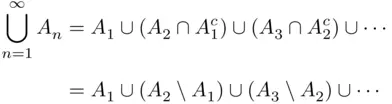
the events on the right‐hand side being disjoint. Since  (see Section 1.5), using ( 2.8), and the assumption of countable additivity, we obtain
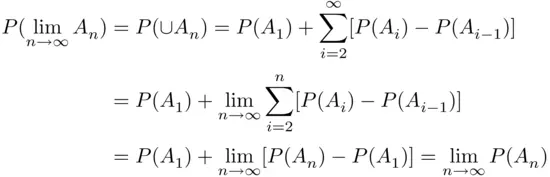
(passing from the first to the second line, we used the fact that the infinite series is defined as the limit of its partial sums). This proves continuity of  from below. To prove continuity from above, we pass to the complements, and proceed as above.
Let us now assume that  is finitely additive and continuous from below, and let
 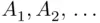 be a sequence of mutually disjoint events. Put
  so that
  is a monotone increasing sequence with
 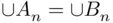 . We have then, using continuity from below and finite additivity,
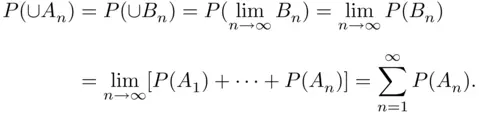
again by definition of a numerical series being the limit of its partial sums. This shows that  is countably additive.
Finally, let us assume that  is finitely additive and continuous from above at the empty set
  (impossible event). Taking again a sequence of disjoint events
 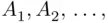 let
let  . We have
  and
and  . By finite additivity, we obtain
(2.9) 
Since ( 2.9) holds for every  , we can write

Again, by the definition of series and the assumption that  ,
,  is countably additive, and the proof is complete.
As an illustration, we now prove the following theorem:
Theorem 2.6.2 (First Borel–Cantelli Lemma) If 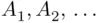 is a sequence of events such that
(2.10) 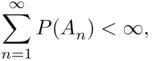
then

Proof : Recall ( 1.7) from Chapter 1, where  = “infinitely many events
  occur” =
  (because the unions
  form a decreasing sequence). Consequently, using the continuity of
  , subadditivity property (2.2), and assumption ( 2.10), we have
Интервал:
Закладка:
Похожие книги на «Probability and Statistical Inference»
Представляем Вашему вниманию похожие книги на «Probability and Statistical Inference» списком для выбора. Мы отобрали схожую по названию и смыслу литературу в надежде предоставить читателям больше вариантов отыскать новые, интересные, ещё непрочитанные произведения.









Обсуждение, отзывы о книге «Probability and Statistical Inference» и просто собственные мнения читателей. Оставьте ваши комментарии, напишите, что Вы думаете о произведении, его смысле или главных героях. Укажите что конкретно понравилось, а что нет, и почему Вы так считаете.