Robert Bartoszynski - Probability and Statistical Inference
Здесь есть возможность читать онлайн «Robert Bartoszynski - Probability and Statistical Inference» — ознакомительный отрывок электронной книги совершенно бесплатно, а после прочтения отрывка купить полную версию. В некоторых случаях можно слушать аудио, скачать через торрент в формате fb2 и присутствует краткое содержание. Жанр: unrecognised, на английском языке. Описание произведения, (предисловие) а так же отзывы посетителей доступны на портале библиотеки ЛибКат.
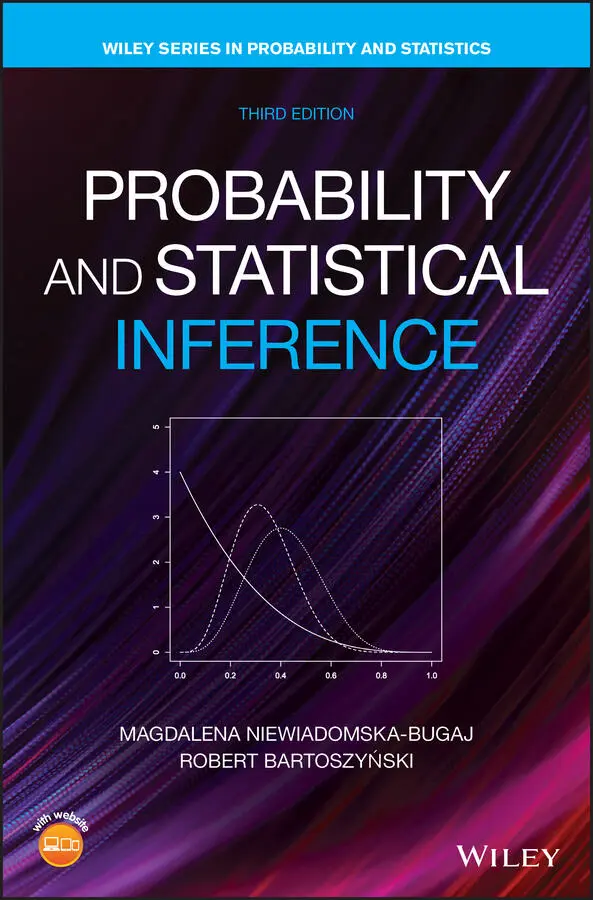
- Название:Probability and Statistical Inference
- Автор:
- Жанр:
- Год:неизвестен
- ISBN:нет данных
- Рейтинг книги:4 / 5. Голосов: 1
-
Избранное:Добавить в избранное
- Отзывы:
-
Ваша оценка:
Probability and Statistical Inference: краткое содержание, описание и аннотация
Предлагаем к чтению аннотацию, описание, краткое содержание или предисловие (зависит от того, что написал сам автор книги «Probability and Statistical Inference»). Если вы не нашли необходимую информацию о книге — напишите в комментариях, мы постараемся отыскать её.
Probability and Statistical Inference, Third Edition
Probability and Statistical Inference
Probability and Statistical Inference — читать онлайн ознакомительный отрывок
Ниже представлен текст книги, разбитый по страницам. Система сохранения места последней прочитанной страницы, позволяет с удобством читать онлайн бесплатно книгу «Probability and Statistical Inference», без необходимости каждый раз заново искать на чём Вы остановились. Поставьте закладку, и сможете в любой момент перейти на страницу, на которой закончили чтение.
Интервал:
Закладка:
An alternative terminology here is that  implies (or entails )
  .
.
Definition 1.3.2Two events  and
and  are said to be equal ,
  , if
, if  and
and  .
.
It follows that two events are equal if they consist of exactly the same sample points.
Example 1.10
Consider two tosses of a coin, and the corresponding sample space  consisting of four outcomes: HH, HT, TH, and TT. The event
  “heads in the first toss”
  HH, HT} is contained in the event
  “at least one head”
  HH, HT, TH}. The events “the results alternate” and “at least one head and one tail” imply one another, and hence are equal.
Definition 1.3.3The set containing no elements is called the empty set and is denoted by  . The event corresponding to
  is called a null ( impossible ) event.
Example 1.11 * 2
The reader may wonder whether it is correct to use the definite article in the definition above and speak of “ the empty set,” since it would appear that there may be many different empty sets. For instance, the set of all kings of the United States and the set of all real numbers  such that
  are both empty, but one consists of people and the other of numbers, so they cannot be equal. This is not so, however, as is shown by the following formal argument (to appreciate this argument, one needs some training in logic). Suppose that
  and
and  are two empty sets. To prove that they are equal, one needs to prove that
  and
and  . Formally, the first inclusion is the implication: “if
  belongs to
  , then
  belongs to
  .” This implication is true, because its premise is false: there is no
  that belongs to
  . The same holds for the second implication, so
  .
.
We now give the definitions of three principal operations on events: complementation , union , and intersection .
Definition 1.3.4The set that contains all sample points that are not in the event  will be called the complement of
  and denoted
  , to be read also as “not
  .”
.”
Definition 1.3.5The set that contains all sample points belonging either to  or to
or to  (so possibly to both of them) is called the union of
  and
and  and denoted
  , to be read as “
  or
or  .”
.”
Definition 1.3.6The set that contains all sample points belonging to both  and
and  is called the intersection of
  and
and  and denoted
  .
.
Интервал:
Закладка:
Похожие книги на «Probability and Statistical Inference»
Представляем Вашему вниманию похожие книги на «Probability and Statistical Inference» списком для выбора. Мы отобрали схожую по названию и смыслу литературу в надежде предоставить читателям больше вариантов отыскать новые, интересные, ещё непрочитанные произведения.








Обсуждение, отзывы о книге «Probability and Statistical Inference» и просто собственные мнения читателей. Оставьте ваши комментарии, напишите, что Вы думаете о произведении, его смысле или главных героях. Укажите что конкретно понравилось, а что нет, и почему Вы так считаете.