Matthew B. Hamilton - Population Genetics
Здесь есть возможность читать онлайн «Matthew B. Hamilton - Population Genetics» — ознакомительный отрывок электронной книги совершенно бесплатно, а после прочтения отрывка купить полную версию. В некоторых случаях можно слушать аудио, скачать через торрент в формате fb2 и присутствует краткое содержание. Жанр: unrecognised, на английском языке. Описание произведения, (предисловие) а так же отзывы посетителей доступны на портале библиотеки ЛибКат.
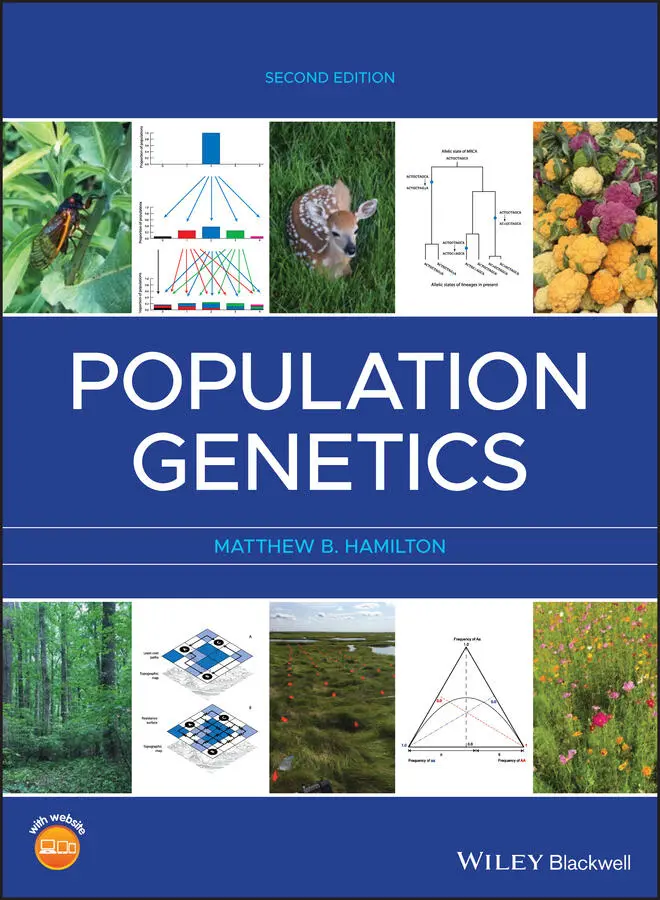
- Название:Population Genetics
- Автор:
- Жанр:
- Год:неизвестен
- ISBN:нет данных
- Рейтинг книги:4 / 5. Голосов: 1
-
Избранное:Добавить в избранное
- Отзывы:
-
Ваша оценка:
Population Genetics: краткое содержание, описание и аннотация
Предлагаем к чтению аннотацию, описание, краткое содержание или предисловие (зависит от того, что написал сам автор книги «Population Genetics»). Если вы не нашли необходимую информацию о книге — напишите в комментариях, мы постараемся отыскать её.
is the classic, accessible introduction to the concepts of population genetics. Combining traditional conceptual approaches with classical hypotheses and debates, the book equips students to understand a wide array of empirical studies that are based on the first principles of population genetics.
Featuring a highly accessible introduction to coalescent theory, as well as covering the major conceptual advances in population genetics of the last two decades, the second edition now also includes end of chapter problem sets and revised coverage of recombination in the coalescent model, metapopulation extinction and recolonization, and the fixation index.
Population Genetics — читать онлайн ознакомительный отрывок
Ниже представлен текст книги, разбитый по страницам. Система сохранения места последней прочитанной страницы, позволяет с удобством читать онлайн бесплатно книгу «Population Genetics», без необходимости каждый раз заново искать на чём Вы остановились. Поставьте закладку, и сможете в любой момент перейти на страницу, на которой закончили чтение.
Интервал:
Закладка:
Inductive and deductive reasoning
Population genetics employs both inductiveand deductive reasoningin an effort to understand the biological processes operating in actual populations as well as to elucidate the general processes that cause population genetic phenomena. The inductive approach to population genetics involves assembling measures of genetic variation (parameter estimates) from various populations to build up evidence that can be used to identify the underlying processes that produced the observed patterns. This approach is logically identical to that used by Isaac Newton, who used knowledge of how objects fall to the surface of the Earth as well as knowledge of the movement of planets to arrive at the general principles of gravity. Application of inductive reasoning requires detailed familiarity with the various empirical data types in population genetics, such as DNA sequences, along with the results of studies that report observed patterns of genetic variation. From this accumulated empirical information, it is then possible to draw more general conclusions about the qualities and quantities of genetic variation in populations. Model organisms like D. melanogaster and Arabidopsis thaliana play a large role in population genetic conclusions reached by inductive reasoning. Because model organisms receive a large amount of scientific effort, for example, to completely sequence and annotate their genomes, a great deal of available genetic data are accumulated for these species. Based on this evidence, many inferences have been made about population genetic processes. Although model organisms are very rich sources of empirical information, the number of species is limited by definition so that any generalizations may not apply universally to all species.
Deductive reasoning:Using general principles to reach conclusions about specific instances.
Inductive reasoning:Utilizing the knowledge of specific instances or cases to arrive at general principles.
The study of population genetics can also be approached using deductive reasoning. The actions of general processes such as genetic drift, mutation, and natural selection are represented by parameters in the mathematical equations that make up population genetic models. These models can then be used to make predictions about the quantity of genetic variation and patterns of genetic variation in space and time. Such population genetic models make general predictions about things like rates of change in allele frequency, the eventual equilibrium of allele or genotype frequencies, and the net outcome of several processes operating at the same time. These predictions are very general in that they apply to any population of any species since the predictions arose from general principles in the first place. At the same time, such general predictions may not be directly applicable to a specific population because the general principles and assumptions used to make the prediction are not specific enough to match an actual population.
Historically, the field of population genetics has developed from an interplay between arguments and evidence developed using both inductive and deductive reasoning approaches. Nonetheless, most of the major ideas in population genetics can be first approached with deductive reasoning by learning and understanding the expectations that arise from the principles of Mendelian heredity. This book stresses on the process of deductive reasoning to arrive at these fundamental predictions. Empirical evidence related to expectations is included to illustrate predictions and to demonstrate hypothesis tests that result from expectations. Because the body of empirical results in population genetics is very large, readers should resist the temptation to generalize too much from the limited number of empirical studies that are presented. Detailed reviews of particular areas of population genetics, many of which are cited, are a better source for comprehensive summaries of empirical studies.
In the next chapter, we will start by building expectations for the frequencies of diploid genotypes based on the foundation of particulate inheritance: that alleles are passed unaltered from parents to offspring. There is ample support for particulate inheritance from both molecular biology, which identifies DNA as the hereditary molecule, and from allele and genotype frequencies that can be observed in actual populations. The general principle of particulate inheritance has been used to formulate a wide array of expectations about allele and genotype frequencies in populations.
1.2 Theory and assumptions
What Is a Theory and What Are Assumptions?
How Can Theories Be Useful with So Many Assumptions?
In colloquial usage, the word theory refers to something that is known with uncertainty, or a quantity that is approximate. On a day you are running late leaving work, you might say, “In theory, I am supposed to depart at 6:00 pm.” In science, theory has a very different meaning. Theory is the accumulation of expectations and observations that have withstood tests and critical scrutiny and are accepted by at least some practitioners of a scientific field. Theory is the collection of all of the expectations developed for specific cases or individual biological processes that together form a more comprehensive set of general principles. The combination of Darwin's hypothesis of natural selection with the laws of Mendelian particulate inheritance is often called the modern synthesis of evolutionary biology since it is a comprehensive theory to explain the causes of evolutionary change. The modern synthesis can offer causal explanations for biological phenomena ranging from antibiotic resistance in bacteria to the behavior of elephants to the rate of DNA sequence change, as well as make predictions to guide animal and plant breeders. In all of the modern synthesis, population genetics plays a central role.
It is common for the uninitiated to ask the question “what good is theory if it is based on so many assumptions?” A body of theory is a useful tool to articulate assumptions and generate testable predictions. Theory that generates many testable predictions about the world also offers many opportunities to falsify its predictions and assumptions. Since hypotheses cannot be proven directly, but alternative hypotheses can be disproven, the generation of plausible, testable alternative hypotheses is a requirement for scientific inquiry. Strong theories are able to make accurate predictions, offer causal explanations for diverse observations, and generate alternative hypotheses based on revised assumptions.
The words theory and assumption can seem abstract, but you should not be intimidated by them. Theories are just collections of expectations, each with a set of assumptions that place bounds on the prediction being made. If you understand what motivates an expectation, its predictions, and its assumptions, then you understand theory. Most expectations in population genetics will have at least a few, and often many, assumptions used to define and bound the situation. For example, we might assume something about the size of a population or the absence of mutation, or that all genotypes are diploid with two alleles. This is a way of limiting the prediction to appropriate circumstances and a way of defining which quantities and conditions can vary and which are fixed. Each of these assumptions can influence the generality of an expectation. Each assumption can also be relaxed or altered to see how strongly it influences the expectation. To return to the example in the preceding section, if, one day, meteorites start falling around us with regularity, we would be forced to call into question some of the basic assumptions originally used to formulate our expectation that meteorite strikes should be rare events. In this way, assumptions are useful tools to ask “what if…?” as part of the process of developing a prediction. If our initial “what if…?” conditions do not match a situation, then the resulting prediction will probably be inaccurate.
Читать дальшеИнтервал:
Закладка:
Похожие книги на «Population Genetics»
Представляем Вашему вниманию похожие книги на «Population Genetics» списком для выбора. Мы отобрали схожую по названию и смыслу литературу в надежде предоставить читателям больше вариантов отыскать новые, интересные, ещё непрочитанные произведения.








Обсуждение, отзывы о книге «Population Genetics» и просто собственные мнения читателей. Оставьте ваши комментарии, напишите, что Вы думаете о произведении, его смысле или главных героях. Укажите что конкретно понравилось, а что нет, и почему Вы так считаете.