Matthew B. Hamilton - Population Genetics
Здесь есть возможность читать онлайн «Matthew B. Hamilton - Population Genetics» — ознакомительный отрывок электронной книги совершенно бесплатно, а после прочтения отрывка купить полную версию. В некоторых случаях можно слушать аудио, скачать через торрент в формате fb2 и присутствует краткое содержание. Жанр: unrecognised, на английском языке. Описание произведения, (предисловие) а так же отзывы посетителей доступны на портале библиотеки ЛибКат.
- Название:Population Genetics
- Автор:
- Жанр:
- Год:неизвестен
- ISBN:нет данных
- Рейтинг книги:4 / 5. Голосов: 1
-
Избранное:Добавить в избранное
- Отзывы:
-
Ваша оценка:
Population Genetics: краткое содержание, описание и аннотация
Предлагаем к чтению аннотацию, описание, краткое содержание или предисловие (зависит от того, что написал сам автор книги «Population Genetics»). Если вы не нашли необходимую информацию о книге — напишите в комментариях, мы постараемся отыскать её.
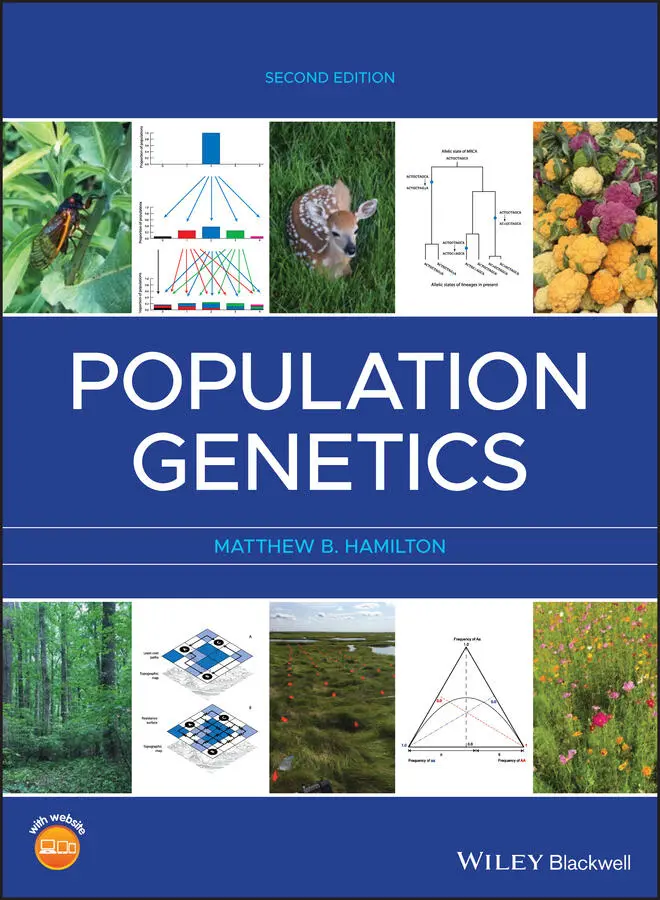
is the classic, accessible introduction to the concepts of population genetics. Combining traditional conceptual approaches with classical hypotheses and debates, the book equips students to understand a wide array of empirical studies that are based on the first principles of population genetics.
Featuring a highly accessible introduction to coalescent theory, as well as covering the major conceptual advances in population genetics of the last two decades, the second edition now also includes end of chapter problem sets and revised coverage of recombination in the coalescent model, metapopulation extinction and recolonization, and the fixation index.
Population Genetics — читать онлайн ознакомительный отрывок
Ниже представлен текст книги, разбитый по страницам. Система сохранения места последней прочитанной страницы, позволяет с удобством читать онлайн бесплатно книгу «Population Genetics», без необходимости каждый раз заново искать на чём Вы остановились. Поставьте закладку, и сможете в любой момент перейти на страницу, на которой закончили чтение.
Интервал:
Закладка:
In population genetics, as in much of science where theory and expectations are involved, empirical data and model expectations are routinely compared. Imagine observing a set of genotype frequencies in a biological population. It would then be natural to construct an idealized population by using theory that approximates the biological population. This is an attempt to construct an idealized population that is equivalent to the actual population from the perspective of the processes influencing genotype frequencies. For example, a large population may behave exactly like a small, randomly mating ideal population in terms of genotype frequencies. This equivalence allows us to use expectations for ideal populations with one or a few variables specified in order to describe an actual population where there are many more, usually unknown, parameters. What we strive to do is to focus on those variables that strongly influence genotype frequencies in the actual population. In this way, it is often possible to reduce the complexity of a real population and determine the key variables that strongly influence a property like genotype frequencies. The ideal population is not meant to match the actual population in every detail.
Theory:A scheme or system of ideas or statements held as an explanation or account of a group of facts or phenomena; the general laws, principles, or causes of something known or observed.
Infer:To draw a conclusion or make a deduction based on facts or indications; to have as a logical consequence.
From the comparison of expectation and observation, we infer that the first principles used to construct the expectation are sound if they can be used to explain patterns observed in the biological world. However, there is a major distinction between considering an actual and idealized population equivalent and considering them identical . This is seen in cases where the observed pattern in an actual population is consistent with the expectations from several model populations built around distinct and incompatible assumptions. In such cases, it is not possible to infer the processes that cause a given pattern without additional information. A common example in population genetics are cases of genetic patterns that are potentially consistent with the random process of genetic drift and, at the same time, consistent with some form of the deterministic process of natural selection. In such cases, unambiguous inference of the underlying cause of a pattern is not possible without additional empirical information or more precise expectations.
1.3 Simulation
A Method of Practice, Trial and Error Learning, and Exploration
Imagine learning to play the piano without ever touching a piano or practicing the hand movements required to play. What if you were expected to play a difficult concerto after extensive exposure (perhaps a semester) to only verbal and written descriptions of how other people play? Such a teaching style would make learning to play the piano very difficult because there would be no opportunity for practice, trial and error, or exploration. You would not have the opportunity for direct experience nor incremental improvement of your understanding. Unfortunately, this is exactly how science courses are taught to some degree. You are expected to learn and remember concepts with only limited opportunities for directly observing principles in action. In fairness, this is partly due to the difficulty of carrying out some of the experiments or observations that originally lead someone to discover and understand an important principle.
In the field of population genetics, computer simulations can be used to effectively demonstrate many fundamental genetic processes. In fact, computer simulations are an important research tool in population genetics. Therefore, when you conduct simulations, you are both learning by direct experience and learning using the same methods that are used by researchers. Simulations allow us to view how quantities like allele frequencies change over time, observe their dynamics, and determine whether a stable end point is reached: an equilibrium. With simulations, we can view dynamics (change over time) and equilibria over very long periods of time and under a vast array of conditions in an effort to reach general conclusions. Without simulations, it would be impossible for us to directly observe allele frequencies over such long periods of time and in such diverse biological situations.
Interact box 1.1 The textbook website
Throughout this book, you will encounter Interact boxes. These boxes contain opportunities for you to interact directly with the material in the text by using computer simulations designed to demonstrate fundamental concepts of population genetics. Each box will contain step‐by‐step instructions for you to follow in order to carry out a simulation. By following the instructions, you will get started with the simulation. However, always feel free to use your own imagination and intuition. After following the instructions in the Interact box and understanding the point at hand, enter different values, push more buttons, and even read the documentation. You can also return to Interact boxes at a later time, perhaps after you have read and understood more of the text, to reconsider a simulation or view it in a different light. You can also use the simulations to answer questions that may occur to you or to test hypotheses that you may have. Questions in population genetics that start off “What would happen if…?” can often be answered with simulation.
The book's website gives you the worldwide web address (URL) for each interact box. This prevents problems in case web addresses change because the website can be updated while your copy of the text cannot be updated.
Step 1 Open a web browser and enter http://www.wiley.com/go/hamiltongenetics
Step 2 Click on the Chapter resources link that is associated with Interact boxes.
Step 3 Verify that the page gives links for each of the Interact boxes listed by their number. You could also bookmark this page so you can access it directly in the future.
Congratulations! You have completed the first Interact box.
Simulations are an effective means to understand some of the fundamental predictions of populations genetics. Mathematical expressions are frequently used to express dynamics and equilibria in population genetics, but the equations alone can be opaque at first. Simulations provide a means to explore the relationships among variables that are summarized in the compact language of mathematics. Many people feel that a set of mathematical equations is much more meaningful after having the chance to explore what they describe with some actual numerical values. Simulation provides the means to explore what equations predict and can make learning population genetics an easier, more rewarding experience.
Carrying out simulations has the potential to make the expectations of population genetics much more accessible and understandable. Conducting simulations is not much extra work, especially once you get into the practice of using the text and simulation software in concert. You can approach simulations as if they are games, where each one shows a visual scene that helps to solve a puzzle. In addition, simulations can help you develop a more intuitive understanding of population genetic predictions so you do not have to approach the expectations of population genetics as disembodied or unanimated “facts.”
It is important to approach simulations in a systematic and organized fashion, not as just a collection of buttons to press and text entry boxes to be filled in on a whim. It is absolutely imperative that you understand the meaning behind each variable that you can control as well as the meaning of the results you obtain. To do so successfully, you will need to be aware of both specific details and larger patterns, or both the individual trees and the forest that they compose. For example, in a simulation that presents results as a graph, it is important that you understand the details of what variables are represented on each axis and the range of axis values. Sometimes these details are not always completely obvious in simulation software, requiring you to use both your intuition and knowledge of the population genetic processes being simulated.
Читать дальшеИнтервал:
Закладка:
Похожие книги на «Population Genetics»
Представляем Вашему вниманию похожие книги на «Population Genetics» списком для выбора. Мы отобрали схожую по названию и смыслу литературу в надежде предоставить читателям больше вариантов отыскать новые, интересные, ещё непрочитанные произведения.











Обсуждение, отзывы о книге «Population Genetics» и просто собственные мнения читателей. Оставьте ваши комментарии, напишите, что Вы думаете о произведении, его смысле или главных героях. Укажите что конкретно понравилось, а что нет, и почему Вы так считаете.