Matthew B. Hamilton - Population Genetics
Здесь есть возможность читать онлайн «Matthew B. Hamilton - Population Genetics» — ознакомительный отрывок электронной книги совершенно бесплатно, а после прочтения отрывка купить полную версию. В некоторых случаях можно слушать аудио, скачать через торрент в формате fb2 и присутствует краткое содержание. Жанр: unrecognised, на английском языке. Описание произведения, (предисловие) а так же отзывы посетителей доступны на портале библиотеки ЛибКат.
- Название:Population Genetics
- Автор:
- Жанр:
- Год:неизвестен
- ISBN:нет данных
- Рейтинг книги:4 / 5. Голосов: 1
-
Избранное:Добавить в избранное
- Отзывы:
-
Ваша оценка:
Population Genetics: краткое содержание, описание и аннотация
Предлагаем к чтению аннотацию, описание, краткое содержание или предисловие (зависит от того, что написал сам автор книги «Population Genetics»). Если вы не нашли необходимую информацию о книге — напишите в комментариях, мы постараемся отыскать её.
is the classic, accessible introduction to the concepts of population genetics. Combining traditional conceptual approaches with classical hypotheses and debates, the book equips students to understand a wide array of empirical studies that are based on the first principles of population genetics.
Featuring a highly accessible introduction to coalescent theory, as well as covering the major conceptual advances in population genetics of the last two decades, the second edition now also includes end of chapter problem sets and revised coverage of recombination in the coalescent model, metapopulation extinction and recolonization, and the fixation index.
Population Genetics — читать онлайн ознакомительный отрывок
Ниже представлен текст книги, разбитый по страницам. Система сохранения места последней прочитанной страницы, позволяет с удобством читать онлайн бесплатно книгу «Population Genetics», без необходимости каждый раз заново искать на чём Вы остановились. Поставьте закладку, и сможете в любой момент перейти на страницу, на которой закончили чтение.
Интервал:
Закладка:
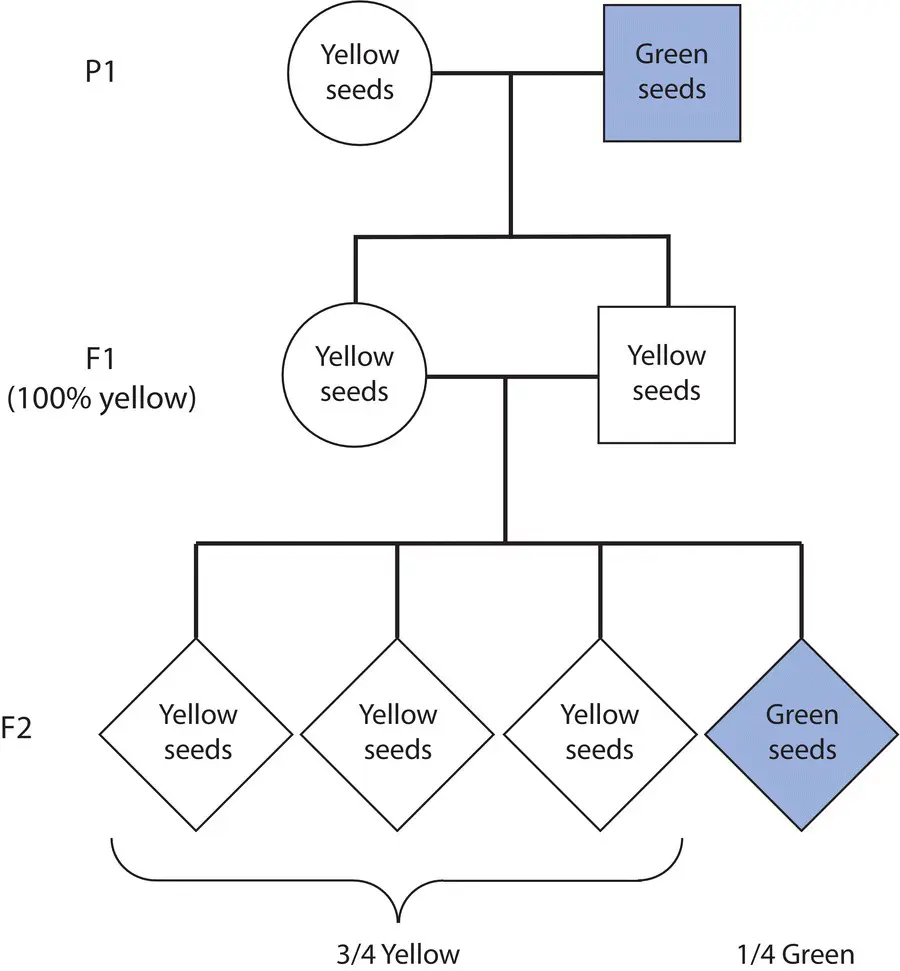
Figure 2.2 Mendel's crosses to examine the segregation ratio in the seed coat color of pea plants. The parental plants (P1 generation) were pure breeding, meaning that if self‐fertilized all resulting progeny had a phenotype identical to the parent. Some individuals are represented by diamonds since pea plants are hermaphrodites and can act as a mother, a father, or can self‐fertilize.
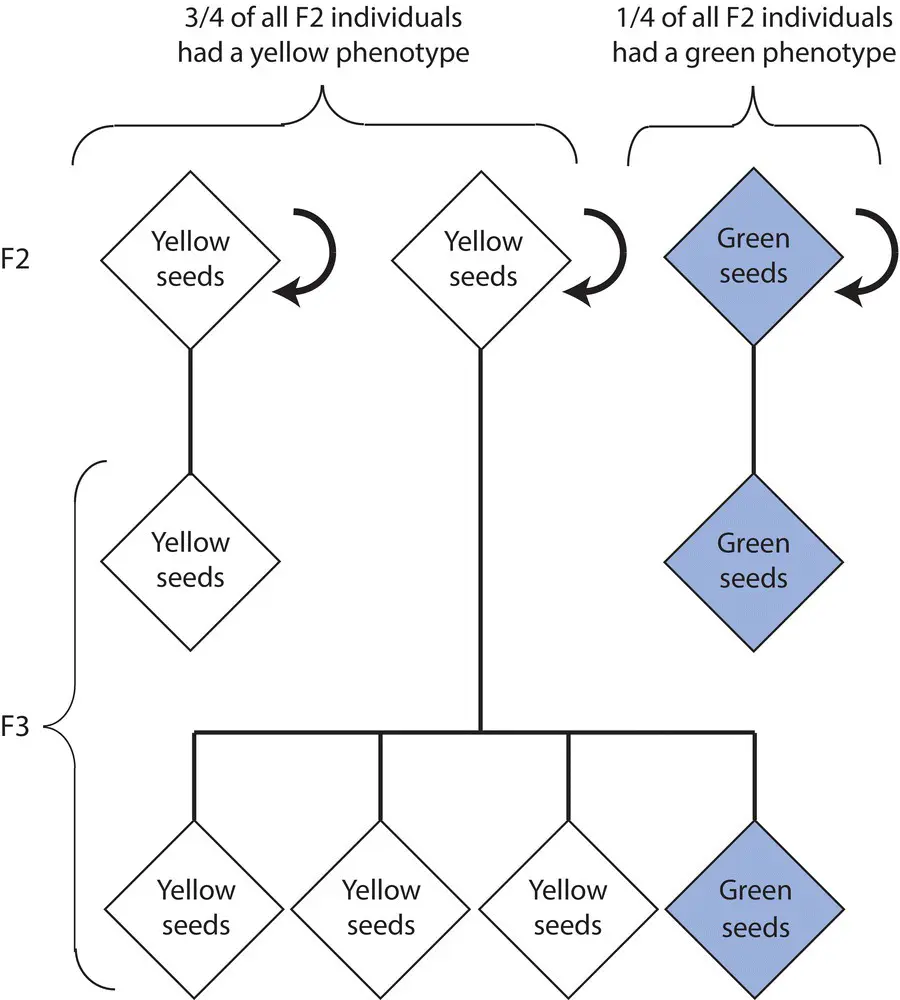
Figure 2.3 Mendel self‐pollinated (indicated by curved arrows) the F2 progeny produced by the cross shown in Figure 2.2. Of the F2 progeny that had a yellow phenotype (3/4 of the total), 1/3 produced all progeny with a yellow phenotype and 2/3 produced progeny with a 3 : 1 ratio of yellow and green progeny (or 3/4 yellow progeny). Individuals are represented by diamonds since pea plants are hermaphrodites.
His insightful next step was to self‐pollinate a sample of the plants from the F2 generation ( Figure 2.3). He considered the F2 individuals with yellow and green seed coats separately. All green‐seeded F2 plants produced green progeny and thus were “pure” green. However, the yellow‐seeded F2 plants were of two kinds. Considering just the yellow F2 seeds, one‐third were pure and produced only yellow‐seeded progeny, whereas two‐thirds were “impure” yellow since they produced both yellow‐ and green‐seeded progeny. Mendel combined the frequencies of the F2 yellow and green phenotypes along with the frequencies of the F3 progeny. He reasoned that three‐quarters of all F2 plants had yellow seeds, but these could be divided into plants that produced pure yellow F3 progeny (one‐third) and plants that produced both yellow and green F3 progeny (two‐thirds). So, the ratio of pure yellow to impure yellow in the F2 was (1/3 × 3/4 =) 1/4 pure yellow to (2/3 × 3/4 =) 1/2 “impure” yellow. The green‐seeded progeny comprised one‐quarter of the F2 generation and all produced green‐seeded progeny when self‐fertilized, so that (1 × 1/4 green =) 1/4 pure green. In total, the ratios of phenotypes in the F2 generation were 1 pure yellow : 2 impure yellow : 1 pure green or 1 : 2 : 1. Mendel reasoned that “the ratio of 3 : 1 in which the distribution of the dominating and recessive traits take place in the first generation therefore resolves itself into the ratio of 1 : 2 : 1 if one differentiates the meaning of the dominating trait as a hybrid and as a parental trait” (quoted in Orel 1996). During his work, Mendel employed the terms “dominating” (which became dominant) and “recessive” to describe the manifestation of traits in impure or heterozygous individuals.
With the benefit of modern symbols of particulate heredity, we could diagram Mendel's monohybrid cross with pea color in the following way.
| P1 | Phenotype | Yellow × green | |
| Genotype | GG | Gg | |
| Gametes produced | G | G | |
| F1 | Phenotype | All “impure”yellow | |
| Genotype | Gg | ||
| Gametes produced | G, g |
A Punnet square could be used to predict the phenotypic ratios of the F2 plants
| G | G | |
| G | GG | Gg |
| G | Gg | Gg |
| F2 | Phenotype | 3 Yellow : 1 green | ||
| Genotype | GG | Gg | Gg | |
| Gametes produced | G | G, g | G |
and another Punnet square could be used to predict the genotypic ratios of the two‐thirds of the yellow F2 plants
| G | G | |
| G | GG | Gg |
| G | Gg | Gg |
Mendel’s first “law”:Predicts independent segregation of alleles at a single locus: two copies of a diploid locus (a pair of alleles that make a diploid genotype) segregate independently into gametes so that in a large number of gametes half carry one allele and the other half carry the other allele.
Individual pea plants obviously have more than a single phenotype, and Mendel followed the inheritance of other characters in addition to seed coat color. In one example of his crossing experiments, Mendel tracked the simultaneous inheritance of both seed coat color and seed surface condition (either wrinkled [“angular”] or smooth). He constructed an initial cross among pure‐breeding lines identical to what he had done when tracking seed color inheritance, except now there were two phenotypes ( Figure 2.4). The F2 progeny appeared in the phenotypic ratio of 9 round/yellow : 3 round/green : 3 wrinkled/yellow : 1 wrinkled/green.
How did Mendel go from this F2 phenotypic ratio to the second law? He ignored the wrinkled/smooth phenotype and just considered the yellow/green seed color phenotype in self‐pollination crosses of F2 plants just like those for the first law. In the F2 progeny, 12/16 or three‐quarters had a yellow seed coat and 4/16 or one‐quarter had a green seed coat, or a 3 yellow : 1 green phenotypic ratio. Again using self‐pollination of F2 plants like those in Figure 2.3, he showed that the yellow phenotypes were (1/3 × ¾) one‐quarter pure and (2/3 × ¾) one‐half impure yellow. Thus, the segregation ratio for seed color was 1 : 2 : 1 and the wrinkled/smooth phenotype did not alter this result. Mendel obtained an identical result when considering instead only the wrinkled/smooth phenotype and ignoring the seed color phenotype.
Mendel concluded that a phenotypic segregation ratio of 9 : 3 : 3 : 1 is the same as combining two independent 3 : 1 segregation ratios of two phenotypes since (3 : 1) × (3 : 1) = 9 : 3 : 3 : 1. Similarly, the multiplication of two (1 : 2 : 1) phenotypic ratios will predict the two phenotype ratios (1 : 2 : 1) × (1 : 2 : 1) = 1 : 2 : 1 : 2 : 4 : 2 : 1 : 2 : 1. We now recognize that dominance in the first two phenotype ratios masks the ability to distinguish some of the homozygous and heterozygous genotypes, whereas the ratio in the second case would result if there was no dominance. You can confirm these conclusions by working out a Punnett square for the F2 progeny in the two‐locus case.
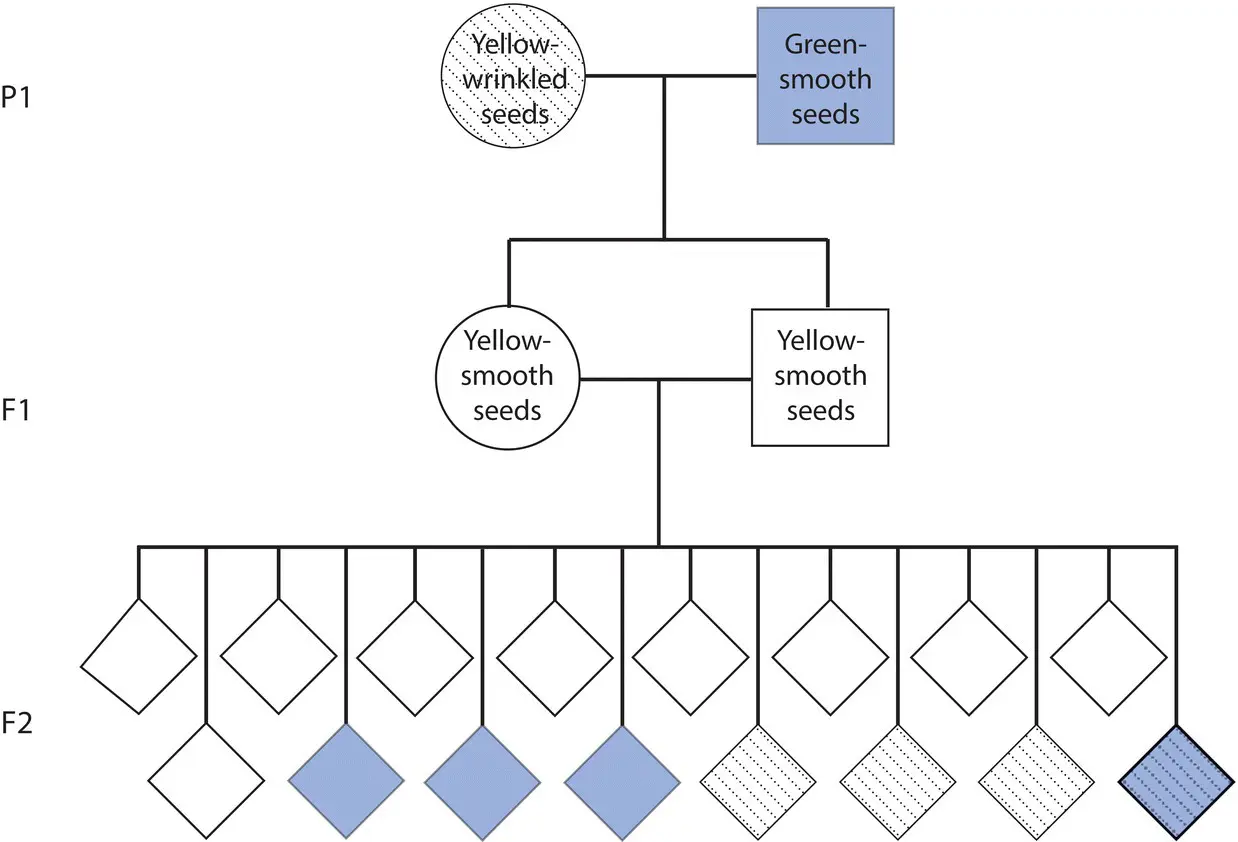
Figure 2.4 Mendel's crosses to examine the segregation ratios of two phenotypes, seed coat color (yellow or green) and seed coat surface (smooth or wrinkled), in pea plants. The stippled pattern indicates wrinkled seeds, while the solid color indicates smooth seeds. The F2 individuals exhibited a phenotypic ratio of 9 round‐yellow: 3 round‐green: 3 wrinkled‐yellow: 1 wrinkled‐green.
Mendel’s second “law”:Predicts independent assortment of multiple loci: during gamete formation, the segregation of alleles of one locus is independent of the segregation of alleles of another locus.
Mendel performed similar breeding experiments with numerous other pea phenotypes and obtained similar results. Mendel described his work with peas and other plants in lectures and published it in 1866 in the Proceedings of the Natural Science Society of Brünn in German where it went unnoticed for nearly 35 years. However, Mendel's results were eventually recognized, and his paper was translated into several languages. Mendel's rediscovered the hypothesis of particulate inheritance was also bolstered by evidence from microscopic observations of chromosomes during cell division that led Walter Sutton to propose in 1902 that chromosomes are the physical basis of heredity, supported by results obtained independently by Theodor Boveri at around the same time (see Crow and Crow 2002).
Читать дальшеИнтервал:
Закладка:
Похожие книги на «Population Genetics»
Представляем Вашему вниманию похожие книги на «Population Genetics» списком для выбора. Мы отобрали схожую по названию и смыслу литературу в надежде предоставить читателям больше вариантов отыскать новые, интересные, ещё непрочитанные произведения.






Обсуждение, отзывы о книге «Population Genetics» и просто собственные мнения читателей. Оставьте ваши комментарии, напишите, что Вы думаете о произведении, его смысле или главных героях. Укажите что конкретно понравилось, а что нет, и почему Вы так считаете.