Matthew B. Hamilton - Population Genetics
Здесь есть возможность читать онлайн «Matthew B. Hamilton - Population Genetics» — ознакомительный отрывок электронной книги совершенно бесплатно, а после прочтения отрывка купить полную версию. В некоторых случаях можно слушать аудио, скачать через торрент в формате fb2 и присутствует краткое содержание. Жанр: unrecognised, на английском языке. Описание произведения, (предисловие) а так же отзывы посетителей доступны на портале библиотеки ЛибКат.
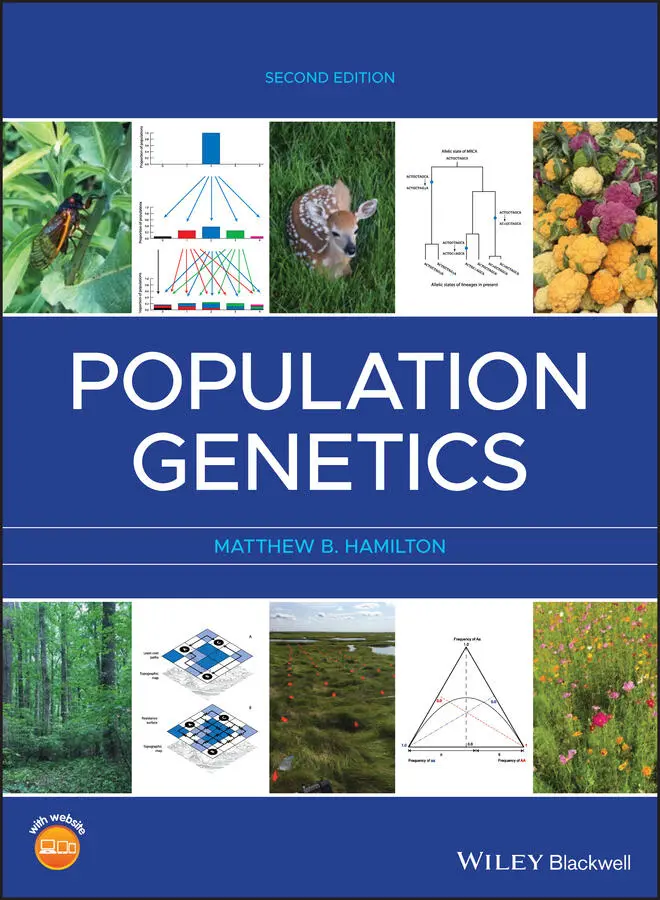
- Название:Population Genetics
- Автор:
- Жанр:
- Год:неизвестен
- ISBN:нет данных
- Рейтинг книги:4 / 5. Голосов: 1
-
Избранное:Добавить в избранное
- Отзывы:
-
Ваша оценка:
Population Genetics: краткое содержание, описание и аннотация
Предлагаем к чтению аннотацию, описание, краткое содержание или предисловие (зависит от того, что написал сам автор книги «Population Genetics»). Если вы не нашли необходимую информацию о книге — напишите в комментариях, мы постараемся отыскать её.
is the classic, accessible introduction to the concepts of population genetics. Combining traditional conceptual approaches with classical hypotheses and debates, the book equips students to understand a wide array of empirical studies that are based on the first principles of population genetics.
Featuring a highly accessible introduction to coalescent theory, as well as covering the major conceptual advances in population genetics of the last two decades, the second edition now also includes end of chapter problem sets and revised coverage of recombination in the coalescent model, metapopulation extinction and recolonization, and the fixation index.
Population Genetics — читать онлайн ознакомительный отрывок
Ниже представлен текст книги, разбитый по страницам. Система сохранения места последней прочитанной страницы, позволяет с удобством читать онлайн бесплатно книгу «Population Genetics», без необходимости каждый раз заново искать на чём Вы остановились. Поставьте закладку, и сможете в любой момент перейти на страницу, на которой закончили чтение.
Интервал:
Закладка:
All rights reserved. No part of this publication may be reproduced, stored in a retrieval system, or transmitted, in any form or by any means, electronic, mechanical, photocopying, recording or otherwise, except as permitted by law. Advice on how to obtain permission to reuse material from this title is available at http://www.wiley.com/go/permissions.
The right of Matthew B. Hamilton to be identified as the author of this work has been asserted in accordance with law.
Registered Office John Wiley & Sons, Inc., 111 River Street, Hoboken, NJ 07030, USA
Editorial Office 9600 Garsington Road, Oxford, OX4 2DQ, UK
For details of our global editorial offices, customer services, and more information about Wiley products, visit us at www.wiley.com.
Wiley also publishes its books in a variety of electronic formats and by print‐on‐demand. Some content that appears in standard print versions of this book may not be available in other formats.
Limit of Liability/Disclaimer of Warranty While the publisher and authors have used their best efforts in preparing this work, they make no representations or warranties with respect to the accuracy or completeness of the contents of this work and specifically disclaim all warranties, including without limitation any implied warranties of merchantability or fitness for a particular purpose. No warranty may be created or extended by sales representatives, written sales materials or promotional statements for this work. The fact that an organization, website, or product is referred to in this work as a citation and/or potential source of further information does not mean that the publisher and authors endorse the information or services the organization, website, or product may provide or recommendations it may make. This work is sold with the understanding that the publisher is not engaged in rendering professional services. The advice and strategies contained herein may not be suitable for your situation. You should consult with a specialist where appropriate. Further, readers should be aware that websites listed in this work may have changed or disappeared between when this work was written and when it is read. Neither the publisher nor authors shall be liable for any loss of profit or any other commercial damages, including but not limited to special, incidental, consequential, or other damages.
Library of Congress Cataloging‐in‐Publication Data
Names: Hamilton, Matthew B., author.
Title: Population genetics / Matthew B. Hamilton.
Description: Second edition. | Hoboken, NJ : Wiley-Blackwell, 2021. |
Includes bibliographical references and index.
Identifiers: LCCN 2020025434 (print) | LCCN 2020025435 (ebook) | ISBN
9781118436943 (hardback) | ISBN 9781118436929 (adobe pdf) | ISBN
9781118436899 (epub)
Subjects: LCSH: Population genetics.
Classification: LCC QH455 .H35 2021 (print) | LCC QH455 (ebook) | DDC
576.5/8–dc23
LC record available at https://lccn.loc.gov/2020025434LC ebook record available at https://lccn.loc.gov/2020025435
Cover Design: Wiley
Cover Images: Matthew B. Hamilton
Dedication
For my wife and best friend, I‐Ling
Preface and acknowledgements
This book was originally born of two desires, one relatively simple and the other more ambitious, both of which were motivated by my experiences learning and teaching population genetics. My first desire was to create an up‐to‐date survey text of the field of population genetics. At the same time, I set out with the more ambitious goal of offering an alternative body of materials to change the manner in which population genetics is taught and learned. The first edition of the book made progress toward these goals, and the second edition provides updates and refinements in that same vein.
Much of population genetics during the twentieth century was hypothesis‐rich but data‐poor. The theory developed between about 1920 and 1980 spawned manifold predictions about basic evolutionary processes. However, many of those predictions could be tested with only very limited power for lack of appropriate or sufficient genetic data. With the advancement of high‐throughput DNA sequencing and its still widening employment, population genetics has become much less data‐limited. Massive amounts of DNA sequence data are being collected for an expanding set of organisms. Polymorphism and divergence data are now available at a scale of many loci to entire genomes per individual. This has led to a new generation in population genetics that is data‐rich. Ironically, this abundance of empirical data has reinforced the central role of models and deductive inference in population genetics. Predictive models have grown to support the genetic data that are now available, fostering innovation at the same time.
Coalescent or genealogical branching models are primary among the models employed in population genetics to make predictions and test hypotheses. During the past few decades, coalescent theory has moved from an esoteric problem pursued for purely mathematical reasons to a central conceptual tool of population genetics. Despite this, the teaching of coalescent theory in undergraduate and graduate population genetics courses has not kept pace with its role in prediction and hypothesis testing. A major impediment has been the lack of teaching materials that make coalescent theory truly accessible to students learning population genetics for the first time. One of my goals was to construct a text that will meet this need with a systematic and thorough introduction to the concepts of coalescent theory and its applications in hypothesis testing. The chapter sections on coalescent theory are presented along with the traditional theory of identity by descent on the same topics to help students see the commonality of the two approaches. However, the coalescence chapter sections could easily be assigned as a group. The second edition retains this focus and adds a section on the ancestral recombination graph.
Another of my goals for this text was to offer a range of explanatory styles. Learning the concepts of population genetics in the language of mathematics is often relatively easy for abstract and mathematical learners. However, my aim was to cater to a wide range of learning styles by building a range of features into the text. A key pedagogical feature of the book is boxes set off from the main text that are designed to engage the various learning styles. Problem boxes placed in the text rather than at the end of chapters are designed to provide practice and to reinforce concepts as they are encountered, appealing to experiential learners. These are now augmented in the second edition with additional end‐of‐chapter problems. Math boxes that explain mathematical derivations will not only appeal to mathematical and logical learners but also provide insight for all readers into the mathematical reasoning employed in population genetics. In addition, the large number of illustrations in the text were designed to appeal and help cultivate visual learning.
A novel feature of the text is Interact boxes that guide students through semi‐structured exercises in computer simulations. These Interact boxes utilize web‐based simulations developed specifically for this book or public domain software. The simulation problems are an active learning approach and should appeal to experiential or visual learners. Simulations are one of the best ways to demonstrate the outcome of stochastic processes where replication is required before a pattern or generalization can be seen. Because the comprehension of stochastic processes in genetics is a major hurdle for many students, the Interact boxes should aid understanding of central concepts. Additionally, the simulations, spreadsheet models, and scripts provide applications of algorithmic thinking. Algorithmic and computational approaches to problem‐solving are now central to prediction and data analysis in population genetics and are useful in most fields of biology and in the sciences more broadly.
Читать дальшеИнтервал:
Закладка:
Похожие книги на «Population Genetics»
Представляем Вашему вниманию похожие книги на «Population Genetics» списком для выбора. Мы отобрали схожую по названию и смыслу литературу в надежде предоставить читателям больше вариантов отыскать новые, интересные, ещё непрочитанные произведения.








Обсуждение, отзывы о книге «Population Genetics» и просто собственные мнения читателей. Оставьте ваши комментарии, напишите, что Вы думаете о произведении, его смысле или главных героях. Укажите что конкретно понравилось, а что нет, и почему Вы так считаете.