Matthew B. Hamilton - Population Genetics
Здесь есть возможность читать онлайн «Matthew B. Hamilton - Population Genetics» — ознакомительный отрывок электронной книги совершенно бесплатно, а после прочтения отрывка купить полную версию. В некоторых случаях можно слушать аудио, скачать через торрент в формате fb2 и присутствует краткое содержание. Жанр: unrecognised, на английском языке. Описание произведения, (предисловие) а так же отзывы посетителей доступны на портале библиотеки ЛибКат.
- Название:Population Genetics
- Автор:
- Жанр:
- Год:неизвестен
- ISBN:нет данных
- Рейтинг книги:4 / 5. Голосов: 1
-
Избранное:Добавить в избранное
- Отзывы:
-
Ваша оценка:
Population Genetics: краткое содержание, описание и аннотация
Предлагаем к чтению аннотацию, описание, краткое содержание или предисловие (зависит от того, что написал сам автор книги «Population Genetics»). Если вы не нашли необходимую информацию о книге — напишите в комментариях, мы постараемся отыскать её.
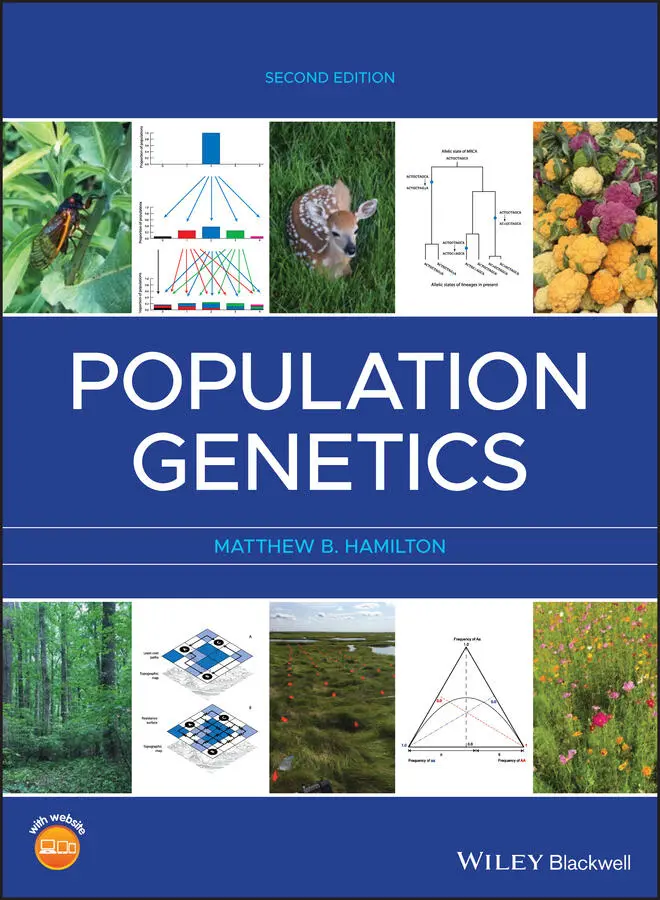
is the classic, accessible introduction to the concepts of population genetics. Combining traditional conceptual approaches with classical hypotheses and debates, the book equips students to understand a wide array of empirical studies that are based on the first principles of population genetics.
Featuring a highly accessible introduction to coalescent theory, as well as covering the major conceptual advances in population genetics of the last two decades, the second edition now also includes end of chapter problem sets and revised coverage of recombination in the coalescent model, metapopulation extinction and recolonization, and the fixation index.
Population Genetics — читать онлайн ознакомительный отрывок
Ниже представлен текст книги, разбитый по страницам. Система сохранения места последней прочитанной страницы, позволяет с удобством читать онлайн бесплатно книгу «Population Genetics», без необходимости каждый раз заново искать на чём Вы остановились. Поставьте закладку, и сможете в любой момент перейти на страницу, на которой закончили чтение.
Интервал:
Закладка:
| Probability | ||||||
|---|---|---|---|---|---|---|
| df | 0.5 | 0.25 | 0.10 | 0.05 | 0.01 | 0.001 |
| 1 | 0.4549 | 1.3233 | 2.7055 | 3.8415 | 6.6349 | 10.8276 |
| 2 | 1.3863 | 2.7726 | 4.6052 | 5.9915 | 9.2103 | 13.8155 |
| 3 | 2.3660 | 4.1083 | 6.2514 | 7.8147 | 11.3449 | 16.2662 |
| 4 | 3.3567 | 5.3853 | 7.7794 | 9.4877 | 13.2767 | 18.4668 |
| 5 | 4.3515 | 6.6257 | 9.2364 | 11.0705 | 15.0863 | 20.5150 |
Assuming Hardy–Weinberg to test alternative models of inheritance
Biologists are all probably familiar with the ABO blood group and are aware that mixing blood of different types can cause blood cell lysis and possibly result in death. Although we take this for granted now, there was a time when blood types and their patterns of inheritance defined an active area of clinical research. It was in 1900 that Karl Landsteiner of the University of Vienna mixed the blood of the people in his laboratory to study the patterns of blood cell agglutination (clumping). Landsteiner was awarded the Nobel Prize for Medicine in 1930 for his discovery of human ABO blood groups. Not until 1925, due to the research of Felix Bernstein, was the genetic basis of the ABO blood groups resolved (see Crow 1993a).
Landsteiner observed the presence of four blood phenotypes A, B, AB, and O. A logical question was then, “what is the genetic basis of these four blood group phenotypes?” We will test two hypotheses (or models) to explain the inheritance of ABO blood groups that coexisted for 25 years. The approach will use the frequency of genotypes in a sample population to test the two hypotheses rather than an approach such as examining pedigrees. The hypotheses are that the four blood group phenotypes are explained by either two independent loci with two alleles each with one allele completely dominant at each locus (hypothesis 1) or a single locus with three alleles where two of the alleles show no dominance with each other but both are completely dominant over a third allele (hypothesis 2). Throughout, we will assume that Hardy–Weinberg expected genotype frequencies are met in order to determine which hypothesis best fits the available data.
Our first task is a straightforward application of Hardy–Weinberg in order to determine the expected frequencies of the blood group genotypes. The genotypes and the expected genotype frequencies are shown in Table 2.6. Look at the table but cover up the expected frequencies with a sheet of paper. The genotypes given for the two hypotheses would both explain the observed pattern of four blood groups. Hypothesis 1 requires complete dominance of the A and B alleles at their respective loci. Hypothesis 2 requires A and B to have no dominance with each other but complete dominance when paired with the O allele.
Now, let's construct several of the expected genotype frequencies (before you lift that sheet of paper). The O blood group under hypothesis 1 is the frequency of a homozygous genotype at two loci (aa bb). The frequency of one homozygote is the square of the allele frequency: fa 2and fb 2if we use fx to indicate the frequency of allele x. Using the product rule or Mendel's second law, the expected frequency of the two‐locus genotype is the product of frequencies of the one‐locus genotypes, fa 2and fb 2. For the next genotype under hypothesis 1 (A_ bb), we use a little trick to simplify the amount of notation. The genotype A_ means AA or Aa: in other words, any genotype but aa. Since the frequencies of the three genotypes at one locus must sum to 1, we can write fA_ as 1 − faa or 1 − fa 2. Then, the frequency of the A_ bb genotype is (1 − fa 2)(fb) 2. You should now work out and write down the other six expected genotype frequency expressions: then lift the paper and compare your work with Table 2.6.
Table 2.6 Hardy–Weinberg expected genotype frequencies for the ABO blood groups under the hypotheses of 1) two loci with two alleles each, and 2) one locus with three alleles. Both hypotheses have the potential to explain the observation of four blood group phenotypes. The notation “fx” is used to refer to the frequency of allele x. The underscore (“_”) indicates any allele, for example, A_ means both AA and Aa genotypes. The observed blood type frequencies were determined for Japanese people living in Korea (from Berstein (1925) as reported in Crow (1993b)).
| Blood | Genotype | Expected genotype frequency | Observed | ||
|---|---|---|---|---|---|
| Type | Hypothesis 1 | Hypothesis 2 | Hypothesis 1 | Hypothesis 2 | (total = 502) |
| O | aa bb | OO | fa 2fb 2 | (fO) 2 | 148 |
| A | A_ bb | AA, AO | (1‐fa 2)(fb) 2 | fA 2+ 2fAfO | 212 |
| B | aa B_ | BB, BO | fa 2(1‐fb 2) | fB 2+ 2fBfO | 103 |
| AB | A_ B_ | AB | (1‐fa 2)(1‐fb 2) | 2fAfB | 39 |
The next step is to compare the expected genotype frequencies for the two hypotheses with observed genotype frequencies. To do this, we will need to estimate allele frequencies under each hypothesis and use these to compute the expected genotype frequencies. (Although these allele frequencies are parameter estimates, the “hat” notation is not used for readability.) For the hypothesis of two loci (hypothesis 1), fb 2= (148 + 212)/502 = 0.717, so we can estimate the allele frequency as fb = √fb 2= √0.717 = 0.847. The other allele frequency at that locus is then determined by subtraction fB = 1–0.847 = 0.153. Similarly, for the second locus fa 2= (148 + 103)/502 = 0.50 and fa = √fa 2= √0.50 = 0.707, giving fA = 1–0.707 = 0.293 by subtraction.
For the hypothesis of one locus with three alleles (hypothesis 2), we estimate the frequency of any of the alleles by using the relationship that the three allele frequencies sum to 1. This basic relationship can be reworked to obtain the expected genotype frequency expressions into expressions that allow us to estimate the allele frequencies (see Problem Box 2.2). It turns out that adding together all expected genotype frequency terms for two of the alleles estimates the square of one minus the other allele. For example, (1 − fB) 2= fO 2+ fA 2+ 2fAfO; and, checking in Table 2.7, this corresponds to (148 + 212)/502 = 0.717. Therefore, 1 − fB = 0.847 and fB = 0.153. Using similar steps, (1 − fA) 2= fO 2+ fB 2+ 2fBfO = (148 + 103)/502 = 0.50. Therefore, 1 – fA = 0.707 and fA = 0.293. Finally, by subtraction, fO = 1 − fB − fA = 1–0.153 − 0.293 = 0.554.
Problem box 2.2 Proving allele frequencies are obtained from expected genotype frequencies
Can you use algebra to prove that adding together expected genotype frequencies under hypotheses 1 and 2 in Table 2.7gives the allele frequencies shown in the text? For the genotypes of hypothesis 1, show that f(aa bb) + f(A_ bb) = fbb. For hypothesis 2, show the observed genotype frequencies that can be used to estimate the frequency of the B allele starting off with the relationship fA + fB + fO = 1 and then solving for fB in terms of fA and fO.
Table 2.7 Expected numbers of each of the four blood group genotypes under the hypotheses of 1) two loci with two alleles each, and 2) one locus with three alleles. Estimated allele frequencies are based on a sample of 502 individuals.
| Blood | Observed | Expected number of genotypes | Observed – Expected | (Observed – Expected) 2/Expected |
|---|---|---|---|---|
| Hypothesis 1: fA = 0.293, fa = 0.707, fB = 0.153, fb = 0.847 | ||||
| O | 148 | 502(0.707) 2(0.847) 2= 180.02 | −32.02 | 5.69 |
| A | 212 | 502(0.500)(0.847) 2= 180.07 | 31.93 | 5.66 |
| B | 103 | 502(0.707) 2(0.282) = 70.76 | 32.24 | 14.69 |
| AB | 39 | 502(0.500)(0.282) = 70.78 | −31.78 | 14.27 |
| Hypothesis 2: fA = 0.293, fB = 0.153, fO = 0.554 | ||||
| O | 148 | 502(0.554) 2= 154.07 | −6.07 | 0.24 |
| A | 212 | 502[(0.293) 2+ 2(0.293)(0.554)] = 206.07 | 5.93 | 0.17 |
| B | 103 | 502[(0.153) 2+ 2(0.153)(0.554)] = 96.85 | 6.15 | 0.39 |
| AB | 39 | 502[2(0.293)(0.153)] = 45.01 | −6.01 | 0.80 |
The number of genotypes under each hypothesis can then be found using the expected genotype frequencies in Table 2.6and the estimated allele frequencies. Table 2.7gives the calculation for the expected numbers of each genotype under both hypotheses. We can also calculate a chi‐squared value associated with each hypothesis based on the difference between the observed and expected genotype frequencies. For hypothesis 1, χ 2= 40.32, whereas, for hypothesis 2, χ 2= 1.60. Both of these tests have one degree of freedom (4 genotypes −2 for estimated allele frequencies −1 for the test), giving a critical value of χ 2 0.05,1= 3.84. Clearly, the hypothesis of three alleles at one locus is the better fit to the observed data. Thus, we have just used genotype frequency data sampled from a population with the assumptions of Hardy–Weinberg equilibrium as a means to distinguish between two hypotheses for the genetic basis of blood groups.
Читать дальшеИнтервал:
Закладка:
Похожие книги на «Population Genetics»
Представляем Вашему вниманию похожие книги на «Population Genetics» списком для выбора. Мы отобрали схожую по названию и смыслу литературу в надежде предоставить читателям больше вариантов отыскать новые, интересные, ещё непрочитанные произведения.










Обсуждение, отзывы о книге «Population Genetics» и просто собственные мнения читателей. Оставьте ваши комментарии, напишите, что Вы думаете о произведении, его смысле или главных героях. Укажите что конкретно понравилось, а что нет, и почему Вы так считаете.