Matthew B. Hamilton - Population Genetics
Здесь есть возможность читать онлайн «Matthew B. Hamilton - Population Genetics» — ознакомительный отрывок электронной книги совершенно бесплатно, а после прочтения отрывка купить полную версию. В некоторых случаях можно слушать аудио, скачать через торрент в формате fb2 и присутствует краткое содержание. Жанр: unrecognised, на английском языке. Описание произведения, (предисловие) а так же отзывы посетителей доступны на портале библиотеки ЛибКат.
- Название:Population Genetics
- Автор:
- Жанр:
- Год:неизвестен
- ISBN:нет данных
- Рейтинг книги:4 / 5. Голосов: 1
-
Избранное:Добавить в избранное
- Отзывы:
-
Ваша оценка:
Population Genetics: краткое содержание, описание и аннотация
Предлагаем к чтению аннотацию, описание, краткое содержание или предисловие (зависит от того, что написал сам автор книги «Population Genetics»). Если вы не нашли необходимую информацию о книге — напишите в комментариях, мы постараемся отыскать её.
is the classic, accessible introduction to the concepts of population genetics. Combining traditional conceptual approaches with classical hypotheses and debates, the book equips students to understand a wide array of empirical studies that are based on the first principles of population genetics.
Featuring a highly accessible introduction to coalescent theory, as well as covering the major conceptual advances in population genetics of the last two decades, the second edition now also includes end of chapter problem sets and revised coverage of recombination in the coalescent model, metapopulation extinction and recolonization, and the fixation index.
Population Genetics — читать онлайн ознакомительный отрывок
Ниже представлен текст книги, разбитый по страницам. Система сохранения места последней прочитанной страницы, позволяет с удобством читать онлайн бесплатно книгу «Population Genetics», без необходимости каждый раз заново искать на чём Вы остановились. Поставьте закладку, и сможете в любой момент перейти на страницу, на которой закончили чтение.
Интервал:
Закладка:
Assortative mating: Mating patterns where individuals do not mate in proportion to their genotype frequencies in the population; mating that is more (positive assortative mating) or less (negative assortative mating) frequent with respect to genotype or genetically based phenotype than expected by random combination.
Consanguineous mating: Mating between related individuals that can take the form of biparental inbreeding (mating between two related individuals) or sexual autogamy (self‐fertilization).
Fixation index (F): The proportion by which heterozygosity is reduced or increased relative to the heterozygosity in a randomly mating population with the same allele frequencies.
Let's work through an example of genotype data for one locus with two alleles that can be used to estimate the fixation index. Table 2.8gives observed counts and frequencies of the three genotypes in a sample of 200 individuals. To estimate the fixation index from these data requires an estimate of allele frequencies first. The allele frequencies can then be used to determine expected heterozygosity under the assumptions of Hardy–Weinberg. If p represents the frequency of the B allele,
(2.10) 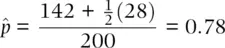
using the genotype counting method to estimate allele frequency ( Table 2.8uses the allele counting method). The frequency of the b allele, q , can be estimated directly in a similar fashion or by subtraction  since there are only two alleles in this case. The Hardy–Weinberg expected frequency of heterozygotes is
  . It is then simple to estimate the fixation index using the observed and expected heterozygosities.
(2.11) 
In this example, there is a clear deficit of heterozygotes relative to Hardy–Weinberg expectations. The population contains 59% fewer heterozygotes than would be expected in a population with the same allele frequencies that was experiencing random mating and the other conditions set out in the assumptions of Hardy–Weinberg. Interpreted as a correlation between the allelic states of the two alleles in a genotype, this value of the fixation index tells us that the two alleles in a genotype are much more frequently of the same state than expected by chance.
Table 2.8 Observed genotype counts and frequencies in a sample of N = 200 individuals for a single locus with two alleles. Allele frequencies in the population can be estimated from the genotype frequencies by summing the total count of each allele and dividing it by the total number of alleles in the sample (2 N ).
| Genotype | Observed | Observed frequency | Allele count | Allele frequency |
|---|---|---|---|---|
| BB | 142 | 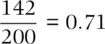 |
284 B |  |
| Bb | 28 | 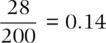 |
28 B, 28 b | |
| bb | 30 | 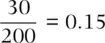 |
60 b | 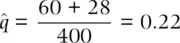 |
In biological populations, a wide range of values have been observed for the fixation index ( Table 2.9). Fixation indices have frequently been estimated with allozyme data (see Box 2.2). Estimates of  are generally correlated with mating system. Even in species where individuals possess reproductive organs of one sex only (termed dioeciousindividuals), mating among relatives can be common and ranges from infrequent to almost invariant. In other cases, mating is essentially random or complex mating and social systems have evolved to prevent consanguineous mating. Pure‐breed dogs are an example where mating among relatives has been enforced by humans to develop lineages with specific phenotypes and behaviors, resulting in high fixation indices in some breeds. Many plant species possess both male and female sexual functions (hermaphrodites) and exhibit an extreme form of consanguineous mating, self‐fertilization, that causes rapid loss of heterozygosity. In the case of Ponderosa pines in Table 2.9, the excess of heterozygotes may be due to natural selection against homozygotes at some loci (inbreeding depression). This makes the important point that departures from Hardy–Weinberg expected genotype frequencies estimated by the fixation index are potentially influenced by processes in addition to the mating system. Genetic loci free of the influence of other processes such as natural selection are often sought to estimate
  . In addition,
  can be estimated using the average of multiple loci, which will tend to reduce bias since loci will differ in the degree they are influenced by other processes and outliers will be apparent.
The fixation index can be understood as a measure of the correlation between the states of the two alleles in a diploid genotype. When F = 0 there is no correlation between the two alleles in a genotype, the states of the two alleles are independent as we expect under Mendel's first law. If F > 0 there is a positive correlation such that if one of the alleles in a genotype is an A, for example, then the other allele will have a correlated state and also be an A. When F < 0 there is a negative correlation between the states of the two alleles in a genotype and heterozygotes are more common since the two alleles tend to have different states.
Extending the fixation index to loci with more than two alleles requires a means to calculate the expected frequency of genotypes with identical alleles (or with non‐identical alleles) for an arbitrary number of alleles at one diploid locus. This can be accomplished by adding up all of the expected frequencies of each possible homozygous genotype and subtracting this total from 1 or summing the expected frequencies of all heterozygous genotypes:
Table 2.9 Estimates of the fixation index (  ) for various species based on pedigree or molecular genetic marker data.
Интервал:
Закладка:
Похожие книги на «Population Genetics»
Представляем Вашему вниманию похожие книги на «Population Genetics» списком для выбора. Мы отобрали схожую по названию и смыслу литературу в надежде предоставить читателям больше вариантов отыскать новые, интересные, ещё непрочитанные произведения.












Обсуждение, отзывы о книге «Population Genetics» и просто собственные мнения читателей. Оставьте ваши комментарии, напишите, что Вы думаете о произведении, его смысле или главных героях. Укажите что конкретно понравилось, а что нет, и почему Вы так считаете.