John O'Brien - Earth Materials
Здесь есть возможность читать онлайн «John O'Brien - Earth Materials» — ознакомительный отрывок электронной книги совершенно бесплатно, а после прочтения отрывка купить полную версию. В некоторых случаях можно слушать аудио, скачать через торрент в формате fb2 и присутствует краткое содержание. Жанр: unrecognised, на английском языке. Описание произведения, (предисловие) а так же отзывы посетителей доступны на портале библиотеки ЛибКат.
- Название:Earth Materials
- Автор:
- Жанр:
- Год:неизвестен
- ISBN:нет данных
- Рейтинг книги:5 / 5. Голосов: 1
-
Избранное:Добавить в избранное
- Отзывы:
-
Ваша оценка:
Earth Materials: краткое содержание, описание и аннотация
Предлагаем к чтению аннотацию, описание, краткое содержание или предисловие (зависит от того, что написал сам автор книги «Earth Materials»). Если вы не нашли необходимую информацию о книге — напишите в комментариях, мы постараемся отыскать её.
Earth Materials,
Earth Materials,
Earth Materials — читать онлайн ознакомительный отрывок
Ниже представлен текст книги, разбитый по страницам. Система сохранения места последней прочитанной страницы, позволяет с удобством читать онлайн бесплатно книгу «Earth Materials», без необходимости каждый раз заново искать на чём Вы остановились. Поставьте закладку, и сможете в любой момент перейти на страницу, на которой закончили чтение.
Интервал:
Закладка:
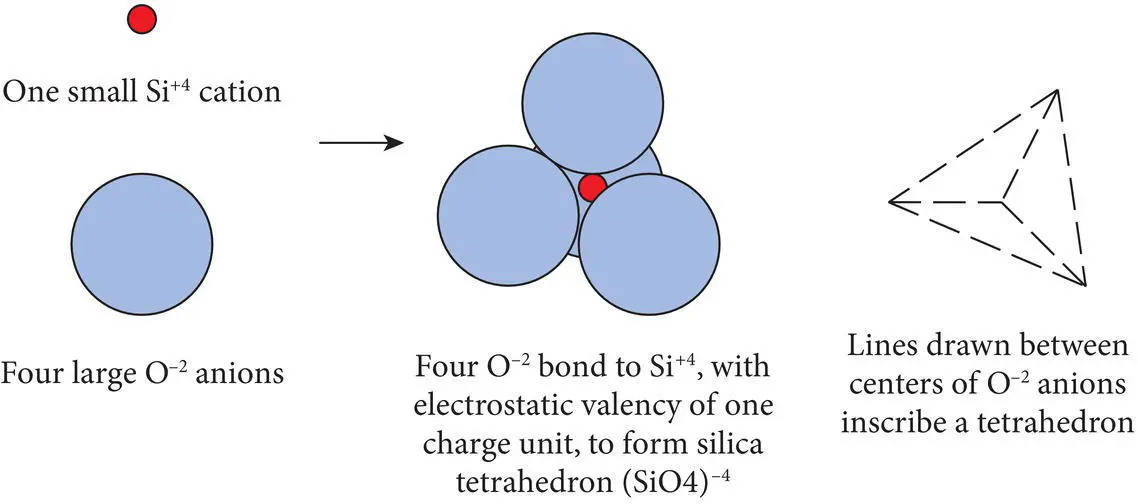
Figure 2.20 A silica tetrahedron is formed when four oxygen ions (O −2) bond to one silicon ion (Si +4) in the form of a tetrahedron. The electrostatic valency of each silicon–oxygen bond in the silica tetrahedron is one charge unit, which fully neutralizes the charge on the central silicon ion (four = four), while leaving the charge on the oxygen ions only partially neutralized (one is one‐half of two).
Table 2.7 Mineral classification based on the major anion groups.
| Mineral group | Major anion groups | Mineral group | Major anion groups |
|---|---|---|---|
| Native elements | None | Nitrates | (NO 3) −1 |
| Halides | F −1, Cl −1, Br −1 | Borates | (BO 3) −3and (BO 4) −5 |
| Sulfides | S −2, S −4 | Sulfates | (SO 4) −2 |
| Arsenides | As −2, As −3 | Phosphates | (PO 4) −3 |
| Sulfarsendies | As −2 orAs −3and S −2 orS −4 | Chromates | (CrO4) −5 |
| Selenides | Se −2 | Arsenates | (AsO 4) −3 |
| Tellurides | Te −2 | Vanadates | (VO 4) −3 |
| Oxides | O −2 | Molybdates | (MO 4) −2 |
| Hydroxides | (OH) −1 | Tungstates | (WO 4) −2 |
| Carbonates | (CO 3) −2 | Silicates | (SiO 4) −4 |
Oxygen (O) and silicon (Si) are the two most abundant elements in Earth's continental crust, oceanic crust and mantle. Under the relatively low pressure conditions that exist in the crust and the upper mantle, the most abundant rock‐forming minerals ( Chapter 5) are silicate minerals. Silicate minerals, characterized by the presence of silicon and oxygen that have bonded together to form silica tetrahedra, are utilized here to show how coordination polyhedra are linked to produce larger structures with the potential for the long‐range order characteristic of all minerals.
2.5.1 The basics: silica tetrahedral linkage
Silica tetrahedra are composed of a single, small, tetravalent silicon ion (Si +4) in fourfold, tetrahedral coordination with four larger, divalent oxygen ions (O −2).These silica tetrahedra may be thought of as the basic building blocks, the LEGO®, of silicate minerals. Because the electrostatic valency of each of the four Si–O bonds in the tetrahedron is one (EV = 1), the +4 charge of the silicon ion is effectively neutralized. However, the −2 charges on the oxygen (O −2) ions are not neutralized. Each oxygen ion possesses an unsatisfied charge of −1 which it can only neutralize by bonding with one or more additional cations in the mineral structure. Essentially, as a crystal forms, oxygen anions can bond to another silicon (Si +4) ion to form a second bond with an electrostatic valency of 1 or it can bond to some other combination of cations (e.g., Al +3, Mg +2, Fe +2, Ca +2, K +1, Na +1) with a total electrostatic valency of 1.
Many factors influence the type of silica tetrahedral structure that develops when silicate minerals form; the most important is the relative availability of silicon and other cations in the environment in which the mineral crystallizes. Environments with abundant silicon (and therefore silica tetrahedra) tend to favor the linkage of silica tetrahedra through shared oxygen ions. Environments depleted in silicon tend to favor the linkage of the oxygen ions in silica tetrahedra to cations other than silicon. In such situations, silica tetrahedra tend to link to coordination polyhedral elements other than silica tetrahedra.
If none of the oxygen ions in a silica tetrahedron bond to other silicon ions in adjacent tetrahedra, the silica tetrahedron will occur as an isolated tetrahedral unit in the mineral structure. If all the oxygen ions in a silica tetrahedron bond to other silicon ions of adjacent tetrahedra, the silica tetrahedra form a three‐dimensional framework structure. If some of the oxygen ions in the silica tetrahedra are bonded to silicon ions in adjacent tetrahedra and others are bonded to other cations in adjacent coordination polyhedra, a structure that is intermediate between totally isolated silica tetrahedra and three‐dimensional frameworks of silica tetrahedra will develop.
Six major silicate groups ( Figure 2.21) are distinguished based upon the linkage patterns of silica tetrahedra. These are: (1) nesosilicates, (2) sorosilicates, (3) cyclosilicates, (4) inosilicates, (5) phyllosilicates, and (6) tectosilicates. Nesosilicates(“island” silicates) are characterized by isolated silica tetrahedra that are not linked to other silica tetrahedra through shared oxygen ions. Sorosilicates(“bow‐tie” silicates) contain pairs of silica tetrahedra linked through shared oxygen ions. In cyclosilicates(“ring” silicates), each silica tetrahedron is linked to two other tetrahedra through shared oxygen ions into ring‐shaped structural units. In single‐chain inosilicates,each silica tetrahedron is linked through shared oxygen anions to two other silica tetrahedra in the form of a long, one‐dimensional chain‐like structure. When two chains are linked through shared oxygen anions a double‐chain inosilicatestructure is formed. When chains are “infinitely” linked to one another through shared oxygen anions, a two‐dimensional sheet of linked silica tetrahedra is formed which is the basic structural unit of phyllosilicates(“sheet” silicates). Finally, when silica tetrahedra are linked to adjacent silica tetrahedra by sharing all four oxygen anions, a three‐dimensional framework of linked silica tetrahedra results, which is the basic structure of tectosilicates(“framework” silicates).
Because the silicate groups constitute the most significant rock‐forming minerals in Earth's crust and upper mantle they are discussed more fully in Chapter 5. In Chapter 3, we will further investigate significant aspects of mineral chemistry, including substitution solid solution and the uses of isotopes and phase stability diagrams in understanding Earth materials.
CONTENT ASSESSMENT
1 Explain the difference between:An isotope and an ion.A cation and an anion and the reason the latter two types of ions exist.A stable isotope and an unstable isotope and how the latter evolve through time.
2 Detail the major factors that determine the effective radii of different atoms and ions.
3 What is the diagonal rule and how does it help to predict the electron configuration of most major elements whose atomic number is known? Use the diagonal rule to write the “ground state” electron configurations for the following elements.(a) Figure 2.21 Major silicate structures: (a) nesosilicate, (b) sorosilicate, (c) cyclosilicate, (d) single‐chain inosilicate, (e) double chain inosilicate, (f) phyllosilicate, (g) tectosilicate.Source: Wenk and Bulakh (2004). © Cambridge University Press.helium (H)carbon (C)oxygen (O)aluminum (Al)argon (Ar)iron (Fe).
4 Referring to the periodic table of the elements ( Table 2.3), which of the reactive (non‐Noble) elements is the most metallic (electropositive) and which of these is the most nonmetallic (electronegative). Use their electron configurations and position on the periodic table to explain why.
5 Explain the differences between ionic, covalent, metallic, and transitional (hybrid) bonds and the properties that commonly characterize materials that possess that type of bond.
Читать дальшеИнтервал:
Закладка:
Похожие книги на «Earth Materials»
Представляем Вашему вниманию похожие книги на «Earth Materials» списком для выбора. Мы отобрали схожую по названию и смыслу литературу в надежде предоставить читателям больше вариантов отыскать новые, интересные, ещё непрочитанные произведения.










Обсуждение, отзывы о книге «Earth Materials» и просто собственные мнения читателей. Оставьте ваши комментарии, напишите, что Вы думаете о произведении, его смысле или главных героях. Укажите что конкретно понравилось, а что нет, и почему Вы так считаете.