John O'Brien - Earth Materials
Здесь есть возможность читать онлайн «John O'Brien - Earth Materials» — ознакомительный отрывок электронной книги совершенно бесплатно, а после прочтения отрывка купить полную версию. В некоторых случаях можно слушать аудио, скачать через торрент в формате fb2 и присутствует краткое содержание. Жанр: unrecognised, на английском языке. Описание произведения, (предисловие) а так же отзывы посетителей доступны на портале библиотеки ЛибКат.
- Название:Earth Materials
- Автор:
- Жанр:
- Год:неизвестен
- ISBN:нет данных
- Рейтинг книги:5 / 5. Голосов: 1
-
Избранное:Добавить в избранное
- Отзывы:
-
Ваша оценка:
Earth Materials: краткое содержание, описание и аннотация
Предлагаем к чтению аннотацию, описание, краткое содержание или предисловие (зависит от того, что написал сам автор книги «Earth Materials»). Если вы не нашли необходимую информацию о книге — напишите в комментариях, мы постараемся отыскать её.
Earth Materials,
Earth Materials,
Earth Materials — читать онлайн ознакомительный отрывок
Ниже представлен текст книги, разбитый по страницам. Система сохранения места последней прочитанной страницы, позволяет с удобством читать онлайн бесплатно книгу «Earth Materials», без необходимости каждый раз заново искать на чём Вы остановились. Поставьте закладку, и сможете в любой момент перейти на страницу, на которой закончили чтение.
Интервал:
Закладка:
This simple picture of transitional ionic–covalent bonding does not hold in bonds that involve transition metals. For example, the mineral galena (PbS) has properties that suggest its bonding is transitional between metallic and ionic. In this case some electrons are partially transferred from lead (Pb) to sulfur (S) in the manner characteristic of ionically bonded substances, but some electrons are weakly held in the manner characteristic of metallic bonds. As a result, galena displays both ionic properties (brittle and somewhat soluble) and metallic properties (soft, opaque and a metallic luster). Figure 2.16utilizes a triangle, with pure covalent, ionic and metallic bonds at the apices, to depict the pure and transitional bonding characteristic of selected minerals, including those discussed above.
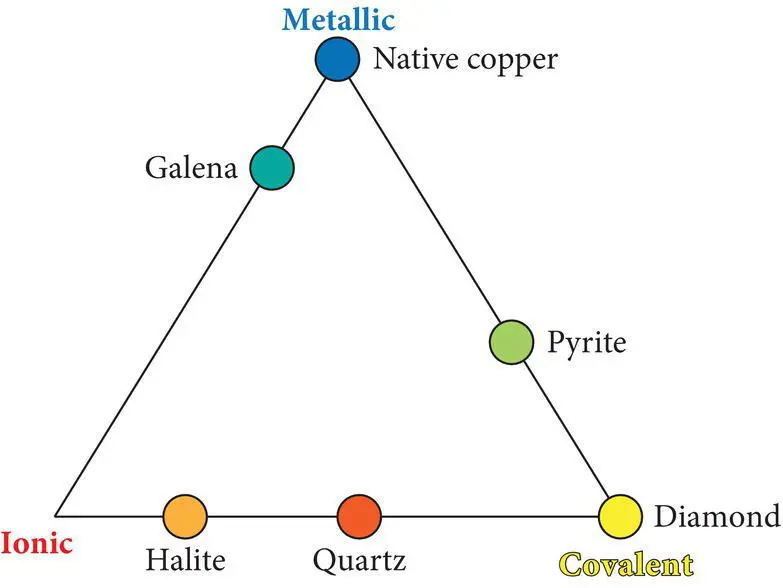
Figure 2.16 Triangular diagram representing the bond types of some common minerals.
2.3.6 Van der Waals and hydrogen bonds
Because the distributions of electrons in the electron cloud are probabilistic and constantly changing, they may be, at any moment, asymmetrically distributed within the electron cloud. This asymmetry gives rise to weak electric dipoles on the surface of the electron cloud; areas of excess negative charge concentration where the electrons are located and areas of negative charge deficit (momentary positive charge) where they are absent. Areas of momentary positive charge on one atom attract electrons in an adjacent atom, thus inducing a dipole in that atom. The areas of excess negative charge on one atom are attracted to the areas of positive charge on an adjacent atom to form a very weak bond that holds the atoms together ( Figure 2.17). Bonds that result from weak electric dipole forces that are caused by the asymmetrical distribution of electrons in the electron cloud are called van der Waals bonds.The presence of very weak van der Waals bonds helps to explain why minerals such as graphite and talc are extremely soft and have a “greasy” feel ( Chapter 5).
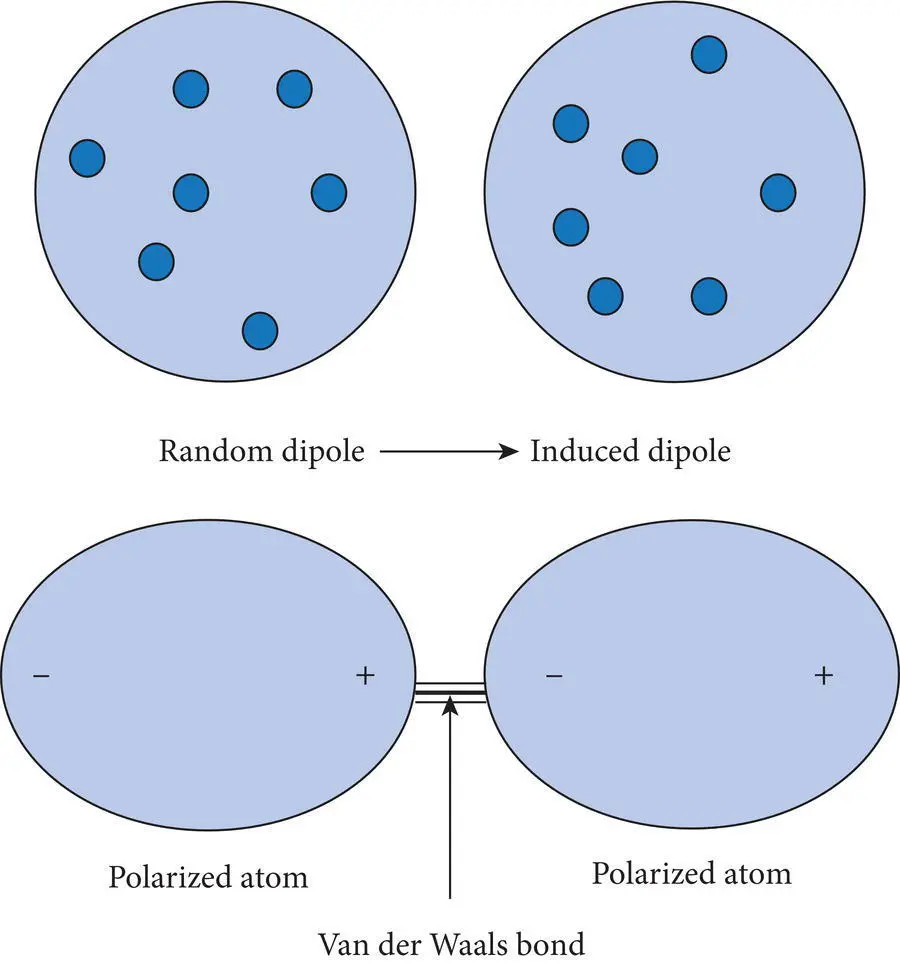
Figure 2.17 Van der Waals bonding occurs when one atom becomes dipolar as the result of the random concentration of electrons in one region of an atom. The positively charged region of the atom attracts electrons in an adjacent atom causing it to become dipolar. Oppositely charged portions of adjacent dipolar atoms are attracted creating a weak van der Waals bond. Larger structures result from multiple bonds.

Figure 2.18 Diagram showing two water molecules joined by a hydrogen bond that links the hydrogen in one molecule to the oxygen in the other molecule.
Hydrogen bondsexist between electropositive hydrogen and electronegative ions such as oxygen in molecules such as water or hydroxyl ions. Because of the profound importance of water (H 2O) and hydroxyl ion (OH −1), in both organic and inorganic compounds, this type of bond has been given its own separate designation ( Figure 2.18). Hydrogen bonds are relatively weak bonds that occur in hydrated (water‐bearing) or hydroxide (hydroxyl‐bearing) minerals.
Atoms are held together by a variety of chemical bonds. The type of bond that forms depends largely on the electron configurations of the combining elements, as expressed by their electronegativities, although environmental factors also play a role. Each bond type imparts certain sets of properties to Earth materials that contain those bonds. In the following section we will discuss factors that determine the three‐dimensional properties of the molecular units that result from such bonding. In Chapter 4we will elaborate on the long‐range crystalline structures that form when these molecular units combine to produce crystals. Remember: it all starts with atoms, their electron properties and the way they bond together to produce crystals.
2.4 PAULING'S RULES AND COORDINATION POLYHEDRA
2.4.1 Pauling's rules and radius ratios
Linus Pauling (1929) established five rules, now called Pauling's rules, which describe cation–anion relationships in ionically bonded substances and are paraphrased below:
Rule 1: A polyhedron of anions is formed about each cation, with the distance between a cation and an anion determined by the sum of their radii (radius sum). The number of coordinated anions in the polyhedron is determined by the cation : anion radius ratio.
Rule 2: An ionic structure is stable when the sum of the strengths of all the bonds that join the cation to the anions in the polyhedron equals (balances) the charge on the cations and on the anions. This rule is called the electrostatic valency rule.
Rule 3: The sharing of edges and particularly faces by adjacent anion polyhedral elements decreases the stability of an ionic structure. Similar charges tend to repel. If they share components, adjacent polyhedra tend to share corners, rather than edges, to maximize cation spacing.
Rule 4: Cations with high valence charges and small coordination number tend not to share polyhedral elements. Their large positive charges tend to repel.
Rule 5: The number of different cations and anions in a crystal structure tends to be small. This is called the rule of parsimony.
Pauling's rules provide important tools for understanding crystal structures. Especially important is the rule concerning radius ratio and coordination polyhedra. Coordination polyhedra provide a powerful means for visualizing crystal structures and their relationship to crystal chemistry. In fact, they provide a fundamental link between the two. When atoms and ions combine to form crystals, they bond together into geometric patterns in which each atom or ion is bonded to a number of nearest neighbors. The number of nearest neighbor ions or atoms is called the coordination number (CN). Clusters of atoms or ions bonded to other coordinating atoms produce coordination polyhedronstructures. Polyhedrons include triangles, cubes, octahedra, tetrahedra, and other geometric forms.
When ions of opposite charge combine to form minerals, each cation attracts as many nearest neighbor anions as can fit around it as approximate “spheres in contact”. In this way, the basic units of crystal structure are formed which grow into crystals as multiples of such units are added to the existing structure. One can visualize crystal structures in terms of different coordinating cations and coordinated anions that together define a simple three‐dimensional polyhedron structure. As detailed in Chapters 3and 4, complex polyhedral structures develop by linking of multiple coordination polyhedra.
The number of nearest neighbor anions that can be coordinated with a single cation “as spheres in contact” depends on the radius ratio (RR = Rc/Ra)which is the radius of the smaller cation (Rc) divided by the radius of the larger anion (Ra). For very small, highly charged cations coordinated with much larger, highly charged anions, the radius ratio (RR) and the coordination number (CN) are small. This is analogous to fitting basketballs as spheres in contact around a small marble. Only two basketballs can fit as spheres in contact with the marble. For cations of smaller charge coordinated with anions of smaller charge, the coordination number is larger. This is analogous to fitting golf balls around a larger marble. One can fit a larger number of golf balls around a large marble as spheres in contact because the radius ratio is larger.
Читать дальшеИнтервал:
Закладка:
Похожие книги на «Earth Materials»
Представляем Вашему вниманию похожие книги на «Earth Materials» списком для выбора. Мы отобрали схожую по названию и смыслу литературу в надежде предоставить читателям больше вариантов отыскать новые, интересные, ещё непрочитанные произведения.










Обсуждение, отзывы о книге «Earth Materials» и просто собственные мнения читателей. Оставьте ваши комментарии, напишите, что Вы думаете о произведении, его смысле или главных героях. Укажите что конкретно понравилось, а что нет, и почему Вы так считаете.