John O'Brien - Earth Materials
Здесь есть возможность читать онлайн «John O'Brien - Earth Materials» — ознакомительный отрывок электронной книги совершенно бесплатно, а после прочтения отрывка купить полную версию. В некоторых случаях можно слушать аудио, скачать через торрент в формате fb2 и присутствует краткое содержание. Жанр: unrecognised, на английском языке. Описание произведения, (предисловие) а так же отзывы посетителей доступны на портале библиотеки ЛибКат.
- Название:Earth Materials
- Автор:
- Жанр:
- Год:неизвестен
- ISBN:нет данных
- Рейтинг книги:5 / 5. Голосов: 1
-
Избранное:Добавить в избранное
- Отзывы:
-
Ваша оценка:
Earth Materials: краткое содержание, описание и аннотация
Предлагаем к чтению аннотацию, описание, краткое содержание или предисловие (зависит от того, что написал сам автор книги «Earth Materials»). Если вы не нашли необходимую информацию о книге — напишите в комментариях, мы постараемся отыскать её.
Earth Materials,
Earth Materials,
Earth Materials — читать онлайн ознакомительный отрывок
Ниже представлен текст книги, разбитый по страницам. Система сохранения места последней прочитанной страницы, позволяет с удобством читать онлайн бесплатно книгу «Earth Materials», без необходимости каждый раз заново искать на чём Вы остановились. Поставьте закладку, и сможете в любой момент перейти на страницу, на которой закончили чтение.
Интервал:
Закладка:
Source : Courtesy of Steve Dutch.
The best known mineral with covalent bonding is diamond ,which is composed of carbon (C). Because carbon is a column 14 atom, it must either lose four electrons or gain four electrons to achieve a stable electron configuration. In diamond, each carbon atom in the structure is bonded to four nearest neighbor carbon atoms that share with it one of their electrons ( Figure 2.13). In this way, each carbon atom attracts four additional electrons, one from each of its neighbors, to achieve the stable noble electron configuration. The long‐range crystal structure of diamond is a pattern of carbon atoms in which every carbon atom is covalently bonded to four other carbon atoms.
Covalently bonded minerals are generally characterized by the following:
1 Hard and brittle at room temperature.
2 Insoluble in polar substances such as water.
3 Crystallize from melts.
4 Moderate to high melting temperatures.
5 Absorb very little light, producing transparent to translucent minerals with light colors and vitreous to sub‐vitreous lusters in macroscopic crystals.
2.3.4 Metallic bonds
When metallic atoms bond with other metallic atoms, a metallic bondis formed. Because very metallic atoms have low first ionization energies, are highly electropositive and possess low electronegativities they do not tend to hold their valence electrons strongly. In such situations, each atom releases valence electrons to achieve a stable electron configuration. The positions of the valence electrons fluctuate or migrate between atoms. Metallic bonding is difficult to model, but is usually portrayed as positively charged partial atoms (nuclei plus the strongly held inner electrons) in a matrix or “gas” of “delocalized” valence electrons that are only temporarily associated with individual atoms ( Figure 2.14). The weak attractive forces between positive partial atoms and valence electrons bond the atoms together. Unlike the strong electron‐sharing bonds of covalently bonded substances, or the frequently strong electrostatic bonds of ionically bonded substances, metallic bonds are rather weak, less permanent and easily broken and reformed. Because the valence electrons are not strongly held by any of the partial atoms, they are easily moved in response to stress or in response to an electric field or thermal gradient.
Excellent examples of metallic bonding exist in the native metals such as native gold (Au), native silver (Ag), and native copper (Cu). Such materials are excellent conductors of electricity and heat. When materials with metallic bonds are subjected to an electric potential or field, delocalized electrons flow toward the positive anode, which creates and maintains a strong electric current. Similarly, when a thermal gradient exists, thermal vibrations are transferred by delocalized electrons, making such materials excellent heat conductors. When metals are stressed, the weakly held electrons tend to flow, which helps to explain the ductile behavior that characterizes native copper, silver, gold, and other metallically bonded substances.
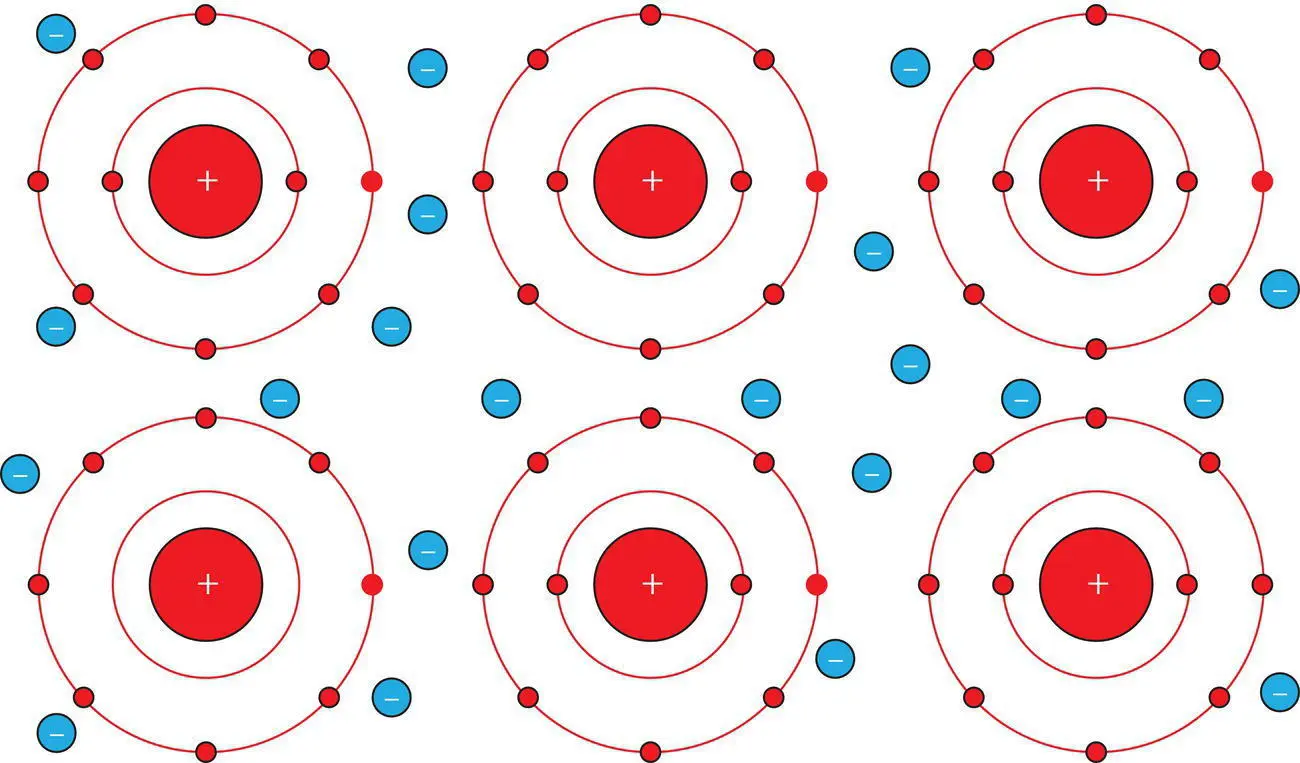
Figure 2.14 A model of metallic bonds with delocalized electrons (dark red) surrounding positive charge centers that consist of tightly held lower energy electrons (light red dots) surrounding individual nuclei (blue).
Minerals containing metallic bonds are generally characterized by the following features:
1 Fairly soft to moderately hard minerals.
2 Deform plastically; malleable and ductile.
3 Excellent electrical and thermal conductors.
4 Frequently high specific gravity.
5 Excellent absorbers and reflectors of light; so are commonly opaque with a metallic luster in macroscopic crystals.
2.3.5 Transitional (hybrid) bonds
Transitionalor hybrid bondsdisplay combinations of ionic, covalent and/or metallic bond behavior. Some transitional bonds can be modeled as ionic–covalent transitional, others as ionic–metallic or covalent–metallic transitional. A detailed discussion of all the possibilities is beyond the scope of this book, but because most bonds in Earth materials are transitional, it is a subject worthy of mention. The following discussion also serves to illustrate once again the enigmatic behavior of which electrons are capable.
Earlier in this chapter, we defined electronegativity in relation to the periodic table. Linus Pauling developed the concept of electronegativity (En) to help model transitional ionic–covalent bonds. In models of such bonds, electrons are partially transferred from the more metallic, more electropositive element to the less metallic, more electronegative element to produce a degree of ionization and electrostatic attraction typical of ionic bonding. At the same time, the electrons are partially shared between the two elements to produce a degree of electron sharing associated with covalent bonding. Such bonds are best modeled as hybrids or transitions between ionic and covalent bonds. Materials that possess such bonds commonly display properties that are transitional between those of ionically bonded substances and those of covalently bonded substances. Using the electronegativity difference– the difference between the electronegativities of the two elements sharing the bond – Pauling was able to predict the percentages of covalent and ionic bonding, that is, the percentages of electron sharing and electron transfer that characterize ionic–covalent transitional bonds. Figure 2.15illustrates the relationship between electronegativity difference and the percentages of ionic and covalent bond character that typify the transitional ionic–covalent bonds.
Where electronegativity differences in transitional ionic–covalent bonds are smaller than 1.68, the bonds are primarily electron‐sharing covalent bonds. Where electronegativity differences are larger than 1.68, the bonds are primarily electron‐transfer ionic bonds. Calculations of electronegativity and bond type lead to some interesting conclusions. For example, when an oxygen atom with En = 3.44 bonds with another oxygen atom with En = 3.44 to form O 2, the electronegativity difference (3.44 − 3.44 = 0.0) is zero and the resulting bond is 100% covalent. The valence electrons are completely shared by the two oxygen atoms. This will be the case whenever two highly electronegative, nonmetallic atoms of the same element bond together. On the other hand, when highly electronegative, nonmetallic atoms bond with strongly electropositive, metallic elements to form ionically bonded substances, the bond is never purely ionic. There is always at least a small degree of electron sharing and covalent bonding. For example, when sodium (Na) with En = 0.93 bonds with chlorine (Cl) with En = 3.6 to form sodium chloride (NaCl), the electronegativity difference (3.6 − 0.93 = 2.67) is 2.67 and the bond is only 83% ionic and 17% covalent. Although the valence electrons are largely transferred from sodium to chloride and the bond is primarily electrostatic (ionic), a degree of electron sharing (covalent bonding) exists. Even in this paradigm of ionic bonding, electron transfer is incomplete and a degree of electron sharing occurs. The bonding between silicon (Si) and oxygen (O), so important in silicate minerals, is very close to the perfect hybrid since the electronegativity difference is 3.44 − 1.90 = 1.54 and the bond is 45% ionic and 55% covalent.

Figure 2.15 Graph showing the electronegativity difference and bond type in covalent–ionic bonds. Percent covalent bonding is indicated by the black line and percent ionic bonding by the blue line.
Читать дальшеИнтервал:
Закладка:
Похожие книги на «Earth Materials»
Представляем Вашему вниманию похожие книги на «Earth Materials» списком для выбора. Мы отобрали схожую по названию и смыслу литературу в надежде предоставить читателям больше вариантов отыскать новые, интересные, ещё непрочитанные произведения.










Обсуждение, отзывы о книге «Earth Materials» и просто собственные мнения читателей. Оставьте ваши комментарии, напишите, что Вы думаете о произведении, его смысле или главных героях. Укажите что конкретно понравилось, а что нет, и почему Вы так считаете.