John O'Brien - Earth Materials
Здесь есть возможность читать онлайн «John O'Brien - Earth Materials» — ознакомительный отрывок электронной книги совершенно бесплатно, а после прочтения отрывка купить полную версию. В некоторых случаях можно слушать аудио, скачать через торрент в формате fb2 и присутствует краткое содержание. Жанр: unrecognised, на английском языке. Описание произведения, (предисловие) а так же отзывы посетителей доступны на портале библиотеки ЛибКат.
- Название:Earth Materials
- Автор:
- Жанр:
- Год:неизвестен
- ISBN:нет данных
- Рейтинг книги:5 / 5. Голосов: 1
-
Избранное:Добавить в избранное
- Отзывы:
-
Ваша оценка:
Earth Materials: краткое содержание, описание и аннотация
Предлагаем к чтению аннотацию, описание, краткое содержание или предисловие (зависит от того, что написал сам автор книги «Earth Materials»). Если вы не нашли необходимую информацию о книге — напишите в комментариях, мы постараемся отыскать её.
Earth Materials,
Earth Materials,
Earth Materials — читать онлайн ознакомительный отрывок
Ниже представлен текст книги, разбитый по страницам. Система сохранения места последней прочитанной страницы, позволяет с удобством читать онлайн бесплатно книгу «Earth Materials», без необходимости каждый раз заново искать на чём Вы остановились. Поставьте закладку, и сможете в любой момент перейти на страницу, на которой закончили чтение.
Интервал:
Закладка:
Column 2 (IIA) metals are the only elements with only two electrons in their highest quantum levels in their electrically neutral states. Column 2 (IIA) elements achieve stability by the removal of two s‐electrons from the outer electron shell to become divalent (+2) cations.
Columns 3–12 (IIIB through IIB) transition elements are situated in the middle of the periodic table. Column 3 (IIIB) elements tend to occur as trivalent (+3) cations by giving up three of their electrons (s2, d1) to achieve a stable electron configuration. The other groups of transition elements, from column 4 (IVB) through column 12 (IIB) are cations that occur in a variety of ionization states. Depending on the chemical reaction in which they are involved, these elements can give up as few as one s‐electron as in Cu+1, Ag+1, and Au+1 or as many as six or seven electrons, two s‐electrons, and four or five d‐electrons as in Cr+6, W+6, and Mn+7. An excellent example of the variable ionization of a transition metal is iron (Fe). In environments where oxygen is relatively scarce, iron commonly gives up two electrons to become Fe+2 or ferrous iron. In other environments, especially those where oxygen is abundant, iron gives up three electrons to become smaller Fe+3 or ferric iron.
Column 13 (IIIA) elements such as Al+3 commonly exist as trivalent (+3) cations by losing three electrons (s2, p1).
Column 14 (IVA) elements such as Si+4 commonly exist as tetravalent (+4) cations by losing four electrons. The behavior of the heavier elements in this group is somewhat more variable than in those groups discussed previously. It depends on the chemical reaction in which the elements are involved. Tin (Sn) and lead (Pb) behave in a similar manner to silicon and germanium in some chemical reactions, but in other reactions they only lose the two s‐electrons in the highest principal quantum level to become divalent cations.
Column 15 (VA) elements commonly have a wide range of ionization states from tetravalent (+5) cations through trivalent (−3) anions. These elements are not particularly electropositive, nor are they especially electronegative. Their behavior depends on the other elements in the chemical reaction in which they are involved. For example, in some chemical reactions, with electropositive elements, nitrogen attracts three additional electrons to become the trivalent anion N−3. In other chemical reactions, with electronegative elements, nitrogen releases as many as five electrons in the second principal quantum level to become the pentavalent cation N+5. In still other situations, nitrogen gives up or attracts smaller numbers of electrons to form a cation or anion of smaller charge. All the other elements in group VA exhibit analogous situational ionization behaviors. Phosphorous, arsenic, antimony and bismuth all have ionic states that range from +5 to −3.
Column 16 (VIA) nonmetallic elements commonly exist as divalent (−2) anions. These elements attract two additional electrons into their highest principal quantum levels to achieve a stable electron configuration. For example, oxygen adds two electrons to become the divalent anion O−2. With the exception of oxygen, however, the column 16 elements display other ionization states as well, especially when they react chemically with oxygen, as will be discussed later in this chapter. Sulfur and the other VIA elements are also quite electronegative, with strong electron affinities, so that they tend to attract two electrons to achieve a stable configuration and become divalent anions such as S−2. However, in the presence of highly electronegative oxygen these elements may lose electrons and become cations such as S+6.
Column 17 (VIIA) nonmetallic elements such as Cl− and F−1 commonly exist as monovalent (−1) anions. Because electrons are very difficult to remove from their electron clouds, these elements tend to attract one additional electron into their highest principal quantum level to achieve a stable electron configuration.
Column 18 (VIIIA) noble gas elements such as He, Ar, and Ne contain complete outer electron shells (s2, p6) and do not commonly combine with other elements to form minerals. Instead, they tend to exist as monatomic (composed of single atoms) gases.
The periodic table is a highly visual and logical way in which to illustrate patterns in the electron configurations of the elements. Elements are grouped in rows or classes according to the highest principal quantum level in which electrons occur in the ground state. Elements are grouped into columns or groups based on similarities in the electron configurations in the higher principal quantum levels; those that are farthest from the nucleus and involved in most chemical reactions. More thorough explanations of the periodic table and the properties of elements are available in many standard texts in chemistry and physics.
From the discussion above, it should be clear that during the chemical reactions that produce Earth materials, elements display behaviors that are related to their electron configurations. Group 18 (VIIIA) elements in the far right column of the periodic table have stable electron configurations and tend to exist as uncharged atoms. Metallic elements toward the left side of the periodic table are strongly electropositive and tend to give up one or more electrons to become positively charged particles called cations. Nonmetallic elements toward the right side of the periodic table, especially in groups 16 (VIA) and 17 (VIIA), are strongly electronegative and tend to attract electrons to become negatively charged particles called anions. Elements toward the middle of the periodic table are somewhat electropositive and tend to lose various numbers of electrons to become cations with various amounts of positive charge. These tendencies are summarized in Table 2.4.
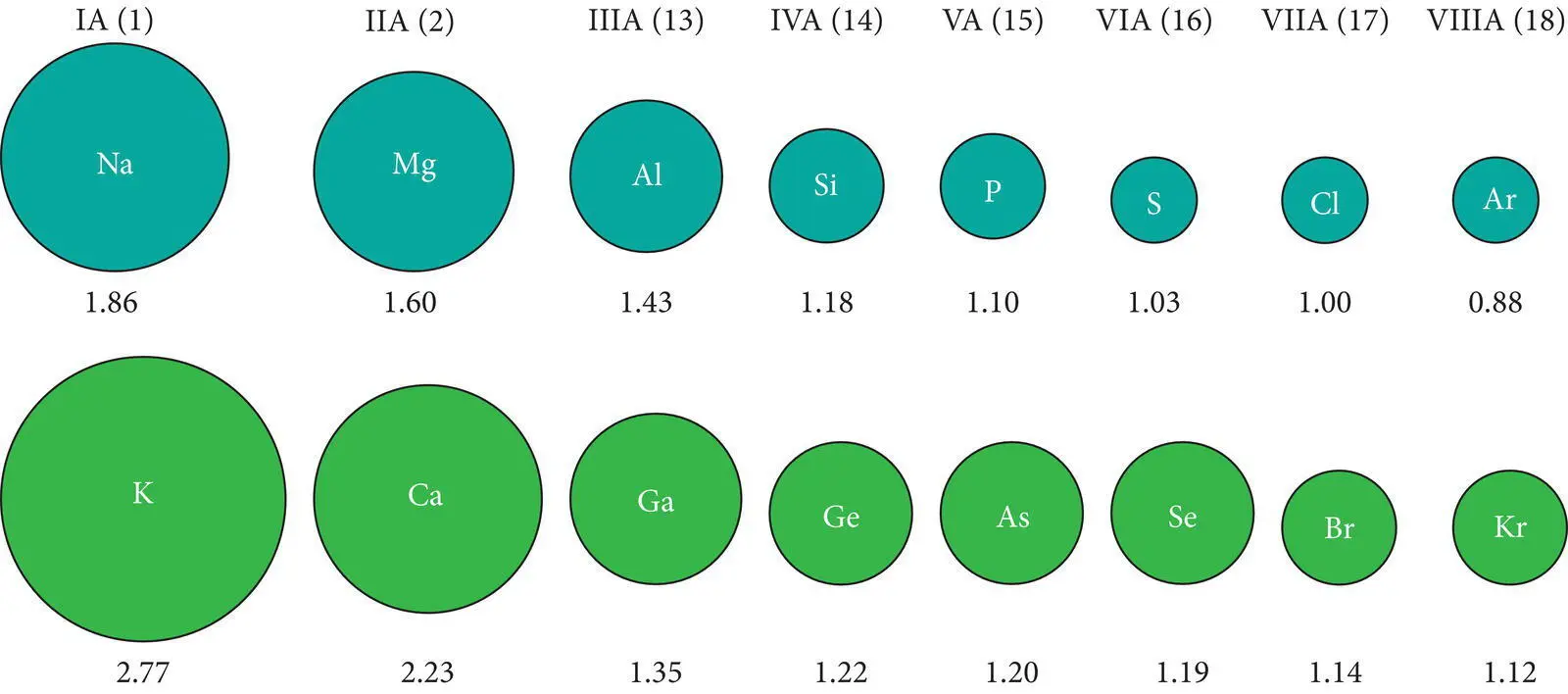
Figure 2.6 Trends in variation of atomic radii (in angstroms; 1 Å = 10 −10m) with their position on the periodic table, illustrated by rows 3 and 4. With few exceptions, radii tend to decrease from left to right and from bottom to top.
2.2.4 Atomic and ionic radii
Atomic radiiare defined as half the distance between the nuclei of identical, bonded neighboring atoms. Because the electrons in higher quantum levels are farther from the nucleus, the effective radius of electrically neutral atoms generally increases from the top to bottom (row 1–row 7) in the periodic table (see Table 2.3). However, atomic radii generally decrease within rows from left to right ( Figure 2.6). This occurs because the addition of electrons to a given quantum level does not significantly increase atomic radius, while the increase in the number of positively charged protons in the nucleus causes the electron cloud to contract as electrons are pulled closer to the nucleus. Atoms with large atomic numbers and large electron clouds include cesium (Cs), rubidium (Rb), potassium (K), barium (Ba), and uranium (U). Atoms with small atomic numbers and small electron clouds include hydrogen (H), beryllium (Be), and carbon (C).
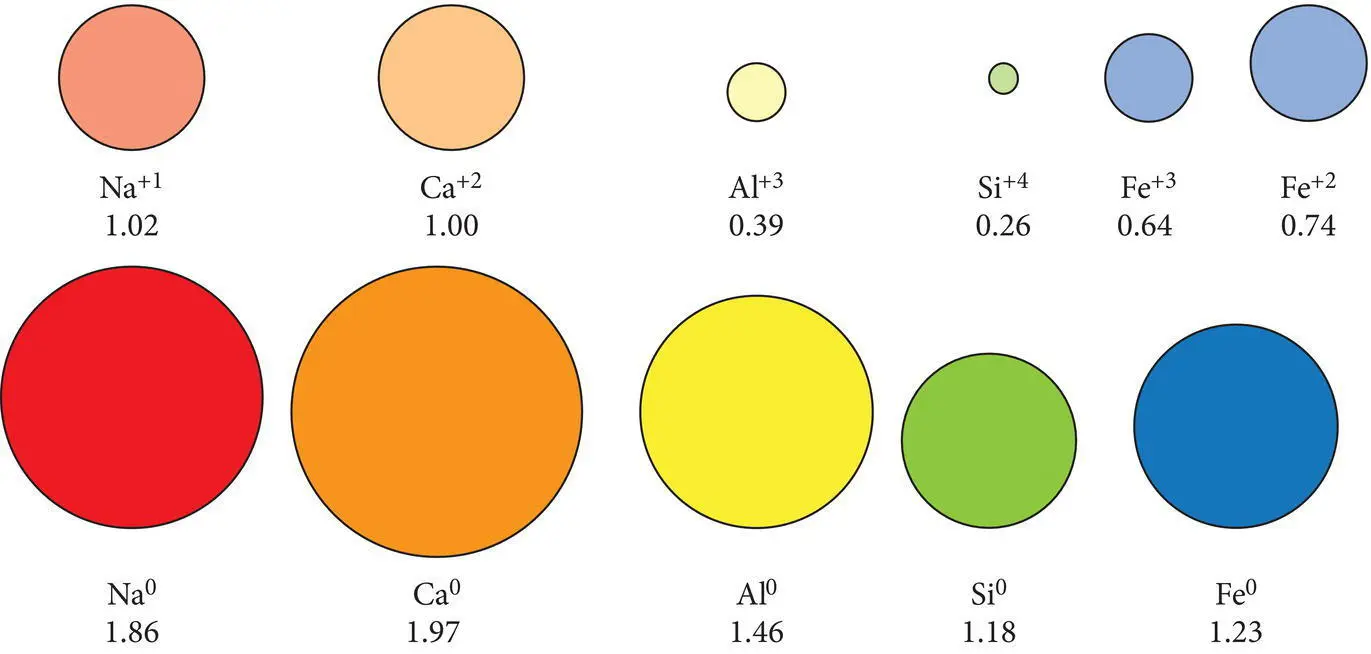
Figure 2.7 Radii (in angstroms) of some common cations in relationship to the atomic radius of the neutral atoms.
Electrons in the outer, higher energy electron levels are least tightly bound to the positively charged nucleus. This weak attraction results because these electrons are farthest from the nucleus and because they are shielded from the nucleus by the intervening electrons that occupy lower quantum level positions closer to the nucleus. These outer electrons or valence electronsare the electrons that are involved in a wide variety of chemical reactions, including those that produce minerals, rocks, and a wide variety of synthetic materials. The loss or gain of these valence electrons produces anions and cations, respectively.
Читать дальшеИнтервал:
Закладка:
Похожие книги на «Earth Materials»
Представляем Вашему вниманию похожие книги на «Earth Materials» списком для выбора. Мы отобрали схожую по названию и смыслу литературу в надежде предоставить читателям больше вариантов отыскать новые, интересные, ещё непрочитанные произведения.










Обсуждение, отзывы о книге «Earth Materials» и просто собственные мнения читателей. Оставьте ваши комментарии, напишите, что Вы думаете о произведении, его смысле или главных героях. Укажите что конкретно понравилось, а что нет, и почему Вы так считаете.