John O'Brien - Earth Materials
Здесь есть возможность читать онлайн «John O'Brien - Earth Materials» — ознакомительный отрывок электронной книги совершенно бесплатно, а после прочтения отрывка купить полную версию. В некоторых случаях можно слушать аудио, скачать через торрент в формате fb2 и присутствует краткое содержание. Жанр: unrecognised, на английском языке. Описание произведения, (предисловие) а так же отзывы посетителей доступны на портале библиотеки ЛибКат.
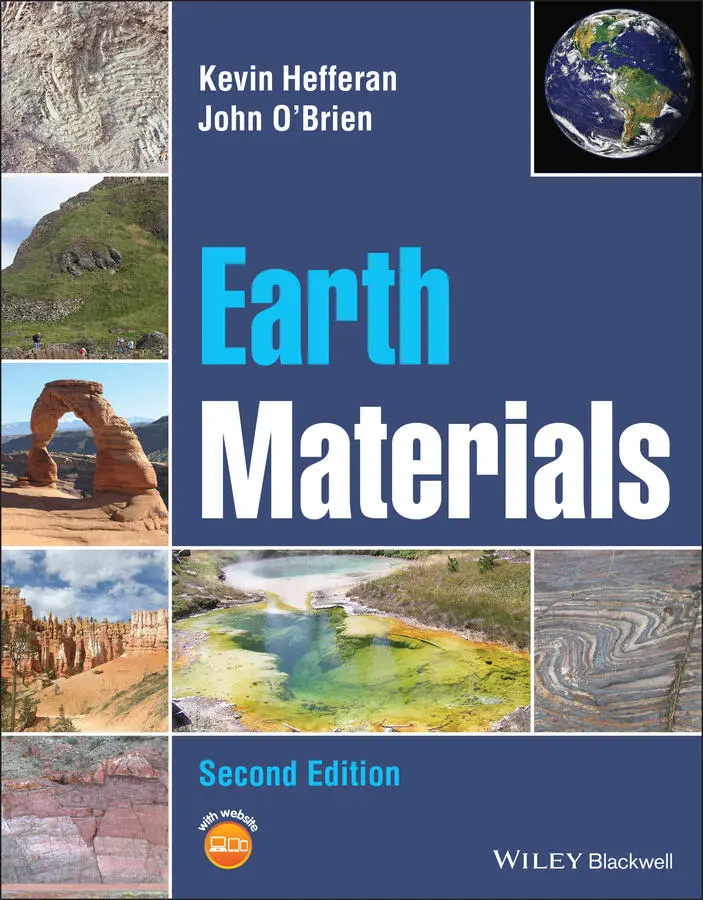
- Название:Earth Materials
- Автор:
- Жанр:
- Год:неизвестен
- ISBN:нет данных
- Рейтинг книги:5 / 5. Голосов: 1
-
Избранное:Добавить в избранное
- Отзывы:
-
Ваша оценка:
Earth Materials: краткое содержание, описание и аннотация
Предлагаем к чтению аннотацию, описание, краткое содержание или предисловие (зависит от того, что написал сам автор книги «Earth Materials»). Если вы не нашли необходимую информацию о книге — напишите в комментариях, мы постараемся отыскать её.
Earth Materials,
Earth Materials,
Earth Materials — читать онлайн ознакомительный отрывок
Ниже представлен текст книги, разбитый по страницам. Система сохранения места последней прочитанной страницы, позволяет с удобством читать онлайн бесплатно книгу «Earth Materials», без необходимости каждый раз заново искать на чём Вы остановились. Поставьте закладку, и сможете в любой момент перейти на страницу, на которой закончили чтение.
Интервал:
Закладка:
Table B2.1 Ionization energies for hydrogen through calcium (units in kJ/mole).
| Element | Ionization energy | |||||||||||||||
|---|---|---|---|---|---|---|---|---|---|---|---|---|---|---|---|---|
| First | Second | Third | Fourth | Fifth | Sixth | Seventh | Eighth | |||||||||
| H | 1312 | |||||||||||||||
| He | 2372 | 5250 | ||||||||||||||
| Li | 520 | 7297 | 11 810 | |||||||||||||
| Be | 899 | 1757 | 14 845 | 21 000 | ||||||||||||
| B | 800 | 2426 | 3 659 | 25 020 | 32 820 | |||||||||||
| C | 1086 | 2352 | 4 619 | 6 221 | 37 820 | 47 260 | ||||||||||
| N | 1402 | 2855 | 4 576 | 7 473 | 9 452 | 53 250 | 64 340 | |||||||||
| O | 1314 | 3388 | 5 296 | 7 467 | 10 987 | 13 320 | 71 320 | 84 070 | ||||||||
| F | 1680 | 3375 | 6 045 | 8 408 | 11 020 | 15 150 | 17 860 | 91 010 | ||||||||
| Ne | 2080 | 3963 | 6 130 | 9 361 | 12 180 | 15 240 | — | — | ||||||||
| Na | 496 | 4563 | 6 913 | 9 541 | 13 353 | 16 610 | 20 114 | 26 660 | ||||||||
| Mg | 737 | 1451 | 7 733 | 10 540 | 13 630 | 17 995 | 21 703 | 25 662 | ||||||||
| Al | 578 | 1817 | 2 745 | 11 575 | 14 830 | 18 376 | 23 292 | — | ||||||||
| Si | 787 | 1577 | 3 231 | 4 356 | 16 091 | 19 784 | 23 783 | — | ||||||||
| P | 1012 | 1903 | 2 912 | 4 956 | 6 273 | 22 233 | 25 397 | — | ||||||||
| S | 1000 | 2251 | 3 361 | 4 564 | 7 012 | 8 495 | 27 105 | — | ||||||||
| Cl | 1251 | 2297 | 3 822 | 5 160 | 6 540 | 7 458 | 11 020 | — | ||||||||
| Ar | 1520 | 2665 | 3 931 | 5 570 | 7 238 | 8 781 | 11 995 | — | ||||||||
| K | 418 | 3052 | 4 220 | 5 877 | 7 975 | 9 590 | 11 343 | 14 944 | ||||||||
| Ca | 590 | 1145 | 4 912 | 6 491 | 8 153 | 10 496 | 12 270 | 14 206 |
2.2.3 Ionization behavior of columns (groups) on the periodic table
The elements in every column or group on the periodic table ( Table 2.3) share a similarity in their electron configuration that distinguishes them from elements in every other column. This shared property causes the elements in each group to behave in a similar manner during chemical reactions. As will be seen later in this chapter and throughout the book, knowledge of these patterns is fundamental to understanding and interpreting the formation and behavior of minerals, rocks, and other Earth materials. The tendency of atoms to form cations or anions is indicated by the location of elements in columns of the periodic table.
Table 2.4 Common ionization states for common elements in columns on the periodic table.
| Column (group) | Ionic charge | Description | Examples |
|---|---|---|---|
| 1 (IA) | +1 | Monovalent cations due to low first ionization energy | Li +1, Na +1, K +1, Rb +1,Cs +1 |
| 2 (IIA) | +2 | Lose two electrons due to low first and second ionization energy | Be +2, Mg +2, Ca +2, Sr +2, Ba +2 |
| 3–12 (IIIB–IIB) | +1 to +7 | Transition elements; lose variable numbers of electrons depending upon environment | Cu +1, Fe +2, Fe +3, Cr +2, Cr +6, W +6, Mn +2, Mn +4, Mn +7 |
| 13 (IIIA) | +3 | Lose three electrons due to low first through third ionization energy | B +3, Al +3, Ga +3 |
| 14 (IVA) | +4 | Lose four electrons due to low first through fourth ionization energy; may lose a smaller number of electrons | C +4, Si +4, Ti +4, Zr +4, Pb +2, Sn +2 |
| 15 (VA) | +5 to −3 | Lose up to five electrons or capture three electrons to achieve stability | N +5, N −3, P +5, As +3, Sb +3, Bi +4 |
| 16 (VIA) | −2 | Generally gain two electrons to achieve stability; gain six electrons in some environments | O −2, S −2, S +6, Se −2, |
| 17 (VIIA) | −1 | Gain one electron to achieve stable configuration | Cl −1, F −1, Br −1, I −1 |
| 18 (VIIIA) | 0 | Stable electron configuration; neither gain nor lose electrons | He, Ne, Ar, Kr |
Metallic elementshave relatively low first ionization energies (<900 kJ/mol) and tend to give up one or more weakly held electrons rather easily. Column 1 and 2 (group IA and group IIA) elements, the alkali metalsand alkali earths, respectively, tend to display the most metallic behaviors. Most of the elements in columns 3–12 (groups IIIB through IIB), called the transition metals, also display metallic tendencies.
Nonmetallic elementshave high first ionization energies (>900 kJ/mol) and tend not to release their tightly bound electrons. With the exception of the stable, nonreactive, very nonmetallic Noble elements in column 18 (group VIIIA), nonmetallic elements tend to be electronegative and possess high electron affinities. Column 16–17 (group VIA and group VIIA) elements, with their especially high electron affinities, display a strong tendency to capture additional electrons to fill their highest principle quantum levels. They provide the best examples of highly electronegative, nonmetallic elements. A brief summary of the characteristics of the columns and elemental groups is presented below and in Table 2.4.
Column 1 (IA) metals are the only elements with a single s‐electron in their highest quantum levels. Elements in column 1 (IA) achieve the stable configuration of the next lowest quantum level when they lose their single s‐electron from the highest principal quantum level. For example, if sodium (Na) with the electron configuration (1s2, 2s2, 2p6, 3s1) loses its single 3s electron (Na+1), its electron configuration becomes that of the stable noble element neon (1s2, 2s2, 2p6) with the “stable octet” in the highest principle quantum level. Similar behavior is true for Li+1, K+1, and the other univalent (+1) cations in column 1 (IA).
Читать дальшеИнтервал:
Закладка:
Похожие книги на «Earth Materials»
Представляем Вашему вниманию похожие книги на «Earth Materials» списком для выбора. Мы отобрали схожую по названию и смыслу литературу в надежде предоставить читателям больше вариантов отыскать новые, интересные, ещё непрочитанные произведения.










Обсуждение, отзывы о книге «Earth Materials» и просто собственные мнения читателей. Оставьте ваши комментарии, напишите, что Вы думаете о произведении, его смысле или главных героях. Укажите что конкретно понравилось, а что нет, и почему Вы так считаете.