John O'Brien - Earth Materials
Здесь есть возможность читать онлайн «John O'Brien - Earth Materials» — ознакомительный отрывок электронной книги совершенно бесплатно, а после прочтения отрывка купить полную версию. В некоторых случаях можно слушать аудио, скачать через торрент в формате fb2 и присутствует краткое содержание. Жанр: unrecognised, на английском языке. Описание произведения, (предисловие) а так же отзывы посетителей доступны на портале библиотеки ЛибКат.
- Название:Earth Materials
- Автор:
- Жанр:
- Год:неизвестен
- ISBN:нет данных
- Рейтинг книги:5 / 5. Голосов: 1
-
Избранное:Добавить в избранное
- Отзывы:
-
Ваша оценка:
Earth Materials: краткое содержание, описание и аннотация
Предлагаем к чтению аннотацию, описание, краткое содержание или предисловие (зависит от того, что написал сам автор книги «Earth Materials»). Если вы не нашли необходимую информацию о книге — напишите в комментариях, мы постараемся отыскать её.
Earth Materials,
Earth Materials,
Earth Materials — читать онлайн ознакомительный отрывок
Ниже представлен текст книги, разбитый по страницам. Система сохранения места последней прочитанной страницы, позволяет с удобством читать онлайн бесплатно книгу «Earth Materials», без необходимости каждый раз заново искать на чём Вы остановились. Поставьте закладку, и сможете в любой момент перейти на страницу, на которой закончили чтение.
Интервал:
Закладка:
3.2 PHASE STABILITY (EQUILIBRIUM) DIAGRAMS
The behavior of materials in Earth systems can be modelled using thermodynamic calculations and/or empirical results from laboratory investigations. The results of such calculations and/or investigations are commonly summarized on phase stability diagrams. A phaseis a mechanically separable part of the system. Phase stability (equilibrium) diagramsdisplay the stability fields (conditions under which a phase is stable) for various phases in a system of specified composition. These fields are separated by phase stability boundary linesthat represent the conditions under which phase changes from one phase to another occur. Phase stability diagrams related to igneous systems and processes summarize relationships between liquids (melts) and solids (crystals) in a system. Such diagrams usually have temperature increasing upward on the vertical axis and composition shown on the horizontal axis. At high temperatures the system is completely melted. The stability field for 100% liquid is separated from the remainder of the phase diagram by a phase boundary line called the liquidusthat represents the temperature above which the system exists as 100% melt and below which it contains some crystals. The low temperature stability field for 100% solid crystals is separated from higher temperature conditions by a phase boundary line called the solidus. At intermediate temperatures between the solidus and liquidus, the system consists of two types of stable phases in equilibrium, both liquid and solid crystals. Phase equilibrium diagrams, based on both theoretical and laboratory analyses, exist for a variety of multicomponent systems. A one‐component and five representative two‐component systems related to the discussion of igneous rocks and processes ( Chapters 7– 10) are discussed below. Metamorphic phase diagrams are discussed in Chapter 18. For discussions of systems that are beyond the scope of this text, including three‐ and four‐component systems, the reader is referred to mineralogy books by Wenk and Bulakh (2016), Nesse (2016), Dyer et al. (2008) and Klein and Dutrow (2007) and to petrology books by Frost and Frost (2019), Philpotts and Ague (2009), Winter (2009) and Best (2000). Some of the more important terms you will encounter in this discussion are defined in Table 3.1.
Table 3.1 A list of some common terms used in discussing phase diagrams.
| Terms | Definitions |
|---|---|
| Liquidus | Phase boundary (line) that separates the all‐liquid (melt) stability field from stability fields that contain at least some solids (crystals) |
| Solidus | Phase boundary (line) that separates the all‐solid (crystal) stability field from stability fields that contain at least some liquid (melt) |
| Eutectic | Condition under which liquid (melt) is in equilibrium with two different solids |
| Peritectic | Condition under which a reaction occurs between a pre‐existing solid phase and a liquid (melt) to produce a new solid phase |
| Phase | A mechanically separable part of the system; may be a liquid, gas or solid with a discrete set of mechanical properties and composition |
| Invariant melting | Occurs when melts of the same composition are produced by melting rocks of different initial composition |
| Incongruent melting | Occurs when a solid mineral phase melts to produce a melt and a different mineral with a different composition from the initial mineral |
| Discontinuous reaction | Mineral crystals and melt react to produce a completely different mineral; negligible solid solution exists between the minerals |
| Continuous reaction | Mineral crystals and melt react to continuously and incrementally change the composition of both; requires a mineral solid solution series |
| Solvus | Phase boundary (line) that separates conditions in which complete solid solution occurs within a mineral series from conditions under which solid solution is limited |
3.2.1 The phase rule
The phase rule(Gibbs 1928) governs the number of phases that can coexist in equilibrium in any system and can be written as:

where
P represents the number of phases present in a system. Phases are mechanically separable varieties of matter that can be distinguished from other varieties based on their composition, structure and/or state. Phases in igneous systems include minerals of various compositions, and crystal structures, amorphous solids (glass) and fluids such as liquids or gases. All phases are composed of one or more of the components used to define the composition of the system.
C designates the minimum number of chemical components required to define the phases in the system. These chemical components are usually expressed as proportions of oxides. The most common chemical components in igneous reactions include SiO2, Al2O3, FeO, Fe2O3, MgO, CaO, Na2O, K2O, H2O, and CO2. All phases in the system can be made by combining components in various proportions.
F refers to the number of degrees of freedom or variance. Variance means the number of independent factors that can vary, such as temperature, pressure, and the composition of each phase, without changing the phases that are in equilibrium with one another. We will use the first phase diagram in the next section to show how the phase rule can be applied to understanding phase diagrams. A discussion of the phase rule and of phase diagrams related to metamorphic processes is presented in Chapter 18.
3.2.2 One component phase diagram: silica polymorphs
Pure silica (SiO 2) occurs as a number of different mineral phases, each characterized by a different crystal structure. These silica minerals include low quartz (alpha quartz), high quartz (beta quartz), tridymite (alpha and beta), cristobalite (alpha and beta), coesite, and stishovite. Each polymorph of silica is stable under a different set or range of temperature and pressure conditions. A phase stability diagram ( Figure 3.6), where pressure increases upward and temperature increases to the right, shows the stability fields for the silica minerals. The stability fields represent the temperature and pressure conditions under which each mineral phase is stable. Each stability field is bounded by phase boundaries, lines that define the limits of the stability field as well as the conditions under which phases in adjoining fields can coexist in equilibrium. Where three phase boundaries intersect, a unique set of conditions is defined under which three stable phases can coexist simultaneously.
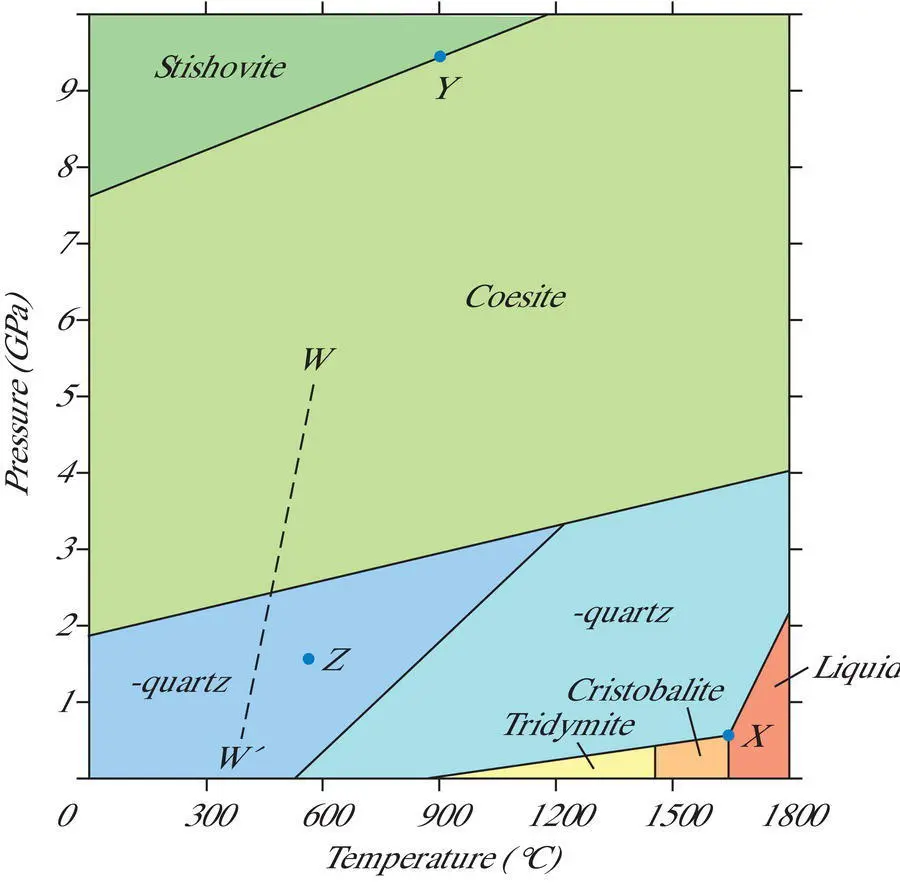
Figure 3.6Phase diagram for silica depicting the temperature–pressure stability fields for the major polymorphs and the liquid phase.
Source : Adapted from Wenk and Bulakh (2004). © John Wiley & Sons.
The positions of the stability fields show that stishoviteand coesiteare high pressure varieties (polymorphs) of silica and that tridymiteand cristobaliteare high temperature/low pressure minerals. In this diagram both high temperature/low pressure polymorphs are the beta varieties. The high pressure polymorphs, coesite and stishovite, occur in association with meteorite impact and thermonuclear bomb sites, and stishovite is very likely a constituent of the deep mantle. The diagram shows that quartz is the stable polymorph of silica over a broad range of temperature–pressure conditions common in Earth's crust. This wide stability range and an abundance of silicon and oxygen help to explain why quartz is such an abundant rock‐forming mineral in the igneous, sedimentary and metamorphic rocks of Earth's crust. Figure 3.6also shows that alpha quartz (low quartz) is generally more stable at lower temperatures than beta quartz (high quartz). Lastly, the diagram shows a phase stability boundary (liquidus or melting curve) on the far right that separates the lower temperature/pressure conditions under which silica is solid from the higher temperature/pressure conditions under which it is a liquid. The phase rule permits a deeper understanding of the relationships portrayed in the diagram. Places where three phase boundaries intersect represent unique temperature and pressure conditions where three stable mineral phases can coexist. For example, at point X at ~1650 °C and ~0.04 GPa high quartz, cristobalite and liquid coexist because the high quartz/liquid, high quartz/cristobalite, and cristobalite/liquid phase boundaries intersect. Because there are three phases and one component, the phase rule (P = C + 2 − F) yields 3 = 1 + 2 − F, so that F must be 0. This simply means that the temperature and pressure cannot be varied if three phases are to coexist. There are no degrees of freedom. Figure 3.6shows additional triple points where three phases, all of them solid, coexist under a unique set of temperature and pressure conditions. If either temperature or pressure is varied, the system moves to a place on the diagram where one or more phases are no longer stable. At triple points, there are no degrees of freedom; the system is invariant.
Читать дальшеИнтервал:
Закладка:
Похожие книги на «Earth Materials»
Представляем Вашему вниманию похожие книги на «Earth Materials» списком для выбора. Мы отобрали схожую по названию и смыслу литературу в надежде предоставить читателям больше вариантов отыскать новые, интересные, ещё непрочитанные произведения.











Обсуждение, отзывы о книге «Earth Materials» и просто собственные мнения читателей. Оставьте ваши комментарии, напишите, что Вы думаете о произведении, его смысле или главных героях. Укажите что конкретно понравилось, а что нет, и почему Вы так считаете.