Ko Un - Maninbo - Peace & War
Здесь есть возможность читать онлайн «Ko Un - Maninbo - Peace & War» весь текст электронной книги совершенно бесплатно (целиком полную версию без сокращений). В некоторых случаях можно слушать аудио, скачать через торрент в формате fb2 и присутствует краткое содержание. Год выпуска: 2015, ISBN: 2015, Издательство: Bloodaxe Books, Жанр: Поэзия, на английском языке. Описание произведения, (предисловие) а так же отзывы посетителей доступны на портале библиотеки ЛибКат.
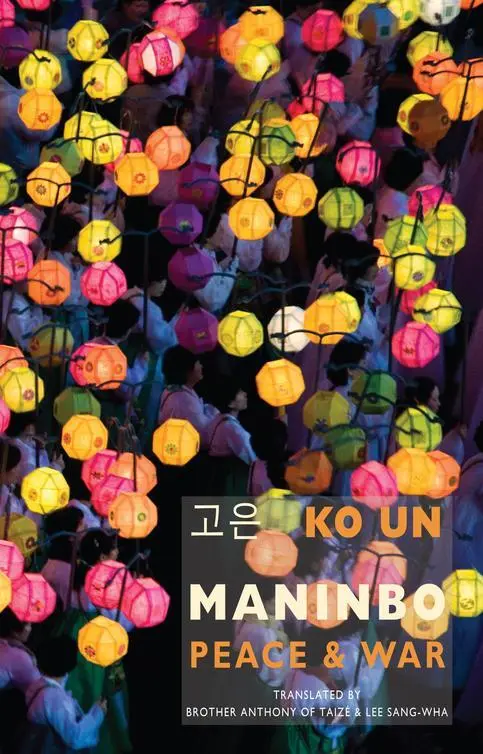
- Название:Maninbo: Peace & War
- Автор:
- Издательство:Bloodaxe Books
- Жанр:
- Год:2015
- ISBN:9781780372433
- Рейтинг книги:3 / 5. Голосов: 1
-
Избранное:Добавить в избранное
- Отзывы:
-
Ваша оценка:
Maninbo: Peace & War: краткое содержание, описание и аннотация
Предлагаем к чтению аннотацию, описание, краткое содержание или предисловие (зависит от того, что написал сам автор книги «Maninbo: Peace & War»). Если вы не нашли необходимую информацию о книге — напишите в комментариях, мы постараемся отыскать её.
Maninbo: Peace & War — читать онлайн бесплатно полную книгу (весь текст) целиком
Ниже представлен текст книги, разбитый по страницам. Система сохранения места последней прочитанной страницы, позволяет с удобством читать онлайн бесплатно книгу «Maninbo: Peace & War», без необходимости каждый раз заново искать на чём Вы остановились. Поставьте закладку, и сможете в любой момент перейти на страницу, на которой закончили чтение.
Интервал:
Закладка:
who had no luck with horoscopes and was always quarrelling.
Then, when that poet went to prison,
he deposited the poet’s meagre royalties in the bank.
First Love
The full moon rose
over a hillside slum in Bongcheon-dong, southern Seoul.
A young man was climbing the steep path
around 11.30 p.m.
after working overtime.
His name was Yun Sang-gon, he had grown up well,
though knowing nothing of father or mother.
At the top of the steep path
someone was waiting for him in an alleyway, freezing cold.
Her name was Kim Sun-ja.
The full moon was high in the sky.
In a world abounding with the sound of moonlight,
how could poverty be all there was?
Twenty-year-old Sang-gon’s tough hand
seized seventeen-year-old Sun-ja’s coarsened hand.
Sun-ja had no smell of face-powder.
There was nothing like, ‘I love you’.
The young man trembled as he spoke:
‘Let’s not change.’
Choking, the girl nodded.
She bit her lips in confusion and blood gathered in her mouth.
Won Byeong-o’s DMZ
The 38th parallel cut the Korean peninsula in two
from the summer of 1945.
Once again
after the summer of 1950
the DMZ divided the Korean peninsula
with guns aimed across at each other since 1953.
One hundred and sixty miles of barbed wire.
Father in the North,
and son in the South were both experts on birds.
The son in the south tied his name
to a bird’s leg and set it loose.
A few years later
the father in the north
set loose a bird carrying his name.
No message.
Had there been a message
it would have been a crime against national security
under the South’s anti-communist laws,
and a crime under the North’s criminal laws.
Each merely attached his name to a bird,
set it free,
sent it back.
That southern son was Won Byeong-o, a professor at Kyunghee University.
The father was an ornithologist in North Korea.
The beauty of blood ties in this time of division
was also the sorrow of the son’s
already bald head.
A Fake Blind Beggar
On a corner of Hyoje-dong opposite Jongno 5ga in Seoul
all day long
a blind beggar lay hunched over
wearing dark glasses.
He was murmuring something,
no telling what,
murmuring, murmuring.
Placing before him a ragged cap
he collected 10 won coins, 100 won coins.
Considering the patient hard work of not moving all day long,
the beggar’s wage was far too low.
Apart from occasional crackdowns,
our country offers the freedom and right to be a beggar.
But this beggar, once night fell,
rose to his feet, holding a slender cane,
and quietly headed for the alley of bars
on the slopes of Ehwa-dong.
There he removed his dark glasses and opened blind eyes.
He ordered a drink at his regular bar,
‘Hey, give me soju and that.’
‘That’ usually meant a side-dish of spicy fried brawn.
Five years later, that fake blind beggar moved
to the station square down in Jochiwon, South Chungcheong province.
A little thief is better
than a thief,
than a big thief.
A beggar is better
than a little thief.
Why, wasn’t Sakymuni a chief of beggars?
The Seven-year-old King
In Goguryeo, the nation founded by Go Ju-mong at age fifteen
the royal palace was a thatched cottage.
The waters of the Yalu rose far off.
Day by day the nation prospered.
The cottage turned into an imposing palace.
The sixth king, Taejo,
ascended the throne aged seven.
The king played with his top.
His mother looked after the child-king.
King Jinheung of Silla, too,
became king at seven,
while his aunt exercised royal power.
Isn’t regency more than playing the king?
Cheong-dam the Monk
His height when sitting was that of an ordinary person standing unnoticed.
While studying at the Jinju Agricultural High School,
and after graduating, too,
he could not for an instant live without Buddhism.
Already married, and one daughter.
First he crossed the sea,
staying at a number of temples in Japan,
then returned to become a monk at Okcheon-sa temple in Goseong,
the Venerable Bak Han-yeong his master.
After studying his fill
he went to deliver a sermon
at Hoguk-sa temple in Jinju, his home.
In the evening following the sermon
his mother came into his room
and produced a kitchen knife from her sleeve.
If you don’t come back home with me tonight,
I’ll stab myself in the belly until I’m dead.
What I want is a grandson.
He had no choice but to follow his mother
and return to his wife for just that one night.
After that, blaming himself for his apostasy,
he went everywhere barefoot.
And still he nourished great dreams.
So, during the Japanese occupation
he started the National Student Monks’ Assembly.
then in 1954 he organised the National Conference of Monks,
establishing the Jogye Order after a sit-in fast
with a hundred monks and a hundred fifty nuns.
He held several posts, such as first General Manager,
Chairman of the Order Committee,
and Supreme Patriarch.
His preaching was not consistent with logic.
He just went on talking endlessly
no way of telling
beginning end
middle
talking all night long until the day shone bright
skipping even the morning chanting.
He died in November of Nineteen Hundred and Seventy-One, at the age of sixty-nine.
Neung-un the Monk
After the Japanese army swept up north in 1592
and the walls of Hanyang, the capital, had fallen,
Neung-un, a monk of Docheon-sa temple, rose up,
gathering seven hundred slow-speaking common folk
in the lower Naepo region of western Chungcheong,
He had always been a stately monk.
Now he tore up his crimson gown, wrapped it round his neck.
With his shaven hair growing long,
his face became that of an angry lion.
He hated the king and his officials
for allowing the invasion,
hated them more than he hated the invading Japanese.
His intention was to attack Hanyang
where the Japanese were stationed,
with Yi Mong-hak and others,
and establish a new world.
When Neung-un was executed, heavy rain poured down.
At Evening
On the estuary at Onsuri, Ganghwa Island,
only a couple of boats bobbing,
the hostess of a bar
gazes out
across the mist-shrouded sea.
Her pencilled brows
are lovely.
‘It’s time they were here…’
She is waiting
for anglers
to arrive on the last boat
crossing from Incheon.
Today she has not had one customer.
On the window of the bar
there is a sheet of yellowing paper:
TURN YOURSELF IN, RETURN TO THE LIGHT.
REPORT ANYONE SUSPICIOUS.
Hyeyung
In the days of the Liberal Party in the 1950s
at Mirae-sa temple in Mireuk Island,
in Tongyeong, South Gyeongsang province,
the disciples of the Great Master Hyobong gathered:
Gusan, Ilgak, Ilcho, Ilgwan and Beopjeong.
Beopcheol and Beopdal were there, too.
And Hwalyeon.
Spring-water-like Hyeyung was also there.
Читать дальшеИнтервал:
Закладка:
Похожие книги на «Maninbo: Peace & War»
Представляем Вашему вниманию похожие книги на «Maninbo: Peace & War» списком для выбора. Мы отобрали схожую по названию и смыслу литературу в надежде предоставить читателям больше вариантов отыскать новые, интересные, ещё непрочитанные произведения.











Обсуждение, отзывы о книге «Maninbo: Peace & War» и просто собственные мнения читателей. Оставьте ваши комментарии, напишите, что Вы думаете о произведении, его смысле или главных героях. Укажите что конкретно понравилось, а что нет, и почему Вы так считаете.