Ko Un - Maninbo - Peace & War
Здесь есть возможность читать онлайн «Ko Un - Maninbo - Peace & War» весь текст электронной книги совершенно бесплатно (целиком полную версию без сокращений). В некоторых случаях можно слушать аудио, скачать через торрент в формате fb2 и присутствует краткое содержание. Год выпуска: 2015, ISBN: 2015, Издательство: Bloodaxe Books, Жанр: Поэзия, на английском языке. Описание произведения, (предисловие) а так же отзывы посетителей доступны на портале библиотеки ЛибКат.
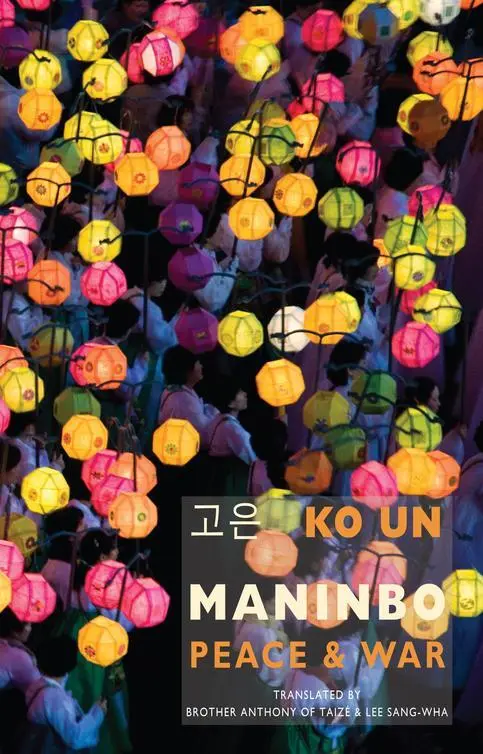
- Название:Maninbo: Peace & War
- Автор:
- Издательство:Bloodaxe Books
- Жанр:
- Год:2015
- ISBN:9781780372433
- Рейтинг книги:3 / 5. Голосов: 1
-
Избранное:Добавить в избранное
- Отзывы:
-
Ваша оценка:
Maninbo: Peace & War: краткое содержание, описание и аннотация
Предлагаем к чтению аннотацию, описание, краткое содержание или предисловие (зависит от того, что написал сам автор книги «Maninbo: Peace & War»). Если вы не нашли необходимую информацию о книге — напишите в комментариях, мы постараемся отыскать её.
Maninbo: Peace & War — читать онлайн бесплатно полную книгу (весь текст) целиком
Ниже представлен текст книги, разбитый по страницам. Система сохранения места последней прочитанной страницы, позволяет с удобством читать онлайн бесплатно книгу «Maninbo: Peace & War», без необходимости каждый раз заново искать на чём Вы остановились. Поставьте закладку, и сможете в любой момент перейти на страницу, на которой закончили чтение.
Интервал:
Закладка:
red-nosed,
he would shelter them from the wind, saying:
‘Ah, you must be cold!’
But he was so poor that finally his children were starving.
Somehow he got hold of three yards of rotten straw rope,
tied it to a tree
and hanged himself.
Or rather, pretended to hang himself,
not intending to die.
Once they got wind of that,
the villagers gathered grain
so he and his children could survive
the winter.
‘No, it would never do for him to die.
Who would do the hard work
in our village,
in the neighbouring villages,
if not No Bong-gu?’
A Night in Mugyo-dong
The food was seasoned with deep-red pepper powder.
The red pepper that people began to eat
from the late Joseon period
is like something Koreans have eaten since ancient times.
You only have to take a bite,
ahh,
a fire kindles in the mouth.
The drinkers’ delight in 1960s and 70s Seoul
was to empty ten bottles of strong soju
alongside such hot –
and salty — side-dishes,
when it was already eleven at night, nearly curfew time.
Why did they have to be so tough?
Around that time everything used to get exaggerated.
Even Park Jung-hee got exaggerated,
so that he shrank to bean-size.
If someone shouted
that brat Park Jung-hee,
that brat was even using his daughter as First Lady,
and so on,
that gave him authority
and the friends who had come with him would pay for the drinks.
One day I picked up a scrap of newspaper
off the cement floor of that kind of bar
and first learned about the self-immolation of the young worker Jeon Tae-il.
The Time It Takes to Piss
There were plenty of prisoners in Daegu prison with long or life terms.
One of the long-term prisoners
with a stiff white beard
looked out into the corridor
and questioned a green youth who had just come from trial.
‘What did you get?’
‘One year two months.’
‘Hell, call that a sentence?
That’s the time it takes a lifer to piss.
Hey, how can that be called a sentence?’
Jang Gwang-seop, with his one year two months,
was nicknamed Muhammad Ali.
Even when he got a thrashing from a guard,
he would brush himself off, stand up as if nothing had happened,
and calmly walk away.
This Ali Jang Gwang-seop
was one of the descendants of Jeong Mong-ju,
who stayed loyal to Goryeo to the bitter end
and wrote a last poem before he was killed.
The poem began:
‘Though I die
and die again a hundred times…’
An Old Prison Officer
Starting as an errand boy in Gyeongseong jail
long ago during the Japanese colonial period,
he became assistant guard,
then guard,
the lowest rank of prison officer,
for forty-seven years in all.
His work was tying the ropes
and fastening the handcuffs
of those going out for morning sessions,
for interrogations by the prosecution or for trial in court.
His pock-marked face was dark
and his eyes looked as though he had not eaten for three days.
His gold-rimmed hat
sat a little too heavily on him.
When convoy vehicles numbers one and two left early in the morning,
he went along as escort.
In the evenings, as a substitute guard,
he would go peeking into this cell and that,
and if the prisoners kindly offered him
fallen apples or
rice cakes they had bought,
he would take them without hesitation,
with not a word of thanks, saying:
‘This rice cake is made with wheat flour,
and coated with soy bean powder.’
For meals he made do with prison food.
When he went home, he did nothing but catch up on his sleep
because he always had triple shift overtime.
That’s why he told the prisoners:
‘No lifer has anything on me, you know.’
The Person in Charge of Detention Cells at Seodaemun Police Station
In winter it was like the outdoors.
He was the man with hair cut short
in charge of detention cells at Seodaemun police station in the 1970s.
He never got promoted.
Every time someone came in,
every time several came in,
surely they had some fault,
and he would find it,
would kick, kick hard,
to depress their spirits from the start.
Im Cheol-man.
But after meals
he would turn to the women’s cell
and demand a song.
If someone sang a song such as,
‘I will build a house like one in a picture,’
a storm of applause would pour
from the men’s cell.
Then it would be the turn of the men’s cell.
If someone jailed for a first burglary after three larcenies
sang ‘Camellia Girl’…
Im Cheol-man would scream:
‘You lout,
shame on you, you, a man, acting so pathetic.’
A perpetual guard,
he once said in prayerful tones:
‘Just one time
these cells
were completely empty
and I was really very bored.
‘Yet my wish
is to be in charge of completely empty cells
with nobody coming in.
Hey, you bastard in cell two,
can’t you just listen quietly to what I’m saying?
Bastard.’
VOLUME 12
Colette, No Jeong-hye
Colette,
born in Lyons, France,
joined an active sisterhood.
Her younger sister first worked in Vietnam, now lives in Japan.
Colette came to Seoul decades ago.
Her Korean is fluent,
her stomach’s accustomed to Korean food.
Even without cheese,
this is her country.
How holy! How amazing!
to have arrived at such intense unity.
Her Korean name is No Jeong-hye.
Secretly, she contributed much to the Korean human rights movement,
starting with the National Democratic Students’ Federation incident,
or even before.
She circulated petitions,
collected donations,
hid people,
even promised to hide me.
Her heart’s a wide plain.
She made her nest in a Sillim-dong slum,
lived in great poverty.
She reckoned a bowl of instant noodles was a feast.
She alone is reason enough why there has to be religion.
A Blind Man by Saetgang River
No one noticed
how salty it had become,
that river
in Sorae, Gyeonggi Province.
Seo Pil-seok cannot see
that river.
Blind,
he lost his sight some time ago.
At high tide
when rising waters advance to the top of the bank,
his back aches.
He hurt his back long ago in the war,
wounded on the central front.
At low tide
his belly aches,
a problem from long working in that salt farm
where he ended up after discharge.
Later, he lost his sight.
First he had something like cataracts
and the things he saw grew hazier day by day,
until finally he could see nothing.
He thought he’d go mad in that merciless darkness.
Time seems to have been a serum even for that darkness.
He grew resigned,
life a fluttering tent
even for a sightless body.
Today, too,
high tide and low tide depend on the moon.
Old Seo Pil-seok is more a man of the moon
than a man
of the earth.
Muttering
Opposite the primary school in Hwagok-dong
remains one house from the initial development.
Читать дальшеИнтервал:
Закладка:
Похожие книги на «Maninbo: Peace & War»
Представляем Вашему вниманию похожие книги на «Maninbo: Peace & War» списком для выбора. Мы отобрали схожую по названию и смыслу литературу в надежде предоставить читателям больше вариантов отыскать новые, интересные, ещё непрочитанные произведения.












Обсуждение, отзывы о книге «Maninbo: Peace & War» и просто собственные мнения читателей. Оставьте ваши комментарии, напишите, что Вы думаете о произведении, его смысле или главных героях. Укажите что конкретно понравилось, а что нет, и почему Вы так считаете.