Ko Un - Maninbo - Peace & War
Здесь есть возможность читать онлайн «Ko Un - Maninbo - Peace & War» весь текст электронной книги совершенно бесплатно (целиком полную версию без сокращений). В некоторых случаях можно слушать аудио, скачать через торрент в формате fb2 и присутствует краткое содержание. Год выпуска: 2015, ISBN: 2015, Издательство: Bloodaxe Books, Жанр: Поэзия, на английском языке. Описание произведения, (предисловие) а так же отзывы посетителей доступны на портале библиотеки ЛибКат.
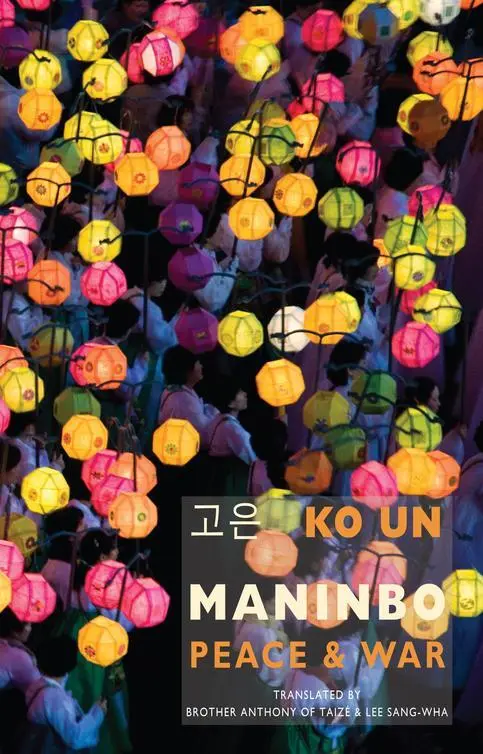
- Название:Maninbo: Peace & War
- Автор:
- Издательство:Bloodaxe Books
- Жанр:
- Год:2015
- ISBN:9781780372433
- Рейтинг книги:3 / 5. Голосов: 1
-
Избранное:Добавить в избранное
- Отзывы:
-
Ваша оценка:
Maninbo: Peace & War: краткое содержание, описание и аннотация
Предлагаем к чтению аннотацию, описание, краткое содержание или предисловие (зависит от того, что написал сам автор книги «Maninbo: Peace & War»). Если вы не нашли необходимую информацию о книге — напишите в комментариях, мы постараемся отыскать её.
Maninbo: Peace & War — читать онлайн бесплатно полную книгу (весь текст) целиком
Ниже представлен текст книги, разбитый по страницам. Система сохранения места последней прочитанной страницы, позволяет с удобством читать онлайн бесплатно книгу «Maninbo: Peace & War», без необходимости каждый раз заново искать на чём Вы остановились. Поставьте закладку, и сможете в любой момент перейти на страницу, на которой закончили чтение.
Интервал:
Закладка:
Most of the cement blocks in its garden wall have crumbled,
the iron gates have rusted away.
Yi Jeong-gu, owner of that house,
lost his wife a year ago
and slowly went mad, aphasic.
Time just flows, flows on
as he mutters, mutters,
mutters from dawn when he wakes
till night when he falls asleep.
He mutters when the wind blows.
Mutters when it rains.
Mutters when it sleets.
A burglar broke into that house,
heard the incessant muttering from the bedroom,
threw up his hands and ran away.
It happened that a rumour spread
of a Goryeo celadon vase in that old house.
Who knows, maybe someone had already taken it,
leaving behind just the muttering within.
Creepers have grown so wild in the garden
someone could easily be lost and bound…
Dr Jang Gi-ryeo
‘Even now, when it rains
I leave the window open
lest I miss the sound
of footsteps
as you approach in the rain.’
Ever since the 4 January retreat in 1951,
he lived in the South,
husband of a divided couple
in a divided country,
never taking a second wife,
sleeping alone in a simple cot.
He settled in Busan and established a modest hospital.
Nobody was ever sent away;
sick and poor,
all received treatment and his loving touch.
For that, he became the model for the protagonist
of Yi Gwang-su’s novel Love .
It was to meet Jang Gi-ryeo, that holy figure,
like big brother meeting younger brother,
like younger brother meeting big brother,
that the great Quaker teacher Ham Seok-heon,
using other errands as his excuse,
so often travelled down to Busan from Seoul.
Three-headed Hawk
There was once a hawk that had three heads:
with one it looked forward,
with one it looked behind,
and one it turned
to look up and down.
Soaring high into the sky, way up,
it took aim at all of Joseon’s corrupt officials.
That’s him , and him , and
there he is.
It dived with sharp eyes glaring,
tore at them with its ferocious beak.
In the name of the people,
it hunted out all the grasping officials
so prevalent in the 400 years of the Joseon Era,
sparing but the two hundred men who were clean-handed.
Wondrous!
When the people’s most ardent wishes and rancour
ran to the high heavens,
the three-headed hawk went flying up.
Kim Geun-tae
During the 1970s he never stuck his head above water.
While infiltrating this or that dark, dank factory
here and there in Incheon,
he earned several vocational certificates.
He gladly threw away his diplomas
from Seoul National University’s Business College and other such.
In the factories he was a respectable Homo Faber .
Face like a white candle,
face like a white goat,
but in his brown eyes
a single unwavering resolve
undeterred through decades
would blaze furtively for an instant
then sink back again out of sight.
Since he’d resolved to spend his life united with the workers,
he was known to very few friends
throughout the 70s.
He never surfaced, devoting the intensity of his youth to this task.
He cared nothing for fame or distinction
or any of that, not then nor later in life.
And to his death, he chose to set aside
that other desperate self who had kept a conscious record
of all the tortures he had undergone.
Jei Jeong-gu
After the Democratic Youth Association incident
he did not turn toward groups of intellectuals.
He turned to the poor
and took as wife
one of his comrades
who lived among them.
His face was invisible among the dissidents of the 70s.
His address was a slum,
unlit,
in the darkness after the moon has set.
With that dignity and manly seriousness
a mother admires in a son-in-law,
the more he tried to be modest,
the more he was like a kimchi jar buried in the ground.
‘Try to live with contradictions.’
If you lived in the face of such contradictions, you would know:
it’s hard just being one of the common folk.
Yun Han-bong
He was fastidious through and through.
He was extreme to a fault.
That is why, even in prison,
after carefully folding up his bedding
he would wipe the cell floor
with a rag, several times.
What purity the word ‘enemy’ had
when it sprang to his lips
with no hint of eloquence.
He was fastidious even with his comrades.
He remained fastidious
when later he disappeared
in the midst of the Gwangju massacre.
and crossed the Pacific hidden in the bottom of a boat
in the darkness,
in the darkness,
and became Political Exile Number One.
Seo Gyeong-seok
His wife, Shin Hye-su, did not want him to become a pastor.
His mother wanted her son to be a pastor.
He himself so far had no thought of becoming a pastor.
He was simply the son of an admiral,
a graduate in engineering.
He was sentenced to twenty years imprisonment
for the Democratic Youth Association incident,
but he refused to appeal and became a convict.
That was his starting-point.
He hurled himself into the YH sit-in incident in 1979
that paved the way for the collapse of President Park’s Yushin regime.
Few could compete with him as an organiser.
Wherever he went
he found something to do
which never failed
to lead to yet greater things.
He had a tragic tenacity,
like the sticky sap emerging from the stump
after a large tree is felled.
A tragic tenacity…
even in his glad smile on meeting you after a long absence.
YH’s Kim Gyeong-suk
In 1970, the young labourer Jeon Tae-il died.
In 1979, the working girl Kim Gyeong-suk of YH Trading plunged to her death
from a rally on the 4th floor of the New Democratic Party building in Mapo.
By dying, one opened an age;
by dying, one closed the age.
Behind the grave of Kim Gyeong-suk stands the grave of Park Chung-hee.
Go and see.
VOLUME 13
Police Inspector Im Byeong-Hyu
From the information service at Yeongdeungpo police station
he was transferred to Gangseo police station as soon as it opened,
to the No. 2 intelligence section there,
and throughout the Seventies
his job was to accompany one poet everywhere.
The pomade he used
to slick down
his thick hair
smelt disgusting at first
but his companion got used to it.
Whenever that poet went to preside at a wedding
he went along too.
When the poet went to a bar
he’d sit over on the far side
with a glass.
Then,
if the poet went to the bathhouse
after a night’s drinking,
he’d go along too,
get into the hot tub naked with him,
and learned to switch between hot and cold tubs.
When the poet went to lecture in Busan, Gwangju, Daegu,
he went along.
When orders came from above,
he’d deploy a combat police unit to keep the poet from leaving home.
A bright-eyed, trustworthy man,
he often wore a blue shirt.
He was reliable but had problems with his wife,
Читать дальшеИнтервал:
Закладка:
Похожие книги на «Maninbo: Peace & War»
Представляем Вашему вниманию похожие книги на «Maninbo: Peace & War» списком для выбора. Мы отобрали схожую по названию и смыслу литературу в надежде предоставить читателям больше вариантов отыскать новые, интересные, ещё непрочитанные произведения.







Обсуждение, отзывы о книге «Maninbo: Peace & War» и просто собственные мнения читателей. Оставьте ваши комментарии, напишите, что Вы думаете о произведении, его смысле или главных героях. Укажите что конкретно понравилось, а что нет, и почему Вы так считаете.