Ko Un - Maninbo - Peace & War
Здесь есть возможность читать онлайн «Ko Un - Maninbo - Peace & War» весь текст электронной книги совершенно бесплатно (целиком полную версию без сокращений). В некоторых случаях можно слушать аудио, скачать через торрент в формате fb2 и присутствует краткое содержание. Год выпуска: 2015, ISBN: 2015, Издательство: Bloodaxe Books, Жанр: Поэзия, на английском языке. Описание произведения, (предисловие) а так же отзывы посетителей доступны на портале библиотеки ЛибКат.
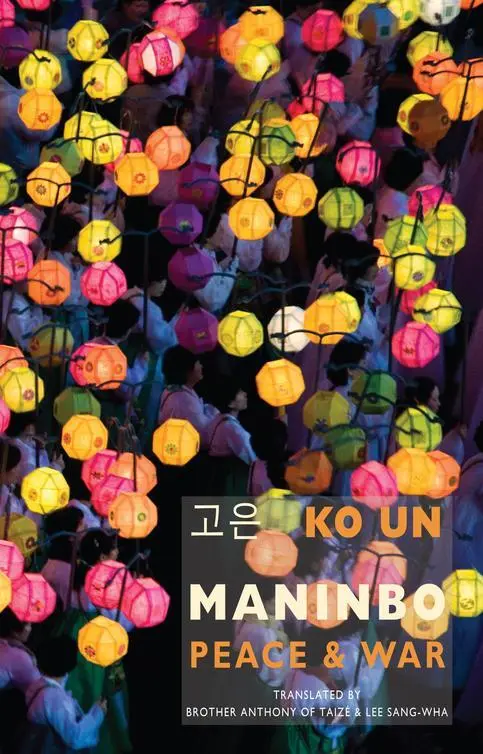
- Название:Maninbo: Peace & War
- Автор:
- Издательство:Bloodaxe Books
- Жанр:
- Год:2015
- ISBN:9781780372433
- Рейтинг книги:3 / 5. Голосов: 1
-
Избранное:Добавить в избранное
- Отзывы:
-
Ваша оценка:
Maninbo: Peace & War: краткое содержание, описание и аннотация
Предлагаем к чтению аннотацию, описание, краткое содержание или предисловие (зависит от того, что написал сам автор книги «Maninbo: Peace & War»). Если вы не нашли необходимую информацию о книге — напишите в комментариях, мы постараемся отыскать её.
Maninbo: Peace & War — читать онлайн бесплатно полную книгу (весь текст) целиком
Ниже представлен текст книги, разбитый по страницам. Система сохранения места последней прочитанной страницы, позволяет с удобством читать онлайн бесплатно книгу «Maninbo: Peace & War», без необходимости каждый раз заново искать на чём Вы остановились. Поставьте закладку, и сможете в любой момент перейти на страницу, на которой закончили чтение.
Интервал:
Закладка:
During the war,
they were insects, they were netted fish.
They wriggled
they flapped, they collapsed, grew stiff.
People were as vulgar as vulgar could be.
On March 5, 1951,
people went into air-raid shelters
and shook with fear of being bombed.
At the least sound of a plane
cold sweat ran down their backs.
Once the sound of the plane had died away
vegetables came out, meat appeared,
rice-cakes too appeared
in front of the Central Cinema at Wangsim-ni.
They had to go on living amidst the bombs.
They had to buy and sell.
If a bomb fell somewhere close,
the merchants vanished
leaving their bundles of cabbages where they were.
In March the Chinese forces began to retreat.
On March 10 the People’s Army withdrew.
Yi Hae-myeong, from the royal line of Joseon,
was forced to go with the People’s Army as a volunteer.
In streets littered with corpses
Yi Hae-myeong’s wife
wore men’s underwear
and came out to sell women’s clothes.
She never hid during bombing raids
but stayed in her market corner
Even when she’d had nothing to eat for three days
her face retained its human dignity,
female modesty too,
and her woman’s patience
remained alive, enduring the pain deep inside her.
In a rough age
she remained, still a human being.
DDT
Soon after Liberation in 1945,
Seoul began to swarm with 370 different political parties and civic groups.
Every morning when you woke up
several more had hung out their signboards.
Parties of just five members appeared, without even a signboard.
The commander of the occupying forces, General Hodge,
detested the Koreans, calling them cats or worse.
All the Koreans working in Hodge’s headquarters
and the Koreans in the streets
outside his headquarters
were liberally doused in DDT.
Smothered in that poisonous powder
the Koreans would giggle helplessly
while seething with shame.
Thanks to the Americans who came for the war
in 1950 Korea again became a land of DDT.
Fleas, bugs and the plentiful lice and nits about their bodies,
even the invisible microbes,
were uncivilised
so the Americans drenched the Koreans
in plentiful quantities of DDT.
All the orphans likewise
received baptisms in Hallelujah and DDT.
Offspring with neither dad nor mom became the offspring of DDT.
Choi Johan, a war orphan,
had as his family name that of the director of his orphanage, Zion Home,
and as his given name
the John of the Gospel of St. John.
His original name, Bak Seon-sik was completely forgotten.
Since his room happened to be next to a stinking cesspool,
Choi Johan’s blanket
always smelt of a mixture of sewage and DDT.
Ah, home, sweet home.
Yi Jeong-i’s family
They walked all the way from Jinnampo in North Korea
to Hongseong in South Korea’s Chungcheong province.
They walked and walked.
For twenty days they fled.
Yi Jeon-hae
and her sister Yi Jeong-i
with their parents following them.
All day long walking with nothing to eat.
When they found a well
they drank then walked on in the flesh-biting cold.
They dreaded the American troops
so they smeared their clothes
with their own shit.
They spread soot from kitchen chimneys
over their faces.
The mother became
a beggar-mum,
her daughters beggar kids
Their bodies stank of shit.
Instead of American troops, dogs came running.
Their robust father
likewise
blackened his face. The teeth inside his lips looked stronger still.
When snow fell
they ventured into a village
and were saved by a shed
or an empty cowstall.
Three hundred miles they walked
to arrive at Hongseong, and settle there.
When China attacked in January 1951,
Chinese forces never reached Hongseong,
being held back near the 38th parallel.
The family began a new life amidst the hills and fields of Hongseong,
purchased a big hospital.
One daughter, Yi Jeong-i, got married,
became the wife of poet-professor Kim Young-moo. Never late for Mass.
An Empty House
In Jangsa-dong, central Seoul, a big tiled-roof house lay empty.
After Seoul was recaptured for the second time
someone, intent on taking over the house,
came along, snarling:
‘This house used to be a red’s; from now on it’s mine.’
Another man came along, snarling:
‘I must live here.
A red killed my brother.’
Yet another man came along, accompanied by an MP.
‘I’m anti-communist fighter Bak Jong-sik, don’t you know?
You two, get out.
This house should belong to an anti-communist fighter.
Down with Kim Il-sung!
Defeat the communist party!’
Bak Jong-sik, a relative of the MP, took over the house.
After the MP left in his jeep,
the new owner moved into the empty house.
He removed the spider webs.
He had a name-plate made.
He bought a fierce dog.
‘Beware of the dog!’ was painted on the gate.
BIOGRAPHICAL NOTES
Born in 1933 in Gunsan, North Jeolla Province, Korea, Ko Unis Korea’s foremost living writer. After immense suffering during the Korean War, he became a Buddhist monk. His first poems were published in 1958, his first collection in 1960. A few years later he returned to the world. After years of dark nihilism, he became a leading spokesman in the struggle for freedom and democracy during the 1970s and 1980s, when he was often arrested and imprisoned.
He has published more than 150 volumes of poems, essays, and fiction, including the monumental seven-volume epic Mount Paekdu and the 30-volume Maninbo (Ten Thousand Lives) series. In recent years, more than thirty volumes of translations of his work have been published in some twenty languages. A selection from the first ten volumes of Maninbo relating to Ko Un’s village childhood was published in the US by Green Integer in 2006 under the title Ten Thousand Lives . A selection from the second ten volumes, Maninbo: Peace and War , was published by Bloodaxe Books in 2015. Ko Un’s most recent poetry was translated by Brother Anthony of Taizé and Lee Sang-Wha and published by Bloodaxe in 2012 in First Person Sorrowful . See: http://www.koun.co.kr
Born in 1942 in Cornwall, Brother Anthony of Taizéhas lived in Korea since 1980. He is an Emeritus Professor at Sogang University, and Chair-Professor at Dankook University. He has published some thirty volumes of English translations of Korean poetry and fiction, including eight volumes of work by Ko Un. He is a naturalised Korean citizen with the name An Sonjae. For more information see http://hompi.sogang.ac.kr/anthony/
Lee Sang-Whais an emeritus professor in the English Department of Chung Ang University, Seoul, and has published seven volumes of translations of English literature including two prose works by Gary Snyder.
Интервал:
Закладка:
Похожие книги на «Maninbo: Peace & War»
Представляем Вашему вниманию похожие книги на «Maninbo: Peace & War» списком для выбора. Мы отобрали схожую по названию и смыслу литературу в надежде предоставить читателям больше вариантов отыскать новые, интересные, ещё непрочитанные произведения.





Обсуждение, отзывы о книге «Maninbo: Peace & War» и просто собственные мнения читателей. Оставьте ваши комментарии, напишите, что Вы думаете о произведении, его смысле или главных героях. Укажите что конкретно понравилось, а что нет, и почему Вы так считаете.