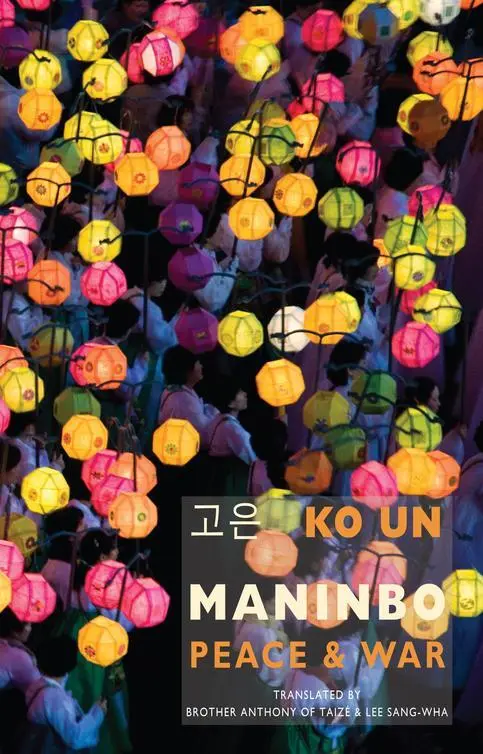
Ko Un - Maninbo - Peace & War
Здесь есть возможность читать онлайн «Ko Un - Maninbo - Peace & War» весь текст электронной книги совершенно бесплатно (целиком полную версию без сокращений). В некоторых случаях можно слушать аудио, скачать через торрент в формате fb2 и присутствует краткое содержание. Год выпуска: 2015, ISBN: 2015, Издательство: Bloodaxe Books, Жанр: Поэзия, на английском языке. Описание произведения, (предисловие) а так же отзывы посетителей доступны на портале библиотеки ЛибКат.
- Название:Maninbo: Peace & War
- Автор:
- Издательство:Bloodaxe Books
- Жанр:
- Год:2015
- ISBN:9781780372433
- Рейтинг книги:3 / 5. Голосов: 1
-
Избранное:Добавить в избранное
- Отзывы:
-
Ваша оценка:
Maninbo: Peace & War: краткое содержание, описание и аннотация
Предлагаем к чтению аннотацию, описание, краткое содержание или предисловие (зависит от того, что написал сам автор книги «Maninbo: Peace & War»). Если вы не нашли необходимую информацию о книге — напишите в комментариях, мы постараемся отыскать её.
Maninbo: Peace & War — читать онлайн бесплатно полную книгу (весь текст) целиком
Ниже представлен текст книги, разбитый по страницам. Система сохранения места последней прочитанной страницы, позволяет с удобством читать онлайн бесплатно книгу «Maninbo: Peace & War», без необходимости каждый раз заново искать на чём Вы остановились. Поставьте закладку, и сможете в любой момент перейти на страницу, на которой закончили чтение.
Интервал:
Закладка:
When Jeong-tae had been drinking
he longed to see his right-wing father
then if he drank more
he longed to see his left-wing maternal uncle.
The people who’d loved him
when he was a child.
Seven-year-old Nam-ok
In a roadside shack in Osan
lived a brother and sister whose parents had been killed.
The brother was fifteen, and
— the child below him having died –
then came Nam-ok, seven.
Her brother had gone along the railway lines collecting coals;
she was all alone,
having fun playing marbles.
Their land’s sky was completely occupied by American planes.
No Cheon-myeong
‘The deer,
a pathetic animal on account of its long neck.’
The woman who wrote that poem,
had a pointed chin,
wore traditional Korean skirt and jacket,
the skirt short, the jacket-ribbons long.
On June 24, 1950,
she was invited for a convivial supper
at the house of the older poet Mo Yun-suk,
who afterward accompanied her home in a jeep.
After the war broke out on June 25,
Mo Yun-suk hid on Aegi Hill behind Ewha Womans University.
She sent someone to No Cheon-myeong to ask for some food
and two summer jackets.
That woman,
far from sending summer jackets, demanded:
Tell me where Mo Yun-suk is.
If you don’t
I’ll hand you over to the security forces.
Soon loudspeakers echoed over Aegi Hill:
The reactionary Mo Yun-suk is hiding on this mountain.
Report her on sight.
In an extreme situation people have to betray even friends and colleagues.
In an extreme situation even lyric poets
become cold-blooded enemies.
In an extreme situation a delicate spinster
becomes a cruel witch.
In an extreme situation a simple rural emotion becomes an evil ideology.
When Seoul was recaptured, No Cheon-myeong was sentenced to death.
That was commuted to a life sentence,
then reduced to twenty years,
and soon
she was released on bail after writers sent in a petition.
Dressed in a white jacket and black skirt, No Cheon-myeong
turned up at a meeting of woman-writers in ruined Myeong-dong.
A Chance Encounter
Allied search teams were in full swing.
Enemy search teams also.
Somewhere near Palgong Mountain
Jeong Hae-bong,
a member of the twelfth regiment’s search team,
encountered Jeong Hae-seon, from the enemy search team.
They stood there, ten yards apart,
aiming rifles at each other.
Then one exclaimed:
‘Brother!’
The other replied:
‘Is that you, Hae-seon?’
They fell into each other’s arms.
The elder was twenty,
the younger eighteen.
Jeong Hae-seon joined the Southern search unit.
The two brothers, Jeong Hae-bong
and Jeong Hae-seon
both ate a lot of rice.
Rice was their hometown, their parents..
Eon-nyeon in Siberia
In the 1920s
some Koreans
made their way beyond Mongolia
into Russia,
journeyed all the way to near Lake Baikal
and settled in a ruined hut kept standing by props.
Such a long way to go to live.
Despite blizzards
and days so cold their urine froze,
they managed
not to freeze to death.
So harsh a way to live.
One freezing morning
a girl in Korean dress, long skirt and blouse,
a water pot on her head
went to fetch water
carrying a club to smash the ice
Not yet called Anna or Tatiana,
just Eon-nyeon, Pretty Girl.
Her father had not come back home for several days.
Boarding a sledge,
he went off to a hunting-lodge
in Bear Forest
Eon-nyeon had
two younger brothers
and two younger sisters
The family had grown as they journeyed on.
They’re not yet called Sergei or Josip or Boris but
First Twin
Second Twin
Dong-seop
Geut-seop
Below Eon-nyeon
Little Girl
Last Girl
Once she turned eight Eon-nyeon became an adult.
She had been living the days
she was destined to live.
Seong-jin
The Japanese imposed the solar calendar on the Korean people.
They abolished the first Korean festival,
the first day of the first lunar month,
Lunar New Year –
New Year ancestral offerings they abolished too.
January 1, solar new year, was the Japanese New Year.
Unknown to the authorities
we celebrated our own New Year.
Lunar New Year was our Independence Movement.
Broiled beef
fried flat cakes
cinnamon punch afloat with thin flakes of ice
boiled rice
steamed fish
Wearing new clothes we went round paying our respects.
But Seong-jin’s family in their grass hut outside the village
kept neither the Korean New Year
nor the Japanese New Year.
You would find there no bright party clothes,
no rice cakes.
Unearthing the root of an arrowroot vine
from the sunny side of some hill
Seong-Jin would chew hard on the root
for sudden new energy.
On a New Year’s morning
his prick stood erect in vain.
In June that year the war began.
One month later, when the People’s Army was in charge for three months,
he served as illiterate chairman for the Democratic Young People’s Front
after which he went missing, permanently.
Hallelujah
Outside Ganghwa town on Ganghwa Island
there’s Gapgot Point, a place where breezes blow.
In the fields of Gapgot,
once the distinctive February wind drops off,
the March wind comes along.
Skylarks venturing upward are hurt by the wind.
Across the whirlwind-stirred sea,
in the haze of the Gimpo plains
the April wind urges young rice seed-beds to sprout.
The seedlings are planted out in May.
As people plant the rice, they shout:
Hallelujah
Hallelujah
Once Christianity arrived at isolated villages
believers
and non-believers
became deadly foes.
In a single village
Baptists and Episcopalians
each the others’ foes
could not intermarry
or attend each others’ wedding parties.
A member of the Holiness Church, Gwak Il-gyu,
who shouts Hallelujah a hundred times a day,
is getting married to Hong Sun-ja of the same church,
who shouts Hallelujah two hundred times a day.
Episcopalians dare not attend
the wedding.
Even if they’re cousins
or distant relatives.
Former co-workers,
former close friends and kin
vanished,
became one another’s foes.
The moment the North Korea armies arrived
those on the left arose and killed those of the right.
Once the North withdrew
the right was left
having slaughtered all those of the left.
The churches prospered.
The churches distributed
American relief food and goods.
People came flocking
to collect wheat flour.
They even received a second-hand suit of clothes.
All were forced to shout Hallelujah!
Out in the fields at harvest time too:
Hallelujah!
Hallelujah!
Ji Ha-ryeon
At the height of Japanese rule the blue sky begot despair.
She was a poet’s wife,
a poet’s comrade.
From the very start her belated love
was heading for open-eyed darkness.
When she published her short story ‘Farewell’ in the review Munjang
Читать дальшеИнтервал:
Закладка:
Похожие книги на «Maninbo: Peace & War»
Представляем Вашему вниманию похожие книги на «Maninbo: Peace & War» списком для выбора. Мы отобрали схожую по названию и смыслу литературу в надежде предоставить читателям больше вариантов отыскать новые, интересные, ещё непрочитанные произведения.






Обсуждение, отзывы о книге «Maninbo: Peace & War» и просто собственные мнения читателей. Оставьте ваши комментарии, напишите, что Вы думаете о произведении, его смысле или главных героях. Укажите что конкретно понравилось, а что нет, и почему Вы так считаете.