Ko Un - Maninbo - Peace & War
Здесь есть возможность читать онлайн «Ko Un - Maninbo - Peace & War» весь текст электронной книги совершенно бесплатно (целиком полную версию без сокращений). В некоторых случаях можно слушать аудио, скачать через торрент в формате fb2 и присутствует краткое содержание. Год выпуска: 2015, ISBN: 2015, Издательство: Bloodaxe Books, Жанр: Поэзия, на английском языке. Описание произведения, (предисловие) а так же отзывы посетителей доступны на портале библиотеки ЛибКат.
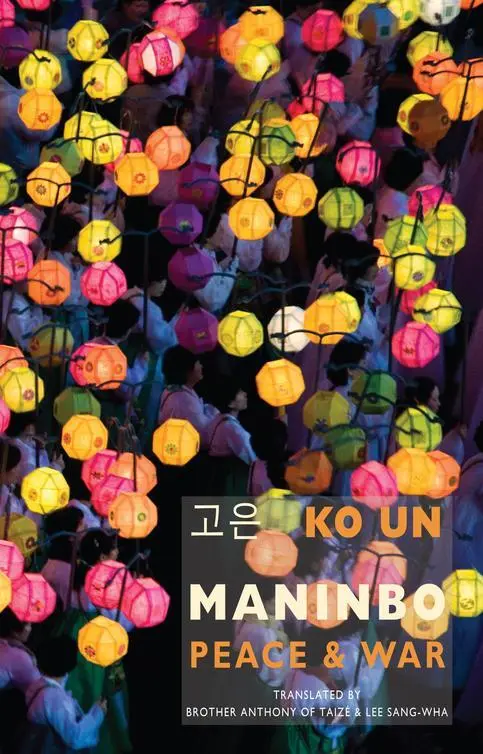
- Название:Maninbo: Peace & War
- Автор:
- Издательство:Bloodaxe Books
- Жанр:
- Год:2015
- ISBN:9781780372433
- Рейтинг книги:3 / 5. Голосов: 1
-
Избранное:Добавить в избранное
- Отзывы:
-
Ваша оценка:
Maninbo: Peace & War: краткое содержание, описание и аннотация
Предлагаем к чтению аннотацию, описание, краткое содержание или предисловие (зависит от того, что написал сам автор книги «Maninbo: Peace & War»). Если вы не нашли необходимую информацию о книге — напишите в комментариях, мы постараемся отыскать её.
Maninbo: Peace & War — читать онлайн бесплатно полную книгу (весь текст) целиком
Ниже представлен текст книги, разбитый по страницам. Система сохранения места последней прочитанной страницы, позволяет с удобством читать онлайн бесплатно книгу «Maninbo: Peace & War», без необходимости каждый раз заново искать на чём Вы остановились. Поставьте закладку, и сможете в любой момент перейти на страницу, на которой закончили чтение.
Интервал:
Закладка:
in 1940, in the midst of the Sino-Japanese War
and just before the Pacific War,
colonised Korea
was proud of its camellia-like woman writer,
Ji Ha-ryeon.
She was Masan’s drunken spirit,
the desire of the night sea in Masan Bay.
Lovely Ji Ha-ryeon fell in love with handsome Im Hwa’s tuberculosis.
She made a secret conversion.
Poet Im Hwa’s original name was Yi Hyeon-uk.
They had the happiest times after Liberation.
Her husband,
putting on light linen clothes,
invited Kim Sun-nam
and Ham Se-deok to dinner,
a meal which his wife in her apron prepared to perfection.
They joined the underground,
went North.
Just after the war, the poet was executed,
the poet’s wife
was thrown into an asylum.
She spent days of despair, raving and fainting,
then died like trash.
Ideology, that was their dream.
Ideology, that was their death.
Ji Ha-ryeon.
Literature, revolution, love
beneath skies that spout blue blood.
Lieutenant Bak Baek
Lieutenant Bak Baek,
adjutant of the search company, 2nd battalion, 16th regiment, 8th division.
He advanced as far as Chosan
on the banks of the Yalu River. He was very much moved, impassioned.
It was early winter, 1950.
He gazed across the river
at Manchuria, Chinese land.
They encountered the Communist Chinese army.
His body turned into a hedgehog.
On a hill
between Huicheon and Gujang
he was taken prisoner by the Chinese army.
The company commander was killed in action,
two soldiers were killed, three injured,
and the remaining thirty taken prisoner.
The POW camp at Gwansan in Hwapung
held five hundred South Korean soldiers
and three hundred American soldiers.
In the bitter winter prisoners kept dying.
In the camp
each room held twenty men, no space to lie down.
If one died,
the rest had a little more space.
Keeping prisoners’ corpses
for two or three days in the room,
leaning them against the wall
at roll-call,
the rest shared the rations of the dead.
They were given one handful of corn twice a day.
In one day fifty or so died.
One cupful of lice came crawling
from every corpse.
Some died gnawing icicles.
Numb from frostbite,
they felt no pain when a finger was cut off.
Lieutenant Bak Baek did not die. He came back in an exchange of prisoners.
Bracken in Namdaemun’s Dokkaebi Market
Goods from the PX on the American base at Yongsan are loaded onto a truck.
Kim Cheol-su, a Korean,
and Harry, a black American,
are expert thieves.
They pass the checkpoint at the back gate
when MP John Beckham is on duty,
that’s 4.30 in the morning.
At 5.30
they deliver to Pyo Jong-seon in Namdaemun’s Dokkaebi Market.
Watches,
chocolate,
‘Akadama’ cigarettes,
Camels,
blankets,
military boots,
UN jackets,
fountain pens,
woollen underwear,
gum,
electric razors.
Pyo Jong-seon is from Haeju, up in Hwanghae province.
He never haggles over goods.
He pays what they ask.
This makes him popular,
So the thieves
sell to him cheap.
His nickname is Bracken of Mount Suyang.
On Mount Suyang in Haeju
there’s a shrine commemorating
the Chinese brothers Boyi and Shuqi.
When Mount Suyang Bracken
goes home,
he tells his first grand-daughter about Simcheong,
the second one about Princess Nangnang.
He was one of the rich folk of Chungmu-ro street
but one day
American MPs, preceded by Korean MPs,
raided his store and took him away.
Yi Jung-seop
In 1952
people were drinking Nakdong River soju .
In a bar in an alley of Hyangchon-dong in Daegu
Yi Jung-seop vomited.
Colonel Yi Gi-ryeon
jokingly mocked the drunken Yi Jung-seop:
‘Hey! You smell like a proletarian!’
That means
you’re a commie, you’re a red.
The next day Yi Jong-seop, having sobered up,
remembered the words about his proletarian smell.
He remembered them the day after,
and the next day, as well.
His whole body shrank.
He went to see the head of investigations in Daegu police station.
‘I am not a red.
Please certify
that I’m not a red.’
His friend the poet Ku Sang came to take him home.
Everywhere people were suffering from red persecution complexes.
If someone says
you’re a red, you’re done.
If someone reports you as a red, you’re done.
Such was the age. Fearful.
I am not a red.
Two Men
September 29, 1950.
The day before, the three months of communist rule had ended.
The Republic of Korea that had run away
came back.
The city was still empty.
At the Gwanhwamun intersection
one man came limping from Jong-ro 1-ga.
A ragged figure was approaching
along Sinmun-ro.
They met in the middle of the intersection. They were strangers to each other.
For a full thirty minutes
they talked.
They told tales
and listened to tales
about how each had survived,
survived in hiding.
How painful it was to live alone,
how despondent they felt
to have survived alone.
The two men shared a cigarette, then parted, saying: ‘See you again.’
Midday came.
At the intersection,
not so much as a mouse in sight.
Na Jeong-gu of Myeong-dong
Anyone was free to get drunk and collapse in ruined Myeong-dong,
free to piss to his heart’s content
on the eulalia growing as dense as pubic hair
between the pieces of broken brick
and cement walls.
Anyone was free to show off,
bragging how splendid he’d once been
but now he was a beggar.
Anyone was free to become an artist
the moment he stood beside an artist.
Beside the tall painter Kim Hwan-gi
anyone could turn into a modern artist
who painted pictures of Joseon-era white jars.
Beside Kim Hyang-an, the former wife of poet Yi Sang,
now the wife of Kim Hwan-gi,
anyone could turn into a stylish essayist.
While walking along with chain-smoking Yi Myeong-on,
anyone could turn into an essayist and former journalist.
Poet Bak In-hwan died
after writing his boisterous poem ‘The Rocking Horse and the Lady, Virginia Woolf’.
Anyone who shook hands with Kim Su-yeong,
who had joined the volunteer army
and was just out of Geoje Island POW camp,
became a post-war poet.
In ruined Myeong-dong there was the freedom of the True and False as one.
The drunkard Na Jeong-gu,
who pushed his way in wherever people were drinking,
was today a poet,
tomorrow an essayist.
What might he be the day after?
So long as he had a mouth to drink with
he was free to enter the bars Poem or Eunjeong
and join any group he found there.
Ah, in the ruins of Myeong-dong under the Republic of Korea
there was freedom for every kind of extravagance and bluff,
freedom hanging in the air like the spell of a dead age.
Hong Sa-jun
One writer’s dream was glorious, his life short.
Hong Sa-jun,
a fine-featured young man,
was a literary star
during the three months of the communist occupation.
North Korean writers praised him highly.
Читать дальшеИнтервал:
Закладка:
Похожие книги на «Maninbo: Peace & War»
Представляем Вашему вниманию похожие книги на «Maninbo: Peace & War» списком для выбора. Мы отобрали схожую по названию и смыслу литературу в надежде предоставить читателям больше вариантов отыскать новые, интересные, ещё непрочитанные произведения.





Обсуждение, отзывы о книге «Maninbo: Peace & War» и просто собственные мнения читателей. Оставьте ваши комментарии, напишите, что Вы думаете о произведении, его смысле или главных героях. Укажите что конкретно понравилось, а что нет, и почему Вы так считаете.