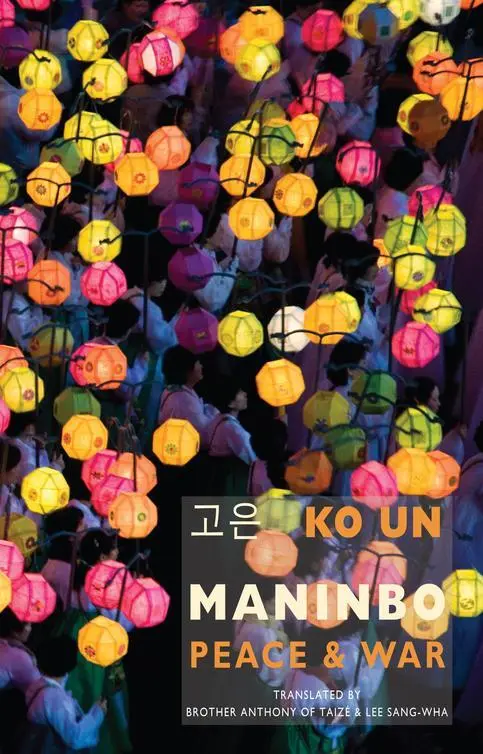
Ko Un - Maninbo - Peace & War
Здесь есть возможность читать онлайн «Ko Un - Maninbo - Peace & War» весь текст электронной книги совершенно бесплатно (целиком полную версию без сокращений). В некоторых случаях можно слушать аудио, скачать через торрент в формате fb2 и присутствует краткое содержание. Год выпуска: 2015, ISBN: 2015, Издательство: Bloodaxe Books, Жанр: Поэзия, на английском языке. Описание произведения, (предисловие) а так же отзывы посетителей доступны на портале библиотеки ЛибКат.
- Название:Maninbo: Peace & War
- Автор:
- Издательство:Bloodaxe Books
- Жанр:
- Год:2015
- ISBN:9781780372433
- Рейтинг книги:3 / 5. Голосов: 1
-
Избранное:Добавить в избранное
- Отзывы:
-
Ваша оценка:
Maninbo: Peace & War: краткое содержание, описание и аннотация
Предлагаем к чтению аннотацию, описание, краткое содержание или предисловие (зависит от того, что написал сам автор книги «Maninbo: Peace & War»). Если вы не нашли необходимую информацию о книге — напишите в комментариях, мы постараемся отыскать её.
Maninbo: Peace & War — читать онлайн бесплатно полную книгу (весь текст) целиком
Ниже представлен текст книги, разбитый по страницам. Система сохранения места последней прочитанной страницы, позволяет с удобством читать онлайн бесплатно книгу «Maninbo: Peace & War», без необходимости каждый раз заново искать на чём Вы остановились. Поставьте закладку, и сможете в любой момент перейти на страницу, на которой закончили чтение.
Интервал:
Закладка:
from Hongcheon to Wonju, from Wonju to Yeongcheon.
Refugees came streaming down, too,
with a pot, some bowls,
a bag of rice, a bottle of salt.
In every village they passed
the villagers killed cows or pigs and sold the meat.
The village people also sold
their belongings one by one.
In any case, the livestock would soon be requisitioned
or carried off by the army.
So they killed them and
received 5 won for a pound of beef,
2 won for a pound of pork.
They boiled them in soy sauce and sold that, too.
Gu Bon-yeong from Yeongcheon
killed two pigs
and sold them to the refugees.
He sold his goats and killed chickens to sell them, too.
Having sold everything
Gu Bon-yeong himself had to flee southward
seven hundred li downstream
along the Nakdong River,
ending up in Busan.
Gu Bon-yeong’s younger brother, Bon-ho, stayed behind.
‘You leave, Brother,
and take Mother,’
he said; ‘I must stay.
If the People’s Army arrives,
I’ll live in their world,’ he said.
‘If the Southern army arrives,
I’ll live in their world.’
His married elder brother had taken the land
their father inherited, fields and paddies.
Bon-ho was an old bachelor with nothing.
He could live with nothing, he said,
in whatever world he found himself.
That old bachelor Bon-ho
followed the People’s Army when they retreated.
Nobody in his family thought he would turn up one night
in their home as a spy.
Little Cheon-dong
In the backcountry of Sangju at the foot of Mount Sobaek
lay a village
of only eleven households.
It was a remote village,
with neither right wing nor left.
Because the world refused to stay still,
these villagers too
followed the head of the neighbouring village, just over the hill,
and joined the refugees on the road.
From the start they had hard times.
Looking back after setting off,
already their houses and their village
looked far away.
Carrying half a sack of rice on his back,
a man dragged along two goats.
The older child carried the bedding,
the younger something lighter.
His pregnant wife went into labour.
Screaming on the grass by the hill path,
she frightened the goats she’d been dragging along
and gave birth to a blood-covered baby.
The man set up a cauldron so she could eat seaweed soup.
He named the new-born Cheon-dong,
meaning ‘live a thousand years’.
The baby’s left hand had six fingers,
so he tied the fifth and sixth together with thread.
There was no going back.
Mother and child spent a while
in someone’s draughty back room.
Then when the People’s Army was near
they took to the road once again.
Cheon-dong was lucky:
his mother was healthy and brimming with milk.
Kim Jin-yeol
War made a person swell up
into someone totally different.
In the train of refugees
he stole
five wristwatches
two gold turtles
twenty-four gold buttons
three gold hair-pins
eight gold rings
and seven thousand won in cash.
He was so delighted he whistled, which tickled his ribs.
He approached a sleeping woman who had a fox-fur muffler
and stealthily removed the muffler from around her neck.
He approached an old man driven into a corner by people’s pushing
and took the bundle he was clutching as he slept.
Inside he found some cash
and several house deeds.
Amazing!
There are guys who get rich even while they’re fleeing for their lives.
How amazing!
Once safely settled in some unfamiliar city,
he fooled a woman into becoming his wife.
Kim Jin-yeol,
son of a stationer at Uljiro 3-ga, Seoul.
Before he fled South,
he had never stolen,
had never looked at a woman.
Bak Gwan-hyeok
Only once did he do good.
Jin-Su’s father was
a miser all his life,
a bully all his life,
a liar all his life,
always abusing and exploiting.
Old Bak Gwan-hyeok.
But as he lay dying, at the age of seventy-seven.
he called for his farmhand Myeong-gu.
From his lips issued these words:
‘You are my son by our kitchen maid.
The half-acre of paddy over in Jindong is yours.’
Then he spoke to his eldest son,
Jin-su:
‘Myeong-gu has our blood in his veins.’
That ruthless old man
had survived in safety
even under the Communists.
Arrowroot-vine sinews his whole life long.
Yi Yeong-geun
In the days of the Liberal Party
he was arrested by Counter-Intelligence.
You bloody red!
Agent for Kim Il-sung!
Agent for Jo Bong-am!
Bastard!
You wretched liberals,
how dare you say anything against His Excellency Syngman Rhee,
you bloody reds!
For one full week,
for all but three or four hours a day,
he suffered
every kind of torture.
Enough to bring Ulsan Rock on Mount Seorak crumbling down.
Through torture
torturers get to know through and through
the one they are torturing.
They got to know that most manly of men,
that most human of humans,
that most admirable man, Yi Yeong-geun.
Baaastard! Fine fellow! Human of humans!
He framed the founding declaration of the Progressive Party.
He followed Jo Bong-am, its leader,
and was close to Bak Jin-mok.
Before Jo Bong-am was arrested
Yi Yeong-geun urged him
to go into exile in India:
he’d arrange for a ship to smuggle him out.
Two days later Jo Bong-am was arrested.
Jo Bong-am was executed.
Yi Yeong-geun, most human of humans,
left for Japan in a smuggler’s boat.
His horselaugh was loud.
His inward heart was deep.
He never spoke of past pains
or present poverty.
By himself, alone, he preserved the world of comrades and old friends.
Gamak Valley
During wartime the men die,
the women survive.
Cockerels have their necks twisted and die,
hens sit on eggs.
At Gamak Valley in Yeonsan,
north of Nonsan in South Chungcheong
sharp hills
approach the ridges of Mount Gyeryong.
Fifty men died there, once,
while two men
twisted their hair into topknots and revered Kim Il-bu’s esoteric Jeongyeok .
The small room, the door of which is never opened
was pitch dark even at midday.
Yeonsan’s Gamak Valley.
Some forty women survived:
old widows,
young concubine widows,
young widows,
old maids.
If an unfamiliar man appears, their eyes light up.
They each offer a gourd of water with a willow leaf on it.
‘You must be thirsty.’
‘You look thirsty.’
‘You’re thirsty.’
The woman from Buyeo with long cheek-bones,
hastily comes forward.
‘Drink this water.
I have no idea who you are or where you are from,
yet your face looks familiar.
If you are hungry
I will warm some cold rice, so you can eat before you go on.’
The woman from Ganggyeong poured the water out of her gourd, grumbling:
‘Yesterday she was making up to a male dog,
today she’s clinging to a man instead of a beast, that slut.’
One Schoolgirl’s Life
Jo Eun-seon,
Jo Sang-yeon’s sister in Sinchon,
Читать дальшеИнтервал:
Закладка:
Похожие книги на «Maninbo: Peace & War»
Представляем Вашему вниманию похожие книги на «Maninbo: Peace & War» списком для выбора. Мы отобрали схожую по названию и смыслу литературу в надежде предоставить читателям больше вариантов отыскать новые, интересные, ещё непрочитанные произведения.









Обсуждение, отзывы о книге «Maninbo: Peace & War» и просто собственные мнения читателей. Оставьте ваши комментарии, напишите, что Вы думаете о произведении, его смысле или главных героях. Укажите что конкретно понравилось, а что нет, и почему Вы так считаете.