Ko Un - Maninbo - Peace & War
Здесь есть возможность читать онлайн «Ko Un - Maninbo - Peace & War» весь текст электронной книги совершенно бесплатно (целиком полную версию без сокращений). В некоторых случаях можно слушать аудио, скачать через торрент в формате fb2 и присутствует краткое содержание. Год выпуска: 2015, ISBN: 2015, Издательство: Bloodaxe Books, Жанр: Поэзия, на английском языке. Описание произведения, (предисловие) а так же отзывы посетителей доступны на портале библиотеки ЛибКат.
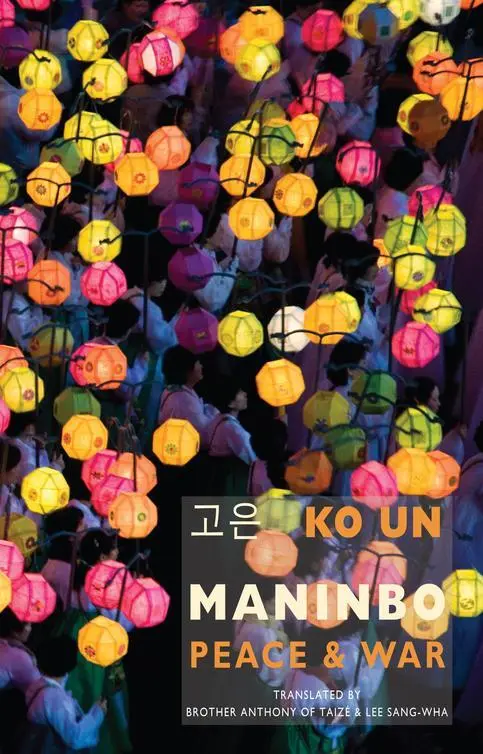
- Название:Maninbo: Peace & War
- Автор:
- Издательство:Bloodaxe Books
- Жанр:
- Год:2015
- ISBN:9781780372433
- Рейтинг книги:3 / 5. Голосов: 1
-
Избранное:Добавить в избранное
- Отзывы:
-
Ваша оценка:
Maninbo: Peace & War: краткое содержание, описание и аннотация
Предлагаем к чтению аннотацию, описание, краткое содержание или предисловие (зависит от того, что написал сам автор книги «Maninbo: Peace & War»). Если вы не нашли необходимую информацию о книге — напишите в комментариях, мы постараемся отыскать её.
Maninbo: Peace & War — читать онлайн бесплатно полную книгу (весь текст) целиком
Ниже представлен текст книги, разбитый по страницам. Система сохранения места последней прочитанной страницы, позволяет с удобством читать онлайн бесплатно книгу «Maninbo: Peace & War», без необходимости каждый раз заново искать на чём Вы остановились. Поставьте закладку, и сможете в любой момент перейти на страницу, на которой закончили чтение.
Интервал:
Закладка:
Within twelve days the finger healed.
Meanwhile he failed the medical, classed third grade.
Relieved, he set about selling tofu.
Putting the tofu trays on his shoulder
he left home early, before breakfast time.
Buy my tofu.
Buy my tofu.
He did evening rounds, too.
Buy my tofu.
Buy my tofu.
After his parents quit the world
he provided his four younger siblings with food,
fed them as well the tofu that was left unsold.
VOLUME 18
Ong-nye’s Husband
Putilovka village in far-away Hassan,
where three borders meet:
Korea, Manchuria, Russia.
In secret, Korean farmers
would cross into that region,
as yet free of bandits.
They built hovels to keep out wind and rain
and survived by grazing cattle and goats
every day on the grass of three countries.
There they lived, snaring birds
on the banks of the Tumen,
catching wild deer,
sowing grain and hunting.
While washing clothes by a stream,
hunter Jang Gil-seong’s daughter Ong-nye
met a man on a horse.
His eyes were hollow
with hunger.
He couldn’t even dismount by himself
Ong-nye wiped her wet hands and helped him down.
She went back home for some cold rice
and returned to feed him.
A Korean independence fighter,
he had crossed the river
on his dead commander’s horse,
pursued by the Japanese.
Actually, he’d rowed across,
the horse swam.
He hadn’t eaten for three days.
Ong-nye brought him home.
When her father returned from hunting, she begged:
Let this man become my husband.
Allow your daughter
to become this man’s wife,
Father!
Her father Jang Gil-seong
tossed his catch — two cock-pheasants –
at the stranger’s feet.
Old Madman
He goes about with a dog’s bone stuck in his belt.
He gobbles up earthworms
and frogs, too, all deftly caught
Heuh heuh,
heuh heuh heuh,
he laughs, looking at the sky,
the sky where hawks hover.
Neighbourhood kids
tease him,
throwing stones.
Heuh heuh,
he laughs.
At the sound of a plane he falls flat on his back.
Asleep
under the bridge beyond the village,
his face becomes utterly holy,
utterly peaceful.
When the curs bark at him
he bows his head obsequiously, twisting his hands, saying:
‘I did wrong.
I did wrong.’
Tae-sun’s grandmother explains:
‘He’s a fellow from Uitteum in Sangchon-ri
who went mad after losing two sons.’
One was conscripted in the Pacific War and never came back.
One was drafted in the Korean War and never came back.
Gunfire in Bongdong-myeon, Wanju
Soldiers of the People’s Army
were despatched to every hamlet in the occupied areas.
One soldier arrived in Bongdong-myeon, Wanju, North Jeolla province.
A greenhorn soldier, always laughing,
he drank the liquor
that the villagers offered with a village girl,
then went into the bean-field with her.
This became known.
His comrades hastily shot him: no trial, nothing.
After that, not one but three soldiers
were stationed in Bongdong-myeon.
A little later, two left.
The third stayed for the last two months
of occupation, then left.
He never accepted a single leaf of tobacco,
let alone a free drink.
This greenhorn soldier left
firing blanks from his submachine gun.
At the foot
of the village’s clay walls and crumbling reed fences
balsam prospered, flowering
no matter who went or didn’t.
A Cow in Gangneung, 1953
War
affects cows, too,
dogs, too.
The war
made not just the eyes of humans
but the eyes of animals bloodshot.
During spring plowing,
one cow would not obey.
Urged on:
This way!
This way!
it just flopped down on the ground.
Shin O-man of Gangneung put up with that.
As Shin O-man’s son
was pouring out the boiled cattle feed
he was gored
and one horn pierced his thigh.
Shin O-man couldn’t put up with that.
With his wooden club.
he gave the cow a blow on the back
War
drives humans mad,
cows too!
He considered selling it,
then, calming down,
decided to wait
a little longer.
Seeing as how the long-drawn-out negotiations for an armistice
are almost over, surely the war is heading away
from our cow, all that we have
and part of the family.
Kim Jong-ho
His mother,
his younger sister,
and his two younger brothers
were caught and killed by the departing commander of the People’s Army.
Kim Jong-ho, who ran away and so survived,
caught the commander’s daughter,
dragged her into an empty house,
raped her, then killed her.
He also caught another commie’s wife,
raped her, then killed her.
He killed in that way
three times,
or four,
or five,
then, on a full-moon night,
climbed to a hilltop and wailed.
After that he drank every day.
He smashed the window of the tavern.
He grabbed the bar-girl by the hair and swung her around.
The neighbourhood menfolk
carted him off,
his limbs flailing.
He went away. Somewhere.
His house was sold off.
Sim Bul-lye
The war was over.
The war had lasted three years which felt like thirteen.
The near-empty crocks on the storage terrace made whining sounds.
The blue sky descended
on the soy sauce left in the crocks
and wept salty tears.
Early summer,
on the sixth day of the Armistice,
she appeared at Daejeon railway station
wearing a nylon skirt
and a nylon blouse
she’d been storing somewhere,
and sporting a parasol:
Sim Bul-lye.
Almost all who intended to return to Seoul were back.
Daejeon too had gone back to being the same old Daejeon.
The sky alighted close by.
Sunlight poured down on the parasol,
repaired some days before;
sweat pearled on the young woman’s breasts.
Yi Song-won, the boy from Gasuwon
who had come visiting every night in her dreams
no longer visited.
He had come visiting every night
since being killed while fighting in the Iron Triangle.
His mother called a shaman;
only after a costly exorcism
was his soul set to rest.
That day she was off to visit her aunt in Jochiwon.
Her aunt who’d been inviting her at every turn:
‘Call on me,
call on me.’
So she set off.
She did the washing, cooked the rice,
finished the sewing, swept the yard,
nursed her father,
drew water at dawn,
drew water at night
Finally, free of housework at last,
she went flying along.
What kind of man did her aunt have her eye on?
She could guess why her aunt wanted her to visit.
She might look young,
but deep inside
she knew what was what.
Sim Bul-lye.
Bak Yeong-man
As a child, he was best at the Thousand-Character Classic.
Ikki eon, ikki jae, on ho, ikki ya …
as he finished the last line of the Classic,
his flushed face looked cute.
Bak Yeong-man,
a boy with a good-looking prick –
Читать дальшеИнтервал:
Закладка:
Похожие книги на «Maninbo: Peace & War»
Представляем Вашему вниманию похожие книги на «Maninbo: Peace & War» списком для выбора. Мы отобрали схожую по названию и смыслу литературу в надежде предоставить читателям больше вариантов отыскать новые, интересные, ещё непрочитанные произведения.





Обсуждение, отзывы о книге «Maninbo: Peace & War» и просто собственные мнения читателей. Оставьте ваши комментарии, напишите, что Вы думаете о произведении, его смысле или главных героях. Укажите что конкретно понравилось, а что нет, и почему Вы так считаете.