Ko Un - Maninbo - Peace & War
Здесь есть возможность читать онлайн «Ko Un - Maninbo - Peace & War» весь текст электронной книги совершенно бесплатно (целиком полную версию без сокращений). В некоторых случаях можно слушать аудио, скачать через торрент в формате fb2 и присутствует краткое содержание. Год выпуска: 2015, ISBN: 2015, Издательство: Bloodaxe Books, Жанр: Поэзия, на английском языке. Описание произведения, (предисловие) а так же отзывы посетителей доступны на портале библиотеки ЛибКат.
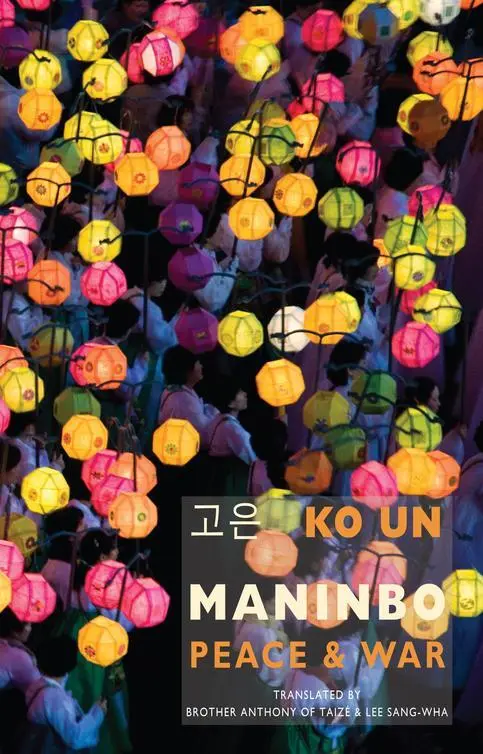
- Название:Maninbo: Peace & War
- Автор:
- Издательство:Bloodaxe Books
- Жанр:
- Год:2015
- ISBN:9781780372433
- Рейтинг книги:3 / 5. Голосов: 1
-
Избранное:Добавить в избранное
- Отзывы:
-
Ваша оценка:
Maninbo: Peace & War: краткое содержание, описание и аннотация
Предлагаем к чтению аннотацию, описание, краткое содержание или предисловие (зависит от того, что написал сам автор книги «Maninbo: Peace & War»). Если вы не нашли необходимую информацию о книге — напишите в комментариях, мы постараемся отыскать её.
Maninbo: Peace & War — читать онлайн бесплатно полную книгу (весь текст) целиком
Ниже представлен текст книги, разбитый по страницам. Система сохранения места последней прочитанной страницы, позволяет с удобством читать онлайн бесплатно книгу «Maninbo: Peace & War», без необходимости каждый раз заново искать на чём Вы остановились. Поставьте закладку, и сможете в любой момент перейти на страницу, на которой закончили чтение.
Интервал:
Закладка:
Jin Mu-gil’s cousin in Okjeong-ri, a tall girl,
locked herself in her room
and huddled all night in the closet, a cripple, a hunchback.
Exoduses
In January 1911
having lost their nation,
the people left, fleeing from the Japanese:
the first exodus.
In 1912
more people left, fleeing from the Japanese:
the second exodus.
In the summer of 1913
more people left, fleeing from the Japanese:
the third exodus.
And a fourth exodus, fifth, sixth…
during the Japanese invasion of Manchuria in 1931,
even during the Pacific War in 1942.
They left
with one pot,
one blanket,
and a sick child on their backs.
Farmers who for centuries had never once thought of leaving
left.
Tomorrow, when they hope to regain their country,
and today, with its starvation, embraced one other,
and they were hopeless on the long mountain ridges
while the sun set.
Amidst such processions
a boy was growing up
who would later throw a bomb
at the Japanese emperor.
Revering Yi Bong-chang
who was executed after throwing a bomb at the Japanese emperor,
he changed his name from Nam Ji-su to Nam Bong-chang,
made a bomb, and was caught in the act.
A Scene
A little boat was floating on the sea off Byeonsan.
During the war
sun-bronzed Gang Dong-su
put out to sea
to draw his father’s spirit out of water.
Bailing out the boat,
Father
Father
Father, come on out.
In the summer of 1950
Gang Byeon-hwan, a guard at the office of the People’s Committee
in Buan, North Jeolla province,
was thrown into the sea with all the other red collaborators
as the communists retreated northward.
Father, father, don’t be afraid, come on out quickly.
That Child
By the sea in Asan,
South Chungcheong province,
rose a hill that looked about to collapse,
a hill
that had thawed after freezing.
Ah, that child,
Kim Tae-seop,
left all alone and
always crying.
A boy in his early teens
with his head completely shaved
passed by some clumps of goosefoot.
Following him
was one hollow-bellied goat.
Not a boat was in sight on the evening sea.
Not a tree on the hills.
His parents, reds, had been arrested and had died.
Their only child
was sent to his maternal uncle’s house.
He grew up working in the paddies
and in the fields.
Today
he has walked a long way
and is gazing at the sea.
Of father,
of mother,
no sign.
Chi-sun
The Soejeongji field,
the Bawipaegi field,
the Galmoe field,
the Jaechongji field,
then over the hill, the Bangattal field,
the Bangjuk field.
Work was unending throughout the year.
First daughter, Chi-sun was adept at housekeeping,
a good worker.
Drawing water at daybreak,
cooking,
pounding the mortar,
boiling cattle feed,
carrying food to the field-workers,
sweeping the yard,
removing the ashes,
catching insects in the kitchen garden,
doing laundry,
weaving straw sacks on rainy days,
patching old clothes by lamplight
in the evenings.
She had no time to catch a cold,
no darkness in which to look up at stars.
She wasn’t born to be a person,
she was born just to be a labourer.
One wish
lay in her heart:
never to marry
into a household with a lot of work.
Then, thanks to a matchmaker, she married
a son of the miller, of all people.
From early morning,
together with one errand-girl,
she measured out the weight of rice
in the dust-filled mill
and in the evenings
kept watch over the watermelon and melon patches.
She wasn’t married as a person
but as a labourer.
Her husband was an invalid,
a consumptive.
She had to prepare drinking tables
for her father-in-law
three or four times a day.
Worn out after such a life, she watched
her husband, his health improving,
take a concubine, a new labourer.
Yi Jong-nak
Intent on restoring Korea’s independence by all means,
he went into exile in Shanghai.
One day at dawn, Yi Jong-nak
woke from a dream where families back home
dressed in white were waving their hands.
After that he fell sick.
He went to a German hospital,
to a Japanese hospital.
He did not want to die
in a Japanese hospital,
so he moved to one in the French concession.
One day,
An Chang-ho visited him in hospital.
He told him to believe in Christianity.
Sick, Yi Jong-nak replied
that he could not believe in order to live;
once he got well he would believe with a sound mind.
One day
he said quietly to his comrade Jeong Hwa-am,
‘Hwa-am, I’m dying. Go on fighting for me as well.’
Clutching his comrade’s hand
he died.
He did nothing really to contribute to the independence movement,
not one act to speak of.
His forearms were so strong an awl could not pierce them.
He was good at the violin, good at sports,
good at singing at drinking parties.
Yi Jong-nak stood briefly on a small corner of his times, then went away.
The Lock-seller
Even a wooden shack had to have a lock.
Anyone who went to sleep leaving the front gate open was a fool.
Anyone who went to sleep without locking the door to his room was a fool.
Midsummer evenings,
while people were killing and being killed on the front,
in the rear thieves made their rounds by night.
Everyone had to have a padlock.
Safely locked in,
they had to hear in their dreams
the waves of the night sea.
A dusty wind was blowing in Gongdeok-dong in Seoul.
At the entrance to the alley
a seller of locks and keys
walked by, metal locks jangling from his clothes,
dressed in clothes heavy with clumps of iron.
Buy my keys!
Buy my locks!
Keys repaired. Locks repaired.
Buy my locks!
You can trust only to locks.
Buy my locks, buy my keys!
Two passing middle-school boys asked:
‘Hey, Mister!
What’s better, keyhole or key?’
The lock-seller laughed.
‘Hey kids, I don’t know,
go home and ask your parents.’
Yi Yohan the Orphan
Not one child was crying.
On the plaza in front of Busan station in 1952
there were children five-years-old,
six-years-old,
eight-years-old,
and some you could not tell:
five? six? eight?
Some bigger ones were eleven.
Some smaller ones were nine.
The children, wearing old woollen hats,
had been sent from Daegu, were headed
for Zion Orphanage at Songdo, Busan.
Gap-toothed children
deaf children
children with long trails of snot.
When they passed through tunnels
they were covered with coal smoke
in trains without windows
None was crying.
Crying was cowardly. Crying was shameful.
One of those children
was named Yi Yohan.
He had been given the family name of a pastor at a Daegu church.
His Christian name was that of John the Evangelist.
He knew nothing of his mother,
nothing of his father.
Later, this child
grew up to be one of the policemen who opened fire
Читать дальшеИнтервал:
Закладка:
Похожие книги на «Maninbo: Peace & War»
Представляем Вашему вниманию похожие книги на «Maninbo: Peace & War» списком для выбора. Мы отобрали схожую по названию и смыслу литературу в надежде предоставить читателям больше вариантов отыскать новые, интересные, ещё непрочитанные произведения.












Обсуждение, отзывы о книге «Maninbo: Peace & War» и просто собственные мнения читателей. Оставьте ваши комментарии, напишите, что Вы думаете о произведении, его смысле или главных героях. Укажите что конкретно понравилось, а что нет, и почему Вы так считаете.