Ko Un - Maninbo - Peace & War
Здесь есть возможность читать онлайн «Ko Un - Maninbo - Peace & War» весь текст электронной книги совершенно бесплатно (целиком полную версию без сокращений). В некоторых случаях можно слушать аудио, скачать через торрент в формате fb2 и присутствует краткое содержание. Год выпуска: 2015, ISBN: 2015, Издательство: Bloodaxe Books, Жанр: Поэзия, на английском языке. Описание произведения, (предисловие) а так же отзывы посетителей доступны на портале библиотеки ЛибКат.
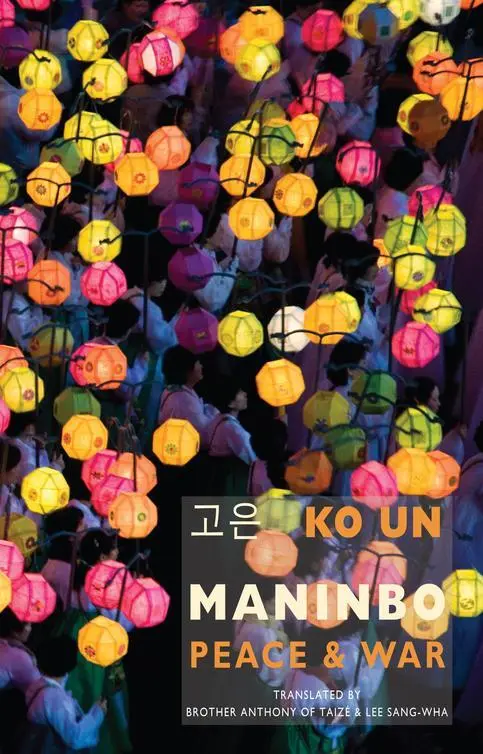
- Название:Maninbo: Peace & War
- Автор:
- Издательство:Bloodaxe Books
- Жанр:
- Год:2015
- ISBN:9781780372433
- Рейтинг книги:3 / 5. Голосов: 1
-
Избранное:Добавить в избранное
- Отзывы:
-
Ваша оценка:
Maninbo: Peace & War: краткое содержание, описание и аннотация
Предлагаем к чтению аннотацию, описание, краткое содержание или предисловие (зависит от того, что написал сам автор книги «Maninbo: Peace & War»). Если вы не нашли необходимую информацию о книге — напишите в комментариях, мы постараемся отыскать её.
Maninbo: Peace & War — читать онлайн бесплатно полную книгу (весь текст) целиком
Ниже представлен текст книги, разбитый по страницам. Система сохранения места последней прочитанной страницы, позволяет с удобством читать онлайн бесплатно книгу «Maninbo: Peace & War», без необходимости каждый раз заново искать на чём Вы остановились. Поставьте закладку, и сможете в любой момент перейти на страницу, на которой закончили чтение.
Интервал:
Закладка:
by any means.
An Outstaring Game
The meeting started,
the first session of the very long,
very tedious
armistice negotiations.
The UN’s chief delegate was American Vice Admiral C. Turner Joy,
the North’s was General Nam Il.
Outside Panmunjeom, the fighting was still furious.
Joy proposed: ‘Let’s make the armistice line the Kansas Line,
passing through Yeoncheon and Cheolwon in Gyeonggi province,
Geumhwa and Ganseong in Gangwon province.’
Nam Il proposed:
‘Let’s go back to the 38th parallel as before the war.’
Nam Il again:
‘During the seven months of the war,
our northern forces occupied territory south of the 38th parallel for five months,
while you occupied land north of the 38th parallel for only two months.
If you insist on the so-called Kansas Line,
we’ll insist on the Nakdong River way down south as the armistice line.’
Joy:
‘No. We have gained full control of air and sea.
In the war against Japan
we made Japan surrender
without even one American soldier landing on Japanese soil.’
Nam Il:
‘You are forgetting some important facts.
What made Japan surrender
was first the Korean people’s fight for independence,
then the Chinese people’s eight-year battle against Japan,
and the entry of the Soviet Union into the war.
You fought against Japan for five years,
but you won thanks only to the entry of the USSR into the war.’
After that
they spent the next 7 hours 10 minutes in an outstaring game,
lips tightly shut.
Whoever blinked first would lose.
This scene was witnessed
only by the English interpreter,
second lieutenant Kim Hyeong-gi,
a briefing officer for the defence ministry’s information bureau,
and Choi Byeong-u, reporter for the Joseon Ilbo newspaper.
All the other reporters depended on Choi.
Later Choi Byeong-u was killed by Chinese gunfire
on the battlefield of Kinmen Island in the Strait of Taiwan.
His wife would become the wife of Professor Wagner
who taught Korean history at Harvard.
Relations in life spread.
A Room at Last
Having escaped, I came back alive.
Grandfather, grandmother,
mother were gone.
I was all alone.
For food, I dug up the roots of alang grass,
gnawed pine needles,
ate amaranthus raw.
I lapped up a bowl
of stale left-overs.
I came back alive.
I slept under a straw mat in the shed of some house.
I slept in an empty stable.
I came back to bombed-out Seoul
after it was recaptured.
In Anguk-dong old tile-roofed houses remained,
the houses where court ladies used to live.
There was one house still empty.
I collected scraps of wood and
made a fire to heat the floor.
My body thawed out.
My name is Yi Jong-su.
How long had it been?
Lying on the warmest spot in the room
I looked up at a framed photo of the owner of the house,
who had run away.
A handful of rice remained in a jar.
I ate the rice alone, without side dishes.
I wished
for soy sauce,
I wished
for red pepper paste,
I wished
for aged kimchi.
Saying that, I fell asleep.
Dreams were unnecessary.
Mud-flats on the West Coast
They say Kim Il-sung has come to Seoul.
They say Syngman Rhee is going to Pyongyang.
Who’s Mao Tse-tung?
They say Mao Tse-tung has come to Seoul.
Or else
Truman is going to Pyongyang.
They say those goddamn Seoulites
have packed their bags to flee any number of times.
They say all the folk on the mainland
are having a really hard time.
In the most remote of the Gyeongnyeol-bi Islands in the Yellow Sea
live nine fishing families,
and in one of them
is Sujin’s Mom,
so gaunt and skinny
she’s called ‘Bamboo chopstick’ or ‘Metal chopstick’,
with her flat chest.
Today too that Chopstick’s been out gathering oysters,
and now she’s mending her husband’s net,
the net with so many holes.
Three or four times a day
planes pass overhead.
Whether they pass
or not
the waves never stop breaking.
Empty boats creak,
tossing in the waves.
No news at all
from Ilmo’s boat,
still not back.
The crimson sun drops down in a flash.
The whole ocean, surprised, grows dark.
If a few planes pass overhead
or not, who cares?
One Day
In the yard of an empty house
a leftist was killing a rightist.
He battered his head
with the back of a spade.
He fell,
his hands bound with wire.
Then he struck his exposed breast
with the back of the spade.
Blood spurted out.
He made his last farewell:
Goodbye, bloody reactionary.
And Another Day
A rightist dragged a leftist
to the square before the station,
and the leftist’s wife as well.
You whore,
now watch your husband die.
The first cudgel blow.
A second.
The leftist fell.
A third.
The leftist squirmed.
A fourth.
The leftist lay unmoving.
The leftist’s wife, standing stock still,
shed not a tear.
The previous night
she’d been dragged out
and raped by four men.
She shed not a tear.
Old Shin
Let’s be off!
Let’s be off!
Old Shin, a refugee,
wanted to go back to the home he had left:
216, Sanjeong-ri, Jaseong-myeon, Gujang-gun, North Pyeongan province.
Half senile and
half insane
he wanted to go back to the home he had left.
Let’s be off!
Let’s be off!
His son came back, drunk.
Once again he’d had no luck finding a job.
Let’s be off!
Let’s be off!
His son suddenly shouted:
‘You old fool, there’s nowhere to go. Drop dead!’
Other Clouds
The living were ashamed before the dead.
The dead were ashamed before the living.
No trains arrived at the station.
The first summer and fall of the war went by.
Winter went by.
The following spring
Yun Do-jun, having survived it all, became a simpleton.
Escaping
bombing
killing
revenge killing
escaping again.
Yun Do-jun, having survived all that,
could not help but become a simpleton.
When children called out: ‘Mister Do-jun!’
his eyes were blank.
When children teased him with, ‘Hey, Do-jun!’
or with, ‘You, Do-jun!’
his eyes were blank.
One child suddenly lost his temper:
‘Why didn’t this idiot die, why’s he still alive?
Not fair! My uncle, he died.’
Homecoming
His father’s last words:
Your brother’s surely still alive.
I feel so sad I am dying without seeing him again.
When your brother comes back,
tell him that.
Later
His mother’s last words:
Your brother’s coming over the hills;
hurry up and bring him back.
After Liberation, their long-absent son stood before their graves.
He shed a lot of tears after 29 years.
The anarchist Jeong Hwa-am’s homecoming
was a shabby affair.
In socialist society as in capitalist society,
an anarchist must be an object of misunderstanding,
Читать дальшеИнтервал:
Закладка:
Похожие книги на «Maninbo: Peace & War»
Представляем Вашему вниманию похожие книги на «Maninbo: Peace & War» списком для выбора. Мы отобрали схожую по названию и смыслу литературу в надежде предоставить читателям больше вариантов отыскать новые, интересные, ещё непрочитанные произведения.






Обсуждение, отзывы о книге «Maninbo: Peace & War» и просто собственные мнения читателей. Оставьте ваши комментарии, напишите, что Вы думаете о произведении, его смысле или главных героях. Укажите что конкретно понравилось, а что нет, и почему Вы так считаете.