Ko Un - Maninbo - Peace & War
Здесь есть возможность читать онлайн «Ko Un - Maninbo - Peace & War» весь текст электронной книги совершенно бесплатно (целиком полную версию без сокращений). В некоторых случаях можно слушать аудио, скачать через торрент в формате fb2 и присутствует краткое содержание. Год выпуска: 2015, ISBN: 2015, Издательство: Bloodaxe Books, Жанр: Поэзия, на английском языке. Описание произведения, (предисловие) а так же отзывы посетителей доступны на портале библиотеки ЛибКат.
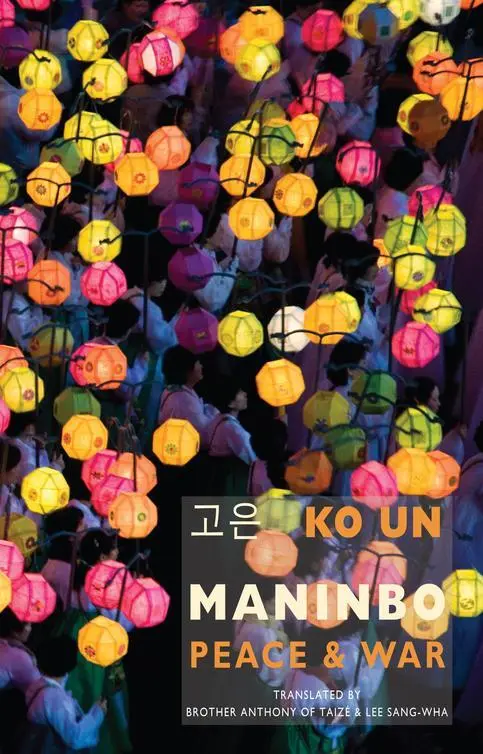
- Название:Maninbo: Peace & War
- Автор:
- Издательство:Bloodaxe Books
- Жанр:
- Год:2015
- ISBN:9781780372433
- Рейтинг книги:3 / 5. Голосов: 1
-
Избранное:Добавить в избранное
- Отзывы:
-
Ваша оценка:
Maninbo: Peace & War: краткое содержание, описание и аннотация
Предлагаем к чтению аннотацию, описание, краткое содержание или предисловие (зависит от того, что написал сам автор книги «Maninbo: Peace & War»). Если вы не нашли необходимую информацию о книге — напишите в комментариях, мы постараемся отыскать её.
Maninbo: Peace & War — читать онлайн бесплатно полную книгу (весь текст) целиком
Ниже представлен текст книги, разбитый по страницам. Система сохранения места последней прочитанной страницы, позволяет с удобством читать онлайн бесплатно книгу «Maninbo: Peace & War», без необходимости каждый раз заново искать на чём Вы остановились. Поставьте закладку, и сможете в любой момент перейти на страницу, на которой закончили чтение.
Интервал:
Закладка:
who threatened you with jail
unless you gave up your valuables
absolute confusion
every kind of crime.
After such chaos,
by the end of December 1950
Seoul was utterly empty; everyone had left.
Except one:
Choi Ik-hwan.
Who refused to leave, saying
somehow or other
this brutal game of death must stop.
Choi Ik-hwan.
He remained in his small room
in a shabby house in Seongbuk-dong in Seoul and wouldn’t leave,
intending to meet the approaching Northern army
to bring about an end to the war
and persuade the leaders to stop the fighting.
Far from making for Busan
where all were fleeing,
he didn’t even head back toward his hometown in Hongseong.
Early in his life
he joined Son Byeong-hui’s Donghak ,
and opened his eyes to the people.
Then he went to Shanghai
with Euichin, one of the last Korean princes,
and took charge of an Independence Movement group,
one known as Daedongdan .
After Liberation,
he was a member of the Democratic Assembly.
In January 1951 he did meet Northern officials
and risked his life negotiating a ceasefire.
Starving,
shivering with cold,
suffering from pleurisy,
he never left.
O Se-do the Trader
O Se-do, slightly pock-marked,
accumulated a fortune through brokerage,
all by himself, all of five-foot tall,
with no store,
no office.
Just how rich he was no one knew.
He was considered the richest man in Cheolwon,
the richest man in Pocheon,
in Yeoncheon.
But no one knew just how rich he was.
During the three years of war,
he raked in profits,
crossing the battlefields
to sell things in the North
and in the South,
while the central front repeatedly advanced and retreated,
one hill taken and re-taken
ninety-nine times.
Heavens! More fearful than warfare
were O Se-do’s business skills.
At times he dealt in war supplies,
so he had dealings with Yi Sang-jo in the North,
with Jeong Il-gwon in the South.
Sometimes he dealt in military intelligence,
sometimes he dealt with the American Eighth Army.
No one knew who he was.
He had a high-pitched voice,
a sixteen-year-old girl’s uvula.
Having a keen sense of smell
he was able to sniff out bean-sprout soup miles away.
A jeep he was riding
got blown up by a landmine.
He was seriously wounded
and taken to the 858 unit’s field hospital.
His belt was packed tight with $120,000.
Yeong-ho’s Sister
Today is another clear day and in his memory his sister is coming.
Today, too,
in his memory — all he has left –
his sister is coming.
Nine-year-old sister Yeong-seon
and five-year-old Yeong-ho,
the two came down to the South alone.
His sister died,
and Yeong-ho became a combat policeman.
He was ordered to go to Jiri Mountain,
and fought.
While fighting,
he suffered a head wound.
He lost his wits.
His only memory
is the coldest, hungriest, hottest instant
of this present time.
In his memory, all other presents
are dimmer.
He ran away from the hospital.
He stole onto a train and later got off unnoticed.
In the deserted plaza in front of Sintan-ri Station
he was looking for someone, gazing around.
He was looking for Yeong-seon, his sister,
his dead sister.
Yi Geuk-no
After the meeting of the Koryo Communist Party
in Irkutsk
he walked
and he walked,
across Mongolian grasslands,
through sandstorms,
as far as Shanghai in China,
he walked on,
starving.
He walked to attend a secret meeting in Shanghai.
The soles of his feet were black and numb.
So very ardent, entirely devoted to his lost nation.
Hyeon Gye-ok in Shanghai
In 1 941 the Shanghai public auditorium looked down on the yellowish river.
An international arts festival was being held:
China,
France,
England,
USSR,
Japan.
Inside the hall
each country’s flag was hanging.
Outside, too,
each country’s flag was fluttering.
Only the Taegeukgi ,
the flag of Korea, nationhood lost,
was not there.
A young girl, Hyeon Gye-ok,
accompanied an independence fighter
from the French Concession.
As the art festival was ending,
although it was not in the programme,
she suddenly took to the stage
before the emcee could stop her.
After putting up the Taegeukgi ,
she performed a gayageum solo.
Slow, with long breaths,
ardently.
The very rapid jajinmori rhythm was entrancing.
The hall sank under deep water.
Applause burst out.
One Chinese spectator wept as he said:
‘You have told people from the whole world
of your nation’s independence.’
Yi Seung-tae
He was arrested at age seventeen.
He was involved in a plot to blow up a police substation.
Part of the building was destroyed.
He was arrested
as he was making his escape.
After being tortured,
he spent one year in detention before being sent for trial.
His release as a minor was approved.
The detective in charge
ordered him to write in his letter of apology that
when he was released
he would be loyal to the Japanese Empire,
and to seal it with a thumbprint.
‘I am a Korean.
I have no duty to serve Japan.
‘Once I am out,
I shall fight for our people’s liberation
until Japan leaves our land.’
He continued:
‘Because of me, my father has become a cripple.
He was stuck in snow
and tortured
to say where I was.
Stricken by frostbite,
he lost one leg.
‘So how could I ever be loyal to Japan?’
Young Yi Seung-tae
grew up.
Soon after Liberation
he became deputy head of the youth division
of the Committee for the Preparation of National Foundation.
He was a fine young man.
When Yeo Un-hyeong was assassinated,
he fasted in mourning for one week. Then he disappeared.
Love
I have seen a
love that is higher
than parents’ love,
than a father’s love,
than children’s love.
That poem was written by a young man
wandering through northern Manchuria in the autumn of 1930,
fighting for the liberation of his colonised country.
His name, Yi Ik-jae,
aged 27.
He was rather young
to leave such a poem behind.
When he was killed in action,
the South Manchuria independence fighters
buried him at the foot of a hill
and carved that poem
on the wooden gravemarker.
Again
the world went back to parents’ love,
went back to wives’ and children’s love.
And the walls of each house grew higher than the next.
A Single Photo
In August 1950,
as day was dawning,
Shin Jo-jun of Pyeong-san, Hwanghae,
crossed the Imjin River, on the western battle front.
He swam straight across the river
holding in his teeth a single photo
of his mother and father when they were young.
He was in Seoul, capital of the South. It lay in ruins.
Living as a beggar
he became a South Korean.
Читать дальшеИнтервал:
Закладка:
Похожие книги на «Maninbo: Peace & War»
Представляем Вашему вниманию похожие книги на «Maninbo: Peace & War» списком для выбора. Мы отобрали схожую по названию и смыслу литературу в надежде предоставить читателям больше вариантов отыскать новые, интересные, ещё непрочитанные произведения.






Обсуждение, отзывы о книге «Maninbo: Peace & War» и просто собственные мнения читателей. Оставьте ваши комментарии, напишите, что Вы думаете о произведении, его смысле или главных героях. Укажите что конкретно понравилось, а что нет, и почему Вы так считаете.