Ko Un - Maninbo - Peace & War
Здесь есть возможность читать онлайн «Ko Un - Maninbo - Peace & War» весь текст электронной книги совершенно бесплатно (целиком полную версию без сокращений). В некоторых случаях можно слушать аудио, скачать через торрент в формате fb2 и присутствует краткое содержание. Год выпуска: 2015, ISBN: 2015, Издательство: Bloodaxe Books, Жанр: Поэзия, на английском языке. Описание произведения, (предисловие) а так же отзывы посетителей доступны на портале библиотеки ЛибКат.
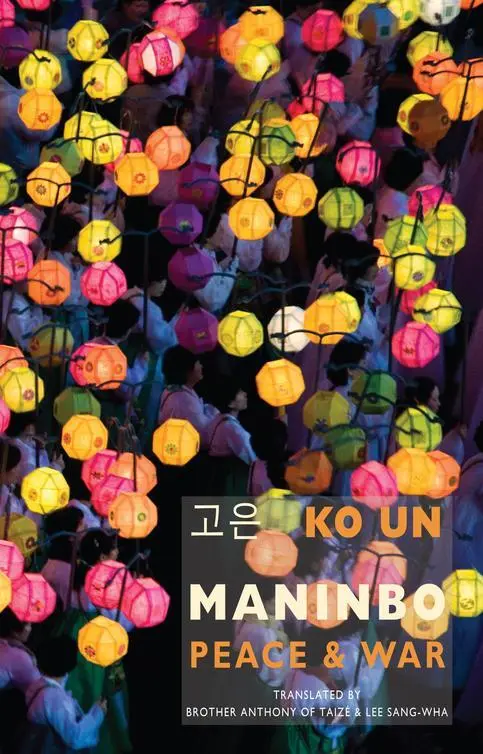
- Название:Maninbo: Peace & War
- Автор:
- Издательство:Bloodaxe Books
- Жанр:
- Год:2015
- ISBN:9781780372433
- Рейтинг книги:3 / 5. Голосов: 1
-
Избранное:Добавить в избранное
- Отзывы:
-
Ваша оценка:
Maninbo: Peace & War: краткое содержание, описание и аннотация
Предлагаем к чтению аннотацию, описание, краткое содержание или предисловие (зависит от того, что написал сам автор книги «Maninbo: Peace & War»). Если вы не нашли необходимую информацию о книге — напишите в комментариях, мы постараемся отыскать её.
Maninbo: Peace & War — читать онлайн бесплатно полную книгу (весь текст) целиком
Ниже представлен текст книги, разбитый по страницам. Система сохранения места последней прочитанной страницы, позволяет с удобством читать онлайн бесплатно книгу «Maninbo: Peace & War», без необходимости каждый раз заново искать на чём Вы остановились. Поставьте закладку, и сможете в любой момент перейти на страницу, на которой закончили чтение.
Интервал:
Закладка:
she left her remote village,
left her home town
shouting, Long Live Korea! Manse!
She was determined to live for the independence of her country
She worked in the kitchen for the Independence Army
in western Manchuria
across the Yalu River.
She quit the kitchen,
made a plan secretly to assassinate the Japanese governor-general.
She failed.
She went to Jillin in Manchuria and continued to work for the Independence Movement.
She planned to rescue General Kim Dong-sam
while he was being transported after being arrested in 1931.
She failed.
In 1932 she cut off two fingers
and wrote an independence petition
in her blood,
addressed to the League of Nation’s fact-finding commission.
Attempting to murder the Japanese ambassador in Manchuria, she was arrested
then tortured severely.
She died in Harbin in 1933.
She was buried in one of the White Russian cemeteries.
No one knows where her child lived or died.
One-armed Park
At dawn on 28 June 1950,
the bridge across the Han River was blown up.
That ear-splitting boom!
Pandemonium.
Silence.
Screams. Groans.
About a thousand
of the Seoul citizens who fled hastily over the bridge
after the war began
died in the explosion.
Among them
a man who lost one arm
grabbed a drifting box with the other hand
and held on to reach the bank at Noryangjin.
He survived,
became One-armed Park, gang-leader of Nampo-dong, Busan,
in 1951, while Busan was the provisional capital.
‘Those goddamn bastards escaped first.
After they made broadcast announcements
telling the people of Seoul to stay and not worry,
those goddamn bastards themselves escaped.
The goddamn President,
those goddamn ministers.
‘Goddamn military, goddamn whoever.
What?
They were serving the nation?
They called themselves the nation’s bulwark?’
One-armed Park spouted abuse as he snuffed the lighter.
The cigarette smoke drifted off. Goddamn!
Yong-sik, Aged Five
Truly his home was poverty itself.
This five-year-old
had moved his lips for half a day.
Does he have a sweet
in his mouth?
Is a sweet melting
in his mouth?
‘Say “Ah.”
You little rascal, what’re you eating?’
He opened his mouth, ‘Ah.’
On his little tongue
was a pebble.
He was hungry and wanted something to eat,
so he’d picked up a stone,
put it in his mouth
and was moving it around.
At sunset, as goose-flesh spread wide,
a wind came down from the hills.
After Seoul Was Recaptured
After the three months of the People’s Republic,
everything in Seoul was destroyed.
Empty houses and
the houses of those who hadn’t left yet,
all of them,
on every rainy day,
echoed with the endless sound of raindrops falling from the eaves.
Those who collaborated during the occupation numbered 400,000.
Sentenced to death,
imprisoned for life,
30 years’ hard labour,
15 years,
5 years.
People were arrested after anonymous tipoffs,
rounded up on false accusations.
Ancient enemies
were denounced on concocted charges of being reds.
Kim Cheong-nang in Seodaemun Prison,
sentenced to life in prison,
had a black wart between his two eyebrows
that made him look most solemn.
All he had done was attend one rally
organised by the city communists during the occupation.
He was indicted as the vile instigator of a rally
thanks to the scheming of Yun Min-u, who owed him money.
Tortured, he was dying
of malnutrition,
of depression.
Finally, he died of a stroke
after he’d served only two years of his life sentence.
No one came forward to claim his body.
He was buried on the slopes of Mount Geomdan, Gyeonggi province
in the cemetery for prisoners with no known relatives.
Commie 1
The more remote a village was,
the more the people there used the lunar calendar.
People’s birthdays were lunar dates,
ancestral rites were lunar, too.
The year’s farming was done by lunar dates:
when to plant barley,
when to plant buckwheat,
when to plant rice
in terraced paddy fields.
In people’s memories
every day was a lunar date.
He spoke with a running nose.
His breath
spilled out and dispersed in clouds of steam.
So, on the twelfth day of the sixth lunar month
the People’s Army
passed through this mountain village
Someone said they were from the North’s Fourth Division.
They reached the hills of Geochang in the north
via Hamyang from Namwon.
Soldiers who looked very young
were carrying submachine guns the wrong way up.
There was no doubt we were in trouble.
Thinking I should escape somewhere
I took the ox from the stable
and went to my in-laws’ home in Sancheong.
The Communist army passed through there, too.
I took the ox and came back home.
I swept away the cobwebs,
warmed the room,
dried out the green mildew.
While I was living like that
someone came down from the hills and took me with him.
I carried food up and down mountains until I was caught.
I was sentenced to twenty-five years.
My knee got broken in jail, my teeth fell out.
I tossed the fallen teeth through the bars.
Sometimes I cried.
I was a commie.
Commie 2
I was no commie.
One day I met my kid’s schoolteacher
and bought him a drink
in the tavern at the junction.
As we were drinking a measure of makgeolli , then another half-measure,
the school teacher
praised my kid saying
his grades were so-so
but he was good at stopping kids fighting.
Then, pinching the wrinkles between his eyebrows,
Mr Kim said:
‘In future,
the time will come when everyone lives equally well.
The land will not belong to landowners
but to all who farm it.’
I lost all taste for liquor and opened my eyes wide.
Inside the tavern
there was an old woman
and two other drinkers.
A few days later I heard
that a plainclothesman was coming to arrest me.
The village head shook his head:
Strange,
strange.
You’re no commie.
I was scared.
I escaped to my wife’s home several miles away,
then moved to another house.
I kept moving around,
as I hated being a burden to other people.
Then a man told me he was on his way up into the mountains,
so I followed him.
I was no commie.
Then, eventually,
I became a commie.
From Jiri Mountain I used to look toward home,
longing to go back down.
Longing to go back down.
Commie 3
When I was six,
my maternal uncle
set me behind him on his bicycle
and sped along the new road with poplars on both sides.
That uncle
was my ideal.
Uncle was a university student in Japan.
Uncle passed the higher civil-service exam.
Everyone in the village came to the congratulatory party
at my mother’s parents’ house.
But my uncle rejected official positions,
went roaming
all the way to Seoul,
to Buan,
to Daegu.
He was arrested at Suwon Station in 1943.
Читать дальшеИнтервал:
Закладка:
Похожие книги на «Maninbo: Peace & War»
Представляем Вашему вниманию похожие книги на «Maninbo: Peace & War» списком для выбора. Мы отобрали схожую по названию и смыслу литературу в надежде предоставить читателям больше вариантов отыскать новые, интересные, ещё непрочитанные произведения.








Обсуждение, отзывы о книге «Maninbo: Peace & War» и просто собственные мнения читателей. Оставьте ваши комментарии, напишите, что Вы думаете о произведении, его смысле или главных героях. Укажите что конкретно понравилось, а что нет, и почему Вы так считаете.