Ko Un - Maninbo - Peace & War
Здесь есть возможность читать онлайн «Ko Un - Maninbo - Peace & War» весь текст электронной книги совершенно бесплатно (целиком полную версию без сокращений). В некоторых случаях можно слушать аудио, скачать через торрент в формате fb2 и присутствует краткое содержание. Год выпуска: 2015, ISBN: 2015, Издательство: Bloodaxe Books, Жанр: Поэзия, на английском языке. Описание произведения, (предисловие) а так же отзывы посетителей доступны на портале библиотеки ЛибКат.
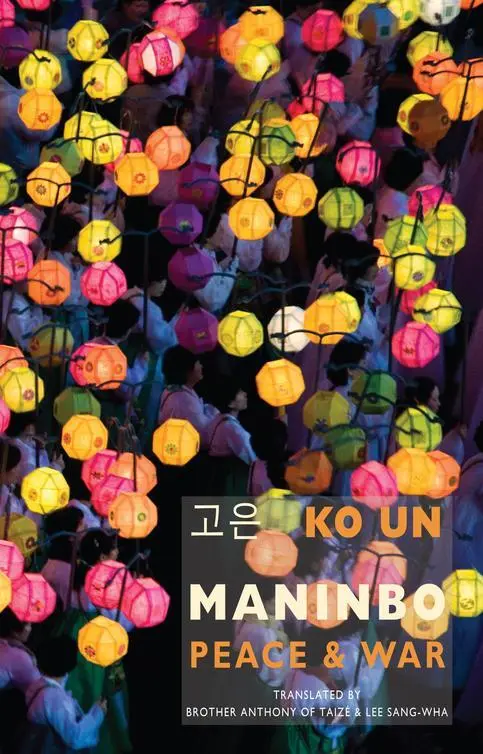
- Название:Maninbo: Peace & War
- Автор:
- Издательство:Bloodaxe Books
- Жанр:
- Год:2015
- ISBN:9781780372433
- Рейтинг книги:3 / 5. Голосов: 1
-
Избранное:Добавить в избранное
- Отзывы:
-
Ваша оценка:
Maninbo: Peace & War: краткое содержание, описание и аннотация
Предлагаем к чтению аннотацию, описание, краткое содержание или предисловие (зависит от того, что написал сам автор книги «Maninbo: Peace & War»). Если вы не нашли необходимую информацию о книге — напишите в комментариях, мы постараемся отыскать её.
Maninbo: Peace & War — читать онлайн бесплатно полную книгу (весь текст) целиком
Ниже представлен текст книги, разбитый по страницам. Система сохранения места последней прочитанной страницы, позволяет с удобством читать онлайн бесплатно книгу «Maninbo: Peace & War», без необходимости каждый раз заново искать на чём Вы остановились. Поставьте закладку, и сможете в любой момент перейти на страницу, на которой закончили чтение.
Интервал:
Закладка:
On 31 December 1951
President Syngman Rhee reluctantly ordered the citizens of Seoul to evacuate.
The Chinese human wave strategy
was once again threatening Seoul.
General Ridgeway, commanding the American forces,
ordered his men to retreat to the south of the Han River.
On 3 January 1951 –
not much of a new year –
the government hurriedly left.
Three hundred thousand Seoul citizens
had to cross the frozen Han River
to head farther
and farther south.
In Waryong-dong, Jongno-gu, Seoul,
one newborn,
the youngest child of the owner of the Seonil Printing Company,
a baby not yet entered in the family register
so still nameless,
was just called,
Dear,
My dear,
My weevil, little rice weevil.
It crossed the Han River ice
on its mother’s back
So it began life.
They were lucky. At Suwon they got a ride on a freight train.
A Grandmother
Su-dong’s grandmother
who lived below Jinnamgwan Hall in Yeosu, South Jeolla province,
knew exactly how many roundworms
her little grandson Su-dong had in his stomach.
When I’m with my grandson
I can see the camellias on Odong Island;
more than that, I can even see
the camellias on Geomun Island over the sea.
Yeong-u, a refugee child,
was extremely envious of Su-dong.
Ah, if only I had such a clairvoyant grandmother!
The siren of the boat heading for Tong-yeong came echoing.
Or maybe it was the boat from Tong-yeong?
Age of Spies
If you did not provide a traveller with a place to sleep,
your family was disgraced.
If you offered cold food
to a traveller,
several generations of your family were disgraced.
Even sixty years ago,
even fifty years ago,
even in days when the nation was stolen from us,
even in wartime,
traces of that old hospitality remained.
Whenever you set off
carrying only a staff and a change of clothes,
each village you passed through
took warm-hearted care of you,
your food and lodging.
If you stayed somewhere for three days, then fell sick,
they’d even provide you with medicine.
Long ago, when Hamel and his companions,
Dutch survivors of shipwreck,
were being escorted from Jeju Island to Seoul
by way of Jeolla Province,
they received a warmer welcome
than they had ever received
in any Christian country in the world.
It was the hospitality given
when humans meet other human beings.
They were moved to say: on our weary journey
the generous hearts of Joseon’s people
are incomparable with those of other lands
Some centuries later,
after the war,
that hospitality vanished.
Not only were visitors treated coldly;
people began to report them to the police.
A suspicious person is a spy.
A traveller is a spy.
Anyone loitering at the seaside early in the morning,
anyone who laughs for no reason
at the sight of someone, anyone, all are spies.
Report them.
Report them and earn a reward that will change your luck.
In this country today we have no more wandering travellers.
Two Kilos of Pork
In 1926, Korea’s Provisional Government
was being pursued all the time,
starving
as it fled along the shores of the Yangtze River.
Kim Gu, the acting premier,
had abolished things like birthdays long ago.
He was stern with himself:
How can people fighting to regain their nation
celebrate a birthday?
However, Na Seok-ju found out when Kim Gu’s birthday was,
pawned his clothes
and bought two kilos of pork.
Everyone cheered up.
With that meat, they were spared for once
their usual poor breakfast.
Kim Gu scolded them:
This will not do.
This will not do.
The Independence Movement knows no birthdays.
Na Seok-ju soon after threw a bomb
that scared the Japanese out of their wits.
He sacrificed himself.
He became a man with no birthday forever.
Manguri Cemetery
The war did not spare even public cemeteries.
The public cemetery in Manguri,
was the underworld of Seoul.
On September 30, 1950,
even that site
became a battlefield.
While six thousand graves lay there,
UN soldiers
and communist soldiers
showered bullets
between the graves,
charged at each other,
stabbed one another with bayonets.
Bodies of fallen soldiers
lay scattered here and there
among the graves.
Bodies of black soldiers,
white soldiers,
bodies of communist soldiers,
were scattered all over the unmown grass.
Seventy-five minutes of deadly battle,
seventy-three dead bodies on both sides:
that was all.
Manguri Cemetery went back to being a cemetery.
3 October 1950
Seoul belonged to the enemy for three months
under the rule of the North Korean People’s Republic.
The American air force’s bombing raids
went on day after day.
Seoul was reduced to ruins.
Grass grew
between the broken bricks in the ruins.
South Korean troops
recaptured Seoul.
The Northern flag was lowered
from the flagstaff on the Government Building,
the American flag was raised,
followed by the South Korean flag,
and the two fluttered there.
Seoul was under martial law.
Curfew lasted from seven in the evening
until five the next morning,
the time for mice.
Checkpoints stood here and there
in the ruins.
The police who had come back
set about arresting those who had collaborated during the past three months,
even children under ten
The kid of the noodle bar in Juja-dong in central Seoul,
got to know about this harsh world
from early on.
He got to know all about
the world with its beaters-up
and its beaten,
a world where there were thieves
amidst all that fear,
a world where even robbers
and thieves were arrested and beaten with clubs.
He was envious of robbers, envious of thieves.
North Korean Soldiers
North Korean soldiers
who drove south
of the 38th parallel
in the summer of 1950…
North Korean soldiers who supervised night operations on aerodromes.
North Korean soldiers never smoked a cigarette,
afraid of American airplanes:
‘The glow of a cigarette can be seen 5 kilometres away.’
They were sixteen,
seventeen years old.
They were carrying submachine guns as tall as themselves.
They had just been mobilised from remote villages.
They were naive,
very shy.
Boys like them were dumped out by the basketful
into the exorbitant war.
Choi Ik-hwan
Everyone was leaving
leaving in a hurry
southward, southward, fleeing refugees
on the 4 January Retreat in 1951,
all but one.
He who refused to leave
had the notion of stopping
this immense calamity,
with his two hands
at any cost
stopping
this war,
a war in which fellow-countrymen were killing one another
left and right
South and North.
Disorder
lawlessness
thieves
ransackers of empty houses
those who had an eye on refugees’ bundles
extortionists charged with arresting collaborators
Читать дальшеИнтервал:
Закладка:
Похожие книги на «Maninbo: Peace & War»
Представляем Вашему вниманию похожие книги на «Maninbo: Peace & War» списком для выбора. Мы отобрали схожую по названию и смыслу литературу в надежде предоставить читателям больше вариантов отыскать новые, интересные, ещё непрочитанные произведения.









Обсуждение, отзывы о книге «Maninbo: Peace & War» и просто собственные мнения читателей. Оставьте ваши комментарии, напишите, что Вы думаете о произведении, его смысле или главных героях. Укажите что конкретно понравилось, а что нет, и почему Вы так считаете.