Ko Un - Maninbo - Peace & War
Здесь есть возможность читать онлайн «Ko Un - Maninbo - Peace & War» весь текст электронной книги совершенно бесплатно (целиком полную версию без сокращений). В некоторых случаях можно слушать аудио, скачать через торрент в формате fb2 и присутствует краткое содержание. Год выпуска: 2015, ISBN: 2015, Издательство: Bloodaxe Books, Жанр: Поэзия, на английском языке. Описание произведения, (предисловие) а так же отзывы посетителей доступны на портале библиотеки ЛибКат.
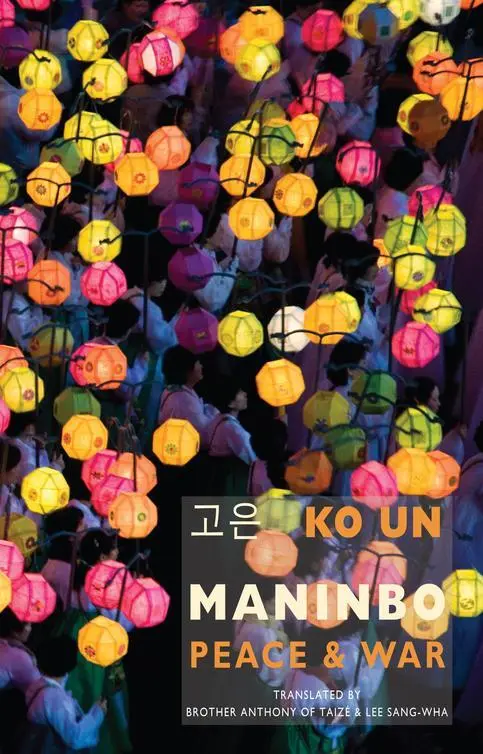
- Название:Maninbo: Peace & War
- Автор:
- Издательство:Bloodaxe Books
- Жанр:
- Год:2015
- ISBN:9781780372433
- Рейтинг книги:3 / 5. Голосов: 1
-
Избранное:Добавить в избранное
- Отзывы:
-
Ваша оценка:
Maninbo: Peace & War: краткое содержание, описание и аннотация
Предлагаем к чтению аннотацию, описание, краткое содержание или предисловие (зависит от того, что написал сам автор книги «Maninbo: Peace & War»). Если вы не нашли необходимую информацию о книге — напишите в комментариях, мы постараемся отыскать её.
Maninbo: Peace & War — читать онлайн бесплатно полную книгу (весь текст) целиком
Ниже представлен текст книги, разбитый по страницам. Система сохранения места последней прочитанной страницы, позволяет с удобством читать онлайн бесплатно книгу «Maninbo: Peace & War», без необходимости каждый раз заново искать на чём Вы остановились. Поставьте закладку, и сможете в любой момент перейти на страницу, на которой закончили чтение.
Интервал:
Закладка:
Then he gave up begging
and ran errands for a grogshop,
then for a shoe-shiner,
bringing him shoes to be polished,
before he became a shoe-shiner himself.
He bought a wooden shack.
Fifteen years after leaving his northern home
he was president of the Actors’ Academy in Chungmu-ro, Seoul.
He had his parents’ photo enlarged
and hung it on his wall.
Somebody asked:
‘What period are those film stars from?’
So-called Student Soldiers
When the Communist army came South,
fourth- and fifth-year middle-school students
were summoned en masse
and forced to enlist.
Fourth and fifth years of middle school!
On 4 January 1951,
when the Northern forces came down again,
first-year high-school students
were summoned at random en masse :
and forced to enlist.
Boys in their later teens,
those early plums,
those early apples,
those early jujubes
died in battle at Pohang,
died on the central front.
The land the South recovered, wherever the battle ended,
was all graves.
VOLUME 17
That Old Woman
She had many stories in her.
Millipedes dropped from the rotten thatched roof of her hut.
Falling raindrops
were part of her family.
Hard times were her strength.
Neither cholera
nor other common diseases visited her.
Even the ghosts
disliked poverty. The daytime moon was one of her family.
Drinking a cup of water,
she tried to forget a host of stories
in the Japanese colonial period,
when moonlit nights were bright in the ruined nation
and then again in the age of a divided Korea.
Once, Eon-nyeon from the village opposite,
came by after gathering greens and said:
‘When you die
we’ll make the memorial offerings for you.’
‘I don’t need that,’ she said
with a smile, her first in a very long time.
If she had no teeth
she still had gums.
Her gummy smile was all she had.
Paddy Fields
There were children laughing in the Pyeongtaek fields,
and girls singing, too.
In that hallucinatory world,
there were tender yellow-green
baby rice plants
in the freshly planted paddy-fields.
Now it was the turn of sunlight,
of water.
After three rounds of weeding the rice would ripen.
They were the fields of the Republic of Korea,
fields of the People’s Republic,
then of the Republic of Korea again,
then of the People’s Republic again,
then of the Republic of Korea again.
After American jets flew over, the fields were quiet.
Don’t be sad.
Your descendants will continue forever because of these fields.
The rice is ripening in the scorching heat.
On the dirt bank of one field, homeless dogs are coupling.
Two Deaths
Gwon Pyeong-geun, aged 47.
Yi Seok-u, aged 26.
Gwon put on the suit long left hanging unworn:
now he was a gentleman of the harbor.
Yi appeared wearing a clean shirt
without his usual People’s Guard’s armband: a lovely young man.
On September 8, 1948
they joined the crowd out to welcome the American military
landing at Incheon harbour,
a zone still being guarded by Japanese police.
There, Gwon Pyeong-geun
and Yi Seok-u were shot dead by a Japanese policeman.
Rejoicing at Liberation,
and gone out to welcome
the liberating army, the allies,
they were killed by the last tatters of Japanese imperialism.
Nay, it was liberation that killed them.
Gweon Pyeong-geun had been chairman of the central committee
of the Incheon branch of the Korea Workers’ Union;
Yi Seok-u had been a guard in the people’s militia.
Regarding their corpses, the Americans said
that the Japanese police were right to fire.
That evening, the Korea Workers’ Union
shouted anti-American slogans
along with anti-Japanese slogans
and tore down from the wall
the Stars and Stripes.
Flowers
In prehistoric times, forty thousand years ago,
as people were moving their homes
one by one from caves to huts,
when a father was killed while hunting
his son
brought him home on his back,
put the body up in a tree
then offered flowers on the ground beneath.
Forty thousand years later
in Jinan, North Jeolla Province,
a family made a grave for a man who died in the war
then a four-year-old boy offered flowers.
Behind him, his mother wept.
A few wild chrysanthemums.
General de Gaulle
Today, again, General de Gaulle was sitting in the café.
The faces around the stove in Café Geosang
behind the old Hwasin department store in Jong-ro, Seoul
turned red
around the hot stove.
His name was Kim Cheol-sun;
his nickname, General de Gaulle;
his occupation, none;
his marital status was unclear –
sometimes he was said to have a son, sometimes not.
More than once every day
the words ‘General de Gaulle’ were sure to come tumbling
out of his mouth, which looked like a turtle’s.
‘In France, General de Gaulle got rid of every traitor,
those who fawned upon Hitler,
those who fawned upon the Vichy government.
He executed some,
sentenced others to life imprisonment,
deprived more than 600,000 of civic rights.
But in this bloody Republic of Korea,
pro-Japanese people have become patriots,
while patriots are blamed as traitors,
as reds.
Where on earth is our national spirit?
Of what country is Dr Syngman Rhee president?’
A few days after,
General de Gaulle failed to appear in the café.
An outstanding bill of eight hundred hwan
began to gather dust.
Lee In-su
Humanity became a tool of barbarity.
Humanity was a sacrificial offering.
During the Japanese colonial period
talented Lee In-su studied English literature
at the University of London,
then came back. After Liberation
he was the pride of Korea University’s English department.
One English teacher from Mokpo,
eager to meet him,
even made the two days’ train journey up to Seoul.
Lee In-su was the pride of Korea’s English studies,
he looked cool after he’d shaved,
he was laconic at all times.
Lee In-su had a wife and children.
He moved between home and school.
War broke out.
He was not able to leave Seoul.
During the three months under the People’s Republic
Kim Dong-seok, who had previously gone North, came back down.
At his urging
Lee In-su made English broadcasts aimed at the American forces.
Even Byeon Yeong-tae, the future premier who had taught English in China,
could not match his English.
After Seoul was recaptured
Lee was arrested.
Kim Seong-su, the founder of Korea University,
addressed a petition to President Syngman Rhee.
Many people
tried to save his life.
Defence minister Shin Seong-mo had him swiftly executed.
Lee In-su was a brilliant scholar
when he was in England.
Shin Seong-mo had been a ship’s captain amidst wild seas.
He always considered Lee In-su his rival.
From early days,
small Shin Seong-mo
had thought only of getting rid of tall Lee In-su,
Читать дальшеИнтервал:
Закладка:
Похожие книги на «Maninbo: Peace & War»
Представляем Вашему вниманию похожие книги на «Maninbo: Peace & War» списком для выбора. Мы отобрали схожую по названию и смыслу литературу в надежде предоставить читателям больше вариантов отыскать новые, интересные, ещё непрочитанные произведения.





Обсуждение, отзывы о книге «Maninbo: Peace & War» и просто собственные мнения читателей. Оставьте ваши комментарии, напишите, что Вы думаете о произведении, его смысле или главных героях. Укажите что конкретно понравилось, а что нет, и почему Вы так считаете.