Ko Un - Maninbo - Peace & War
Здесь есть возможность читать онлайн «Ko Un - Maninbo - Peace & War» весь текст электронной книги совершенно бесплатно (целиком полную версию без сокращений). В некоторых случаях можно слушать аудио, скачать через торрент в формате fb2 и присутствует краткое содержание. Год выпуска: 2015, ISBN: 2015, Издательство: Bloodaxe Books, Жанр: Поэзия, на английском языке. Описание произведения, (предисловие) а так же отзывы посетителей доступны на портале библиотеки ЛибКат.
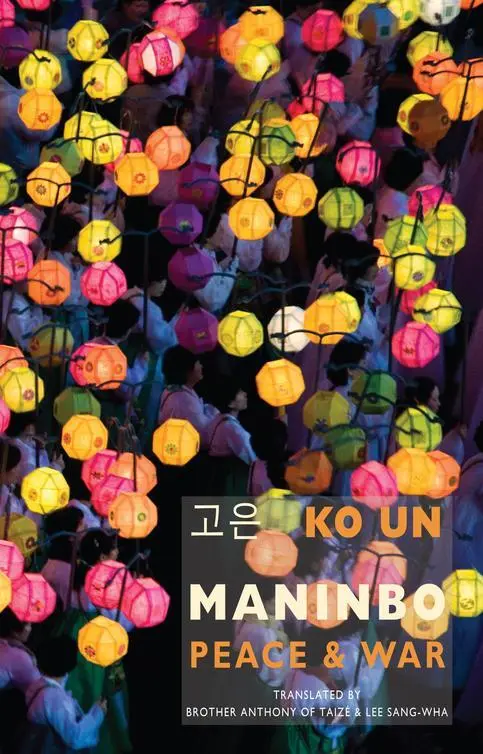
- Название:Maninbo: Peace & War
- Автор:
- Издательство:Bloodaxe Books
- Жанр:
- Год:2015
- ISBN:9781780372433
- Рейтинг книги:3 / 5. Голосов: 1
-
Избранное:Добавить в избранное
- Отзывы:
-
Ваша оценка:
Maninbo: Peace & War: краткое содержание, описание и аннотация
Предлагаем к чтению аннотацию, описание, краткое содержание или предисловие (зависит от того, что написал сам автор книги «Maninbo: Peace & War»). Если вы не нашли необходимую информацию о книге — напишите в комментариях, мы постараемся отыскать её.
Maninbo: Peace & War — читать онлайн бесплатно полную книгу (весь текст) целиком
Ниже представлен текст книги, разбитый по страницам. Система сохранения места последней прочитанной страницы, позволяет с удобством читать онлайн бесплатно книгу «Maninbo: Peace & War», без необходимости каждый раз заново искать на чём Вы остановились. Поставьте закладку, и сможете в любой момент перейти на страницу, на которой закончили чтение.
Интервал:
Закладка:
shabbier than a shadow.
Pagoda Park
In Pagoda Park stands the stone pagoda of Wongak Temple
which looks sometimes like an ice sculpture.
It was noisy around that ice sculpture
after the second recapture of Seoul:
a home for the homeless,
a workplace for those with no work.
From mid-morning on
people would gather one by one around the pagoda.
After five in the afternoon
they left one by one.
There was a man
who made a fervent speech there,
holding an old fan,
when about one hundred
or perhaps only twenty had gathered.
He talked about Dangun, our country’s founder,
General Im Gyeong-eop,
Kim Jong-seo and
and Han Myeong-hui, politicians in days of old, too.
He looked haggard.
His eyes were not clear and he had wrinkles like a mud-flat.
He said,
‘A hundred years from now,
our country will be the centre of the world.
Fifty years from now,
our country will be the top nation of the East.
In future our nation
will receive tribute from 300 countries.’
Kim Dong-bok
never missed a day.
After making a passionate speech for about two hours,
if someone bought him a bowl of noodles
he would gulp down all the broth in a moment,
and then say,
‘In future, Korea
will be the presiding country of
the World Presidents’ Association.
Wait and see.
Wait and see.
Ah, those noodles were tasteless.’
He misspoke. He meant to say ‘tasty’.
He looked around
old panama hats,
felt hats,
helmets,
straw hats,
military caps,
and
bare heads, crew-cuts.
Middle School Classmates
Korea was a battlefield, everywhere.
The battlefront
moved south down the peninsula.
Then the battlefront
shifted north up the peninsula.
The battlefront
left not one place untouched,
rummaged everywhere,
trashed every corner.
Moreover, the battle was not only on the front.
In the rear
between one and another,
there was hatred
deceit,
plunder.
Before, under Japanese rule, foolish people were friends together.
But here on this battlefield
even foolish people turned into one another’s enemies.
Yeom Gi-uk informed on Baek U-jong,
saying that he met the younger brother of Kim Chin-gu
who’d gone north after Liberation.
But Kim Chin-gu had already died in the Bodoyeonmaeng*
and his younger brother had gone north, so he’d never met him.
Yeom was Baek’s middle-school classmate
but Baek once refused a request Yeom made
so Baek U-jong was denounced.
False or not
if you denounced someone as a spy, you got a reward.
All the guys you disliked were spies.
* After Liberation in 1945 and before the Korean War the South government tried to convert communist sympathisers; the organisation composed of such people was called the Bodoyeonmaeng (the Bodo League) and most of them were killed by the police of the Southern government when the South Korean forces were retreating for the second time on January 4, 1951; that was when Koreans began killing each other indiscriminately.
Kim Jin-se
His comrades were arrested.
He slipped away to Tianjin, in China,
to a Chinese slum –
the independence fighter Kim Gyu-sik,
together with his wife Kim Sun-ae,
and their son Kim Jin-se.
Neither father
nor mother
taught Korean to their son, born in 1928.
It would mean the end, if ever
a Korean word popped out
while he was playing with Chinese kids.
Agents of the Japanese army
had ears even in the Chinese slums.
Kim Jin-se only learned Korean after he turned thirty.
He learned some very clumsy Korean
from his countrymen in the Korean Provisional Government
in Shanghai,
in Chongqing.
He spoke Chinese far better.
Chwiwonjang in Northern Manchuria
You had to leave in order to live.
A division of the Japanese army in northern Korea crossed the Tumen River
on an operation designed to annihilate the Koreans
to the north of the Tumen River
and north of the Yalu.
In revenge for the great defeat at Cheongsan-ri
the Japanese planned an operation with three slogans:
Kill on sight!
Burn on sight!
Rob on sight!
The Koreans in western Manchuria
fled northward,
northward,
to the end of maize fields, millet fields,
northward to the end of the sky.
Following the Songhua River for a hundred ri
beyond Harbin,
they fled to the far end of the open plains of North Manchuria,
and there, at the far end of those open plains,
there,
they unloaded,
made dugout shelters, settled down.
Seokju’s first words:
The waters of this Songhua River flow all the way
from Korea’s Paektu Mountain…
They decided to make it the second base for the Independence Movement
and mulled over ways to live.
Brothers were warm-hearted toward each other
in their life of exile.
Yi Sang-ryong
and his younger brother
Yi Bong-hui
shared warm affection and
strong convictions.
There, in Chwiwonjang,
the birch-wood fire in the kitchen
never went out
throughout several bitter winter months.
That Year’s Paper Korean Flags
Japan surrendered at midday on 15 August 1945.
Called an unconditional surrender,
it was conditional,
for the emperor stayed in place.
From that day
paper Taegeukgis fluttered across the Korean peninsula.
They fluttered there, sometimes just with a yin-yang symbol
and the four divination signs added
to the red circle of a Japanese flag.
On 20 August 1945,
a declaration was issued by the Soviet Army:
We, the Red Army, grant all the conditions
needed for the Korean people
to begin to live with freedom and creativity.
The Korean people themselves
should create their own happiness.
On 2 September 1945
General Order No. 1 was issued from the headquarters of America’s MacArthur:
All Korean people must immediately obey all orders
issued under my authority.
All acts of resistance to the occupying forces
and disturbances of public peace
will be severely punished.
Taegeukgis that had been hidden since March 1919 were fluttering everywhere.
Taegeukgis that had been buried until August 1945 were fluttering again.
However, the Americans were not a liberation army
but an occupying army.
Paper Taegeukgis were fluttering for them.
Chin Mu-gil of Yongdun village, Miryong-ri, Mi-myeon, Okku-gun, North Jeolla
was good at painting Taegeukgis on paper.
He drew fifty a day.
He even took some over the hill to Okjeong-ri.
He sent some to Mijei village, too.
On 6 October 1945
an American jeep appeared in Yongdun village.
The villagers welcomed the big-nosed soldiers
carrying Taegeukgis in their hands.
Who knew that the soldiers would start hunting women?
All the village’s pigtailed young women
hid in fireholes,
crept under the floors,
hid in bamboo groves,
but they were dragged from their hiding places
up the hill behind the village.
In Hamgyeong province in northern Korea, too,
it’s said that Soviet troops robbed people of their watches
and hunted for women.
Читать дальшеИнтервал:
Закладка:
Похожие книги на «Maninbo: Peace & War»
Представляем Вашему вниманию похожие книги на «Maninbo: Peace & War» списком для выбора. Мы отобрали схожую по названию и смыслу литературу в надежде предоставить читателям больше вариантов отыскать новые, интересные, ещё непрочитанные произведения.






Обсуждение, отзывы о книге «Maninbo: Peace & War» и просто собственные мнения читателей. Оставьте ваши комментарии, напишите, что Вы думаете о произведении, его смысле или главных героях. Укажите что конкретно понравилось, а что нет, и почему Вы так считаете.