Ko Un - Maninbo - Peace & War
Здесь есть возможность читать онлайн «Ko Un - Maninbo - Peace & War» весь текст электронной книги совершенно бесплатно (целиком полную версию без сокращений). В некоторых случаях можно слушать аудио, скачать через торрент в формате fb2 и присутствует краткое содержание. Год выпуска: 2015, ISBN: 2015, Издательство: Bloodaxe Books, Жанр: Поэзия, на английском языке. Описание произведения, (предисловие) а так же отзывы посетителей доступны на портале библиотеки ЛибКат.
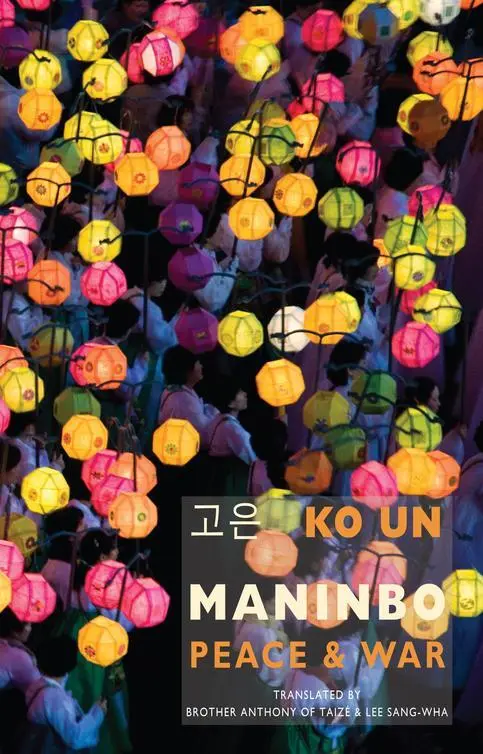
- Название:Maninbo: Peace & War
- Автор:
- Издательство:Bloodaxe Books
- Жанр:
- Год:2015
- ISBN:9781780372433
- Рейтинг книги:3 / 5. Голосов: 1
-
Избранное:Добавить в избранное
- Отзывы:
-
Ваша оценка:
Maninbo: Peace & War: краткое содержание, описание и аннотация
Предлагаем к чтению аннотацию, описание, краткое содержание или предисловие (зависит от того, что написал сам автор книги «Maninbo: Peace & War»). Если вы не нашли необходимую информацию о книге — напишите в комментариях, мы постараемся отыскать её.
Maninbo: Peace & War — читать онлайн бесплатно полную книгу (весь текст) целиком
Ниже представлен текст книги, разбитый по страницам. Система сохранения места последней прочитанной страницы, позволяет с удобством читать онлайн бесплатно книгу «Maninbo: Peace & War», без необходимости каждый раз заново искать на чём Вы остановились. Поставьте закладку, и сможете в любой момент перейти на страницу, на которой закончили чтение.
Интервал:
Закладка:
to suppress the students protesting
in front of the Presidential Mansion
during the April Revolution in 1960.
Police sergeant Yi Yohan.
South Gate Street, Suwon
Soldiers,
gum sellers,
horse-carts,
ox-carts,
piles of droppings in the wake of the carts,
paper-boys,
combs, fine-toothed bamboo combs, glass beads, cheap necklaces,
urchin beggars,
Japanese-era trucks,
American army trucks.
One old beggar lay prostrate all day long.
No sign of human pity anywhere.
The hungry grew hungrier.
The cold grew colder.
In Suwon’s South Gate Street,
Myeong-gu
had no shit inside him today as the day before. None.
He could get no food
anywhere round the city gate.
For three soju bottles, he could get a few crumbs of bread.
But here there was nothing like that in sight.
Only, only
the world.
Myeong-gu’s only thought was for a bowl of rice.
Hey, monks in mountains, what use are those koans you’re contemplating?
Cheonggye Stream
The clothes they were wearing were American-made,
trousers from relief supplies,
and dyed American military jackets –
but
in the university’s French department
students dreamed of themselves as Sartre,
Camus,
André Malraux.
America outside,
France inside.
Perhaps for that reason,
the long Cheonggye Stream
flowing through Seoul between Jong-no and Ulji-ro
was not Korea’s Hudson River
but Korea’s Seine.
There was the Café Seine in Myeong-dong, too.
The Seine was a place for washing clothes,
the Seine was a sewer
with melon-sized balls of shit floating down.
The Seine was a rubbish dump.
A little farther down the Seine
on the bank toward Gwansu-dong
was Division Four of Cheonggye Stream
where the shanty town began
and battles for survival were intense.
Girls working in clothing factories along Cheonggye Stream
lived in rented rooms in shanties.
The owners were kind-hearted by night,
full of abuse by day.
It was one month since Jo Ok-ja had come to Seoul
as a factory girl.
Every one of her fingers ached.
She worked all day at a sewing machine,
with nothing to eat but five small pieces of bread.
During overtime one night
she felt dizzy, collapsed.
She liked nights.
Sometimes, in her dreams,
she saw her mother.
Heukseok-dong
One dim bulb dangled from the ceiling
of the comic books reading-room.
The shoe store stank of leather.
Flies tended bar, no customers.
In the barbershop, honey soap.
Cheap bread stands.
In the mending shop, an old worn-out sewing machine.
All the way along, nothing but wooden shacks,
steep alleys barely wide enough for one
all the way along
There was a single water tap down below.
People lined up with empty water-cans
and a 10- hwan coin; once the cans were filled,
they carried them panting up the alley.
While people were living like this,
on the battlefront people died
and at the rear, people were born.
One woman gave birth two days ago,
and here she was out carrying water.
Her breasts hung
dangling from beneath her blouse.
She gave the child the name
of its father’s North Korean home.
Yu Seon-cheon.
Seon-cheon! Seon-cheon!
Our darling Seon-cheon!
A sliver moon rose early
to shine over this slum-village on a hill.
The Porter at Seoul Station
At 5 a.m. the night train from Busan arrived,
an hour after the end of curfew.
He had to be ready at the exit.
Soon the passengers debarked.
The haggling over porterage was brief.
One large suitcase,
one sack of grain,
one small case,
all loaded onto the A-frame,
while the owner followed behind.
He carried the load as far as the bus stop
across the road,
then demanded five hundred hwan ,
saying the bag was far too heavy.
He refused to put the bag down, demanding payment.
Fingers wagged as they quarreled.
Finally the porter won
after reducing the charge
to four hundred hwan.
No need to be polite, no saying
Thanks or
Good bye.
The porter, Im Ho-sun,
had lost a son the day before.
Today he had come out
and made 400 hwan on his first load.
Once work was over at nightfall
he would down a shot of soju .
Only then would sorrow for his dead son
come welling up.
Until then
Seoul station spurned sorrow;
at the most extreme moments of life,
sorrow too is superfluous.
The 1920 Massacre
Even in the wilds of Manchuria, their place of exile,
the people from Korea
built schools in their villages.
Teaching their children
was the core of the Koreans’ life.
They built houses with floors of clay,
planted maize,
and barley.
After erecting four corner pillars of logs
they covered the roofs with stones packed close like moss
to keep them warm.
The buckwheat harvest was better than the barley.
Even scattered wildly
as if by a mad girl on a seesaw,
it’s tough, grows well.
They raised hens, too,
feeding them corn.
In winter, the people had only buckwheat noodles.
At night
a pine root was used to light the lamps.
Tomorrow they would exchange
a handful of corn for a handful of salt.
Their kimchi, unsalted, was tasteless.
At school
they sang the school song.
Instructor Kim Chang-hwan of the Sinheung Military Academy
shouted commands in a voice so resonant
it echoed off the surrounding hills.
They studied Korean language,
Korean history,
Korean geography,
calligraphy,
composition,
singing,
arithmetic, multiplication tables.
All such villages were burned to the ground.
Everyone was killed.
Everything ransacked.
Nobody was left to grind their teeth.
Old Cha Il-man
As the southern forces marched northward,
at Suritjae village on the banks of the Hantan River
one hundred humble thatched houses were set on fire.
All but one man died, leaving a deathly silence.
The one who survived, Cha Il-man, was sick and old.
He took one look at the dead village.
Crawling outside,
he drank lye beneath the wooden step.
His legs soon stiffened.
Nobody remained.
He himself was a word that nobody
could understand.
Hong Jin-su
His nickname was Inchworm.
On weeding days
he said not a word all day.
Some people working alone
mutter and
mutter,
saying things no one can understand.
But Inchworm Hong Jin-su said never a word.
Herons would fly in close, then fly away again.
In February 1951,
shortly before the second draft for the national militia,
the village youths
all drank castor oil to induce diarrhoea.
They had to lose weight.
Under 45 kilograms, they would be disqualified.
Later, however, whether 40 kg or 30,
they all passed the medical exam, second class.
Inchworm cut off the top of his right index finger
with an adze.
He buried the severed fingertip on the hill behind his house.
Читать дальшеИнтервал:
Закладка:
Похожие книги на «Maninbo: Peace & War»
Представляем Вашему вниманию похожие книги на «Maninbo: Peace & War» списком для выбора. Мы отобрали схожую по названию и смыслу литературу в надежде предоставить читателям больше вариантов отыскать новые, интересные, ещё непрочитанные произведения.






Обсуждение, отзывы о книге «Maninbo: Peace & War» и просто собственные мнения читателей. Оставьте ваши комментарии, напишите, что Вы думаете о произведении, его смысле или главных героях. Укажите что конкретно понравилось, а что нет, и почему Вы так считаете.