Ko Un - Maninbo - Peace & War
Здесь есть возможность читать онлайн «Ko Un - Maninbo - Peace & War» весь текст электронной книги совершенно бесплатно (целиком полную версию без сокращений). В некоторых случаях можно слушать аудио, скачать через торрент в формате fb2 и присутствует краткое содержание. Год выпуска: 2015, ISBN: 2015, Издательство: Bloodaxe Books, Жанр: Поэзия, на английском языке. Описание произведения, (предисловие) а так же отзывы посетителей доступны на портале библиотеки ЛибКат.
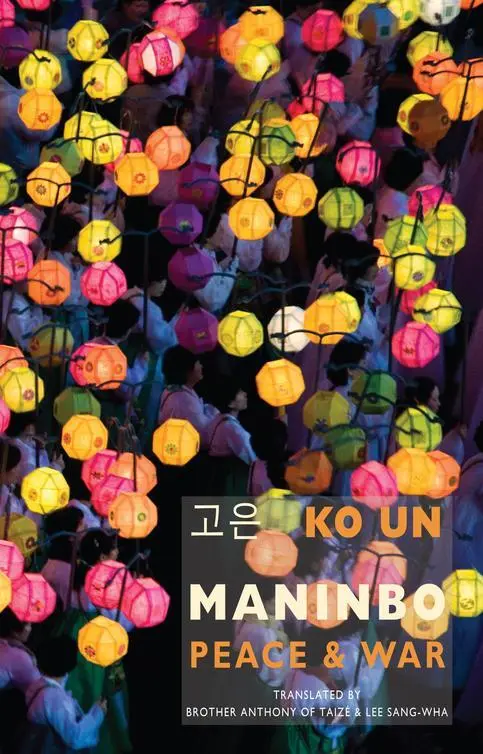
- Название:Maninbo: Peace & War
- Автор:
- Издательство:Bloodaxe Books
- Жанр:
- Год:2015
- ISBN:9781780372433
- Рейтинг книги:3 / 5. Голосов: 1
-
Избранное:Добавить в избранное
- Отзывы:
-
Ваша оценка:
Maninbo: Peace & War: краткое содержание, описание и аннотация
Предлагаем к чтению аннотацию, описание, краткое содержание или предисловие (зависит от того, что написал сам автор книги «Maninbo: Peace & War»). Если вы не нашли необходимую информацию о книге — напишите в комментариях, мы постараемся отыскать её.
Maninbo: Peace & War — читать онлайн бесплатно полную книгу (весь текст) целиком
Ниже представлен текст книги, разбитый по страницам. Система сохранения места последней прочитанной страницы, позволяет с удобством читать онлайн бесплатно книгу «Maninbo: Peace & War», без необходимости каждый раз заново искать на чём Вы остановились. Поставьте закладку, и сможете в любой момент перейти на страницу, на которой закончили чтение.
Интервал:
Закладка:
like a distended ripe pepper when he pissed.
A boy good at twisting thin straw ropes
like his father,
Bak Yeong-man.
In the war he lost a leg.
Field hospital, then
military hospital.
After a long fight,
at the end of long treatment,
he returned to his hometown
with a false leg,
on a crutch.
His neighbours threw a party for him
with makgeolli and dried fish.
The barley fields were the same as before.
The mill was gone,
the miller’s daughter Sun-yeong was gone.
They said she’d married a refugee from Seoul.
Damn it!
By the time he’d smoked two cigarettes, he’d got used to despair.
He relieved himself.
Seok Nak-gu
Old Syngman Rhee was quick to run away.
He left Seoul in secret
a day ahead
of American ambassador Muccio.
In the official residence of the governor of South Chung-Cheong province,
Rhee ate buckwheat noodles
with his wife Francesca.
His face was contorted.
Once Suwon was threatened
he left Daejeon
for Daegu.
He had been the first to run,
leaving everyone in Seoul behind.
He fled, deceiving the people into thinking
that the President was still in Seoul.
Is that how he did things during the Independence Movement?
He hated the insecurity of Siberia,
Manchuria,
and China.
He sought out safety with wealthy America.
If you talked about that carelessly,
the bar owner reported you as a red.
Dragged away by Counter-Intelligence,
soon you couldn’t walk.
Drunkard Seok Nak-gu
was sentenced to three years in prison,
three years confirmed on appeal,
reduced to two-and-a-half by the highest court.
His daughter lost the offer of a job she had got.
Her engagement, too, was broken off.
Outside, night rain grumbles.
Inside, Seok Nak-gu grumbles:
In Hawaii, old Syngman Rhee collected donations from the Korean labourers.
He easily earned honorary degrees from prestigious universities.
Wherever he went, he created factions, dividing the Korean community.
That old scoundrel!
Street Broadcaster Choi Dok-gyeon
One day in late June when it rains often,
at Seoul Radio Station under the People’s Army,
the president of Korea University, Hyeon Sang-yun,
the novelist Yi Gwang-su,
the assemblyman Jo Heon-yeong,
all having failed to escape from Seoul,
made broadcasts denouncing Syngman Rhee:
‘The South’s puppet clique is doomed.
The South’s reactionary leader Syngman Rhee should kill himself.’
‘Daejeon is still Republic of Korea territory,’
the novelist Choi Dok-gyeon declared,
countering the broadcasts from Seoul
with streetside broadcasts and posters.
Making street broadcasts,
he travelled beyond Daejeon southward
to Nonsan, Iri, Jeonju, Gunsan,
and as far as Mokpo.
Much of the time, he walked;
if he found a friendly truck he would ride.
‘Our ally in freedom, the American Army is coming.
Take heart.
The invasion by the Kim Il-sung faction will soon be repulsed.
Don’t believe the broadcasts from Seoul
by leaders who have sided with the reds;
they speak under duress.’
When he returned to Daejeon,
after having made it all the way to Mokpo, to Songjeong-ri,
Syngman Rhee had quit Daejeon
and moved to Daegu.
When he arrived in Daegu,
Syngman Rhee had made a detour
and gone down to Busan.
Choi Dok-gyeon, the author of Sorrowful Song of a Buddhist Temple ,
the dandy Choi Dok-gyeon
travelled on, soaked in sweat, hoarse with broadcasting.
Busan was the last remaining tip of Korea.
He stared at the sea off Taejong Cape.
His street broadcasts were done.
He went back to being a first-class lecher, a second-class journalist, and a third-class writer.
Gi-seon’s Mother
Gi-seon’s mother in Gunsan’s Oryong-dong wore loose working trousers
from the day she got married.
She had to patch the worn knees
over and over again.
She was fully accustomed to poverty.
Yu Sang-ho’s family, five refugees from Jangyeon in Hwanghae province
were living in the barn of Geum-sik’s house.
The wife had to support her sick husband
and three kids.
Buying plaice, sole and other kinds of fish wholesale
and putting them in a rusty tin washbasin,
she went around village after village selling them.
Times she came home with fish left in the basin.
She was always starving.
The traces of beauty in days gone by
were all faded, withered.
Gi-seon’s mother went to the kitchen,
prepared a meal with the rice she was so frugal of
and served it with kimchi on a cheap tall serving tray.
She also gave her some barley
in exchange for three of the unsold fish.
Poor people must look after poor people.
Who else will?
Saying that, Gi-seon’s mother gave that refugee wife a comb.
If you comb your tangled hair
your parting will look nice, she said.
Page from the Diary of a Youth Who Butt-flogged Kafka
Today is the eighth anniversary of the start of the Korean War.
It’s also my big brother’s seventh death anniversary.
Eight years since the war started
and in South Korea today there’s no right wing,
only the extreme right wing.
In the eyes of the far right
everything’s ultra-left.
Dogs are reds, pigs are reds,
even ghosts are reds.
The Armistice Line is still a battle line.
Land of ever-unchanging far right.
In this country
you’re not allowed to sing about red flowers.
You’re not allowed to paint red sunsets.
My blood is definitely not red.
A red skirt received as war relief
must be dyed black before you wear it.
In the summer of the eighth year after the war started,
my friend became a poet.
He recited a poem about snow glowing white
Another friend had his first exhibition of paintings,
composed entirely of abstracts in black and white.
He trembled at the very thought of pink.
The anti-communist league must be getting bored.
They say one of the league’s top executives
shouted in a bar:
Something must happen.
We must make something happen!
I’ve thrown out Kafka.
Oppose communism.
Eradicate communism.
Conquer communism.
I must join the anti-communist league.
Then I’ll be more confident,
for the world will be mine.
Within a few years
I must get promoted, become one of the league’s top executives.
I’ve thrown out Kafka.
Yeong-seop’s Mum
The earth keeps sufficient women alive.
War.
Massacres by rightists and leftists.
You who survive
must erect walls of straw mats on the ashes
and begin life again.
You need to set up a rice-cauldron.
You need to make bitter smoke rise up
like the sound of crying.
Cauldrons have been women’s work for centuries.
Mulberry trees have been women’s work for centuries.
There have to be women.
Only if there are women
can the empty places left by the dead
be filled with new-borns.
Only if there are women
can the stupid men,
when they return home weary of the rough world,
find strength to go back into the world.
After Yun Seong-su’s wife lost her husband
Читать дальшеИнтервал:
Закладка:
Похожие книги на «Maninbo: Peace & War»
Представляем Вашему вниманию похожие книги на «Maninbo: Peace & War» списком для выбора. Мы отобрали схожую по названию и смыслу литературу в надежде предоставить читателям больше вариантов отыскать новые, интересные, ещё непрочитанные произведения.






Обсуждение, отзывы о книге «Maninbo: Peace & War» и просто собственные мнения читателей. Оставьте ваши комментарии, напишите, что Вы думаете о произведении, его смысле или главных героях. Укажите что конкретно понравилось, а что нет, и почему Вы так считаете.