Ko Un - Maninbo - Peace & War
Здесь есть возможность читать онлайн «Ko Un - Maninbo - Peace & War» весь текст электронной книги совершенно бесплатно (целиком полную версию без сокращений). В некоторых случаях можно слушать аудио, скачать через торрент в формате fb2 и присутствует краткое содержание. Год выпуска: 2015, ISBN: 2015, Издательство: Bloodaxe Books, Жанр: Поэзия, на английском языке. Описание произведения, (предисловие) а так же отзывы посетителей доступны на портале библиотеки ЛибКат.
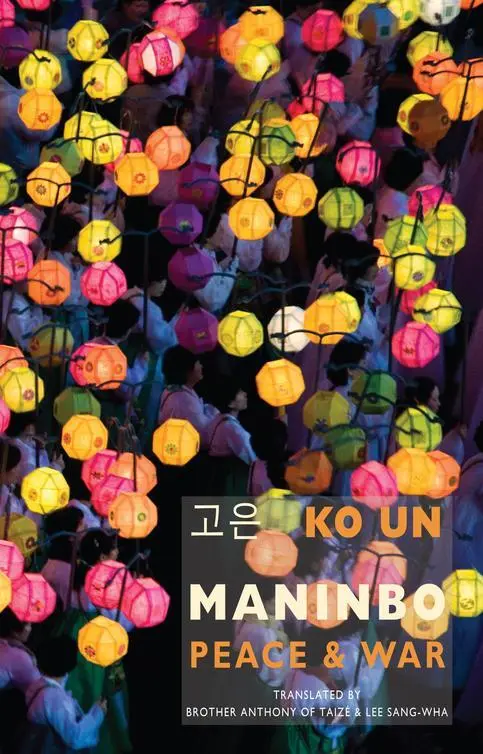
- Название:Maninbo: Peace & War
- Автор:
- Издательство:Bloodaxe Books
- Жанр:
- Год:2015
- ISBN:9781780372433
- Рейтинг книги:3 / 5. Голосов: 1
-
Избранное:Добавить в избранное
- Отзывы:
-
Ваша оценка:
Maninbo: Peace & War: краткое содержание, описание и аннотация
Предлагаем к чтению аннотацию, описание, краткое содержание или предисловие (зависит от того, что написал сам автор книги «Maninbo: Peace & War»). Если вы не нашли необходимую информацию о книге — напишите в комментариях, мы постараемся отыскать её.
Maninbo: Peace & War — читать онлайн бесплатно полную книгу (весь текст) целиком
Ниже представлен текст книги, разбитый по страницам. Система сохранения места последней прочитанной страницы, позволяет с удобством читать онлайн бесплатно книгу «Maninbo: Peace & War», без необходимости каждый раз заново искать на чём Вы остановились. Поставьте закладку, и сможете в любой момент перейти на страницу, на которой закончили чтение.
Интервал:
Закладка:
was so pretty, always quiet and bright
like a rising moon, like moonlight.
Each of the five stalls in the toilets in Sinchon primary school
had the following graffiti:
Jo Eun-seon’s mine.
Jo Eun-seon’s xx is gold-rimmed.
I want to suck Jo Eun-seon’s milk.
Jo Eun-seon is xx
Jo Eun-seon’s my wife.
Jo Eun-seon’s the sun of our nation.
That Jo Eun-seon was in fourth year of teachers’ training college.
Her brother
served as vice-chairman of the local People’s Commission.
After the reds withdrew,
she was arrested
and raped by the head of public security.
When the police came in,
the police lieutenant raped her.
The constables
raped her.
Several more people
raped her.
Then
she was buried alive.
Thus ended a schoolgirl’s life.
Today’s Meal Table
Shin Jang-heon, in his shirt-sleeves,
unfolds the morning paper wide.
He deplores the news, his laments ready-made:
‘Fighting breaking out again… the world’s going to the dogs, to the dogs…’
Where did he learn
that the world cannot be made of peace,
that the world cannot be made of love,
that human goodness is all lies,
that human evil alone is not a lie?
‘The world’s going to the dogs, to the dogs….’
‘The world is all made up of thieves.’
At the table, lamenting, he had three glasses of wine.
On the front page: twenty-one enemy soldiers killed in combat in Inje.
Page three: smuggling organisations rounded up in Busan, Masan, Yeosu,
and, oh, one mutilation murder.
Han Jae-deok
During the Japanese colonial period
he studied French
at Waseda University, Japan.
He was mad about André Gide:
La Porte Étroite
Symphonie Pastorale.
Then
he fell for socialism,
a requisite for students studying abroad.
On October 14, 1945,
a welcoming ceremony was held for General Kim Il-sung
in Pyongyang’s Municipal Stadium.
Two days before,
on October 12,
for the very first time, he proposed to call
Kim Il-sung General Kim Il-sung.
After Han Jae-deok made this proposal,
Kim Il-sung
became known forever
as General Kim Il-sung.
He was always boasting that
he was the one
who made Kim Il-sung a general,
he, Han Jae-deok.
Shortly after the war, Han Jae-deok came South.
He wrote ‘I Accuse Kim Il-sung’
and took charge of theory for the South’s anti-communist movement
He was stoutly built.
If he had met the heavily-built journalist Cheon Gwan-u
they would have vied with one another,
calling each other ‘Younger brother’, ‘Older brother’.
He was just as dark and stout.
In the fifties,
and after that
in the sixties,
in the seventies,
in the eighties,
in the nineties,
he grew old embodying eternal anti-communism in South Korea.
He was dark and stout.
Tachihara Seishu
The thirty-six years under Japanese rule were long for some people.
Short, for some people.
During that time
there were people who were opposed to Japanese imperialism.
There were people who were obedient to Japanese imperialism.
During that time
there were people who enjoyed prosperity under Japanese imperialism.
During that time
there were people
who became completely Japanese,
who deeply worshiped Japan
and Japanese culture.
There were people who every day
forgot completely that they were Koreans.
In Korea, the novelist Yi Gwang-su declared:
‘Koreans should be Japanised
so that when you prick a Korean’s brow with a needle
you find Japanese blood oozing out.’
In Japan, longing to be Japanese,
he wore Japanese costume and clogs
even when he was alone.
The Japanese novelist Tachihara Seishu
had six different names
in his not-so-long lifetime.
Born in Daejang-dong, Seohu-myeon, Andong, North Gyeongsang, Korea,
his name in the family register was Kim Yun-gyu,
which he used for a while
after he went across to Japan.
His new name there was Nomura Shintaro,
or Kim Ingkei,
the Japanese pronunciation of his Korean name, Kim Yun-gyu.
He became Kanai Seishu when he had to be renamed under Japanese rule.
After marrying a Japanese woman
he took his wife’s family name and became
Yonemoto Seishu,
while Tachihara Seishu
was his pen-name as a novelist.
He was officially authorised to register his Japanese name
two months before his life ended.
Then he died.
Born
on January 6, 1926,
his father was Kim Gyeong-mun, a labourer at Bongjeong temple,
in Mount Cheondeung in a valley near Andong
and his mother was Gwon Eum-jeon.
Before Yun-gyu was born
his father had a son
with another woman, Gyu-tae,
whom he entered in the family register with Gwon Eum-jeon as the mother.
When his father died
his mother moved into the town,
then moved far away to Gumi.
From there she crossed over to Japan.
She began a new life in a Japanese slum.
Kim Yun-gyu
went to a commercial high school in Yokohama,
dropped out of Waseda University,
and made his debut as a novelist.
Then his fabrications began.
After the annexation of Korea by Japan, he said,
when the Japanese state policy made Korean noblemen
marry Japanese women,
his father married a Japanese woman.
He was born in the home of his mother’s Nagano family,
in Daegu, North Gyeongsang,
on January 6 1927, the second year of Showa,
but the birth date shown in the family register
was January 6 1926, the fifteenth year of Taisho.
His father was Kanai Keibung,
his mother Nagano Ongko.
At the end of the Joseon dynasty, his father,
born into the noble Yi clan,
was adopted into the Japanese Kanai family.
He served as a soldier, then was discharged.
Since he disliked the world
he eventually became a Zen monk.
While residing at Bongseon temple
on the outskirts of Andong,
he used to come down from the temple once a week.
After his father died
he moved into Andong town.
He attended the Japanese primary school for a time
before transferring to Andong ordinary school for Korean children.
When his mother
remarried into the Japanese Nomura family of Kobe,
he was entrusted to a maternal uncle,
Nagano Tesso, a medical doctor.
He went to Japan
and lived in his aunt’s house in Yokosuka.
There was Yonemoto Miseyo,
a girl one year below him in Yokosuka middle school,
who was to be his future wife.
He stabbed a student
four years older than himself.
His admission to the school was cancelled.
He transferred to Yokosuka Commercial School.
He attained third grade in kendo .
He stayed in Fukuoka at the invitation of his uncle Nagano,
who had moved to the medical school of Kyushu Imperial University.
In the 18th year of Showa, after four years’ preparation for the entrance exam
he entered the preparatory course at Keijo Imperial University, in Seoul.
Then he went back to Japan.
Thus far all pure lies.
Entered law school, Waseda University.
Mobilised into the labour force during the war.
Married.
Was registered in the register of his wife’s Yonemoto Family.
Had a son and daughter.
Читать дальшеИнтервал:
Закладка:
Похожие книги на «Maninbo: Peace & War»
Представляем Вашему вниманию похожие книги на «Maninbo: Peace & War» списком для выбора. Мы отобрали схожую по названию и смыслу литературу в надежде предоставить читателям больше вариантов отыскать новые, интересные, ещё непрочитанные произведения.





Обсуждение, отзывы о книге «Maninbo: Peace & War» и просто собственные мнения читателей. Оставьте ваши комментарии, напишите, что Вы думаете о произведении, его смысле или главных героях. Укажите что конкретно понравилось, а что нет, и почему Вы так считаете.