Ko Un - Maninbo - Peace & War
Здесь есть возможность читать онлайн «Ko Un - Maninbo - Peace & War» весь текст электронной книги совершенно бесплатно (целиком полную версию без сокращений). В некоторых случаях можно слушать аудио, скачать через торрент в формате fb2 и присутствует краткое содержание. Год выпуска: 2015, ISBN: 2015, Издательство: Bloodaxe Books, Жанр: Поэзия, на английском языке. Описание произведения, (предисловие) а так же отзывы посетителей доступны на портале библиотеки ЛибКат.
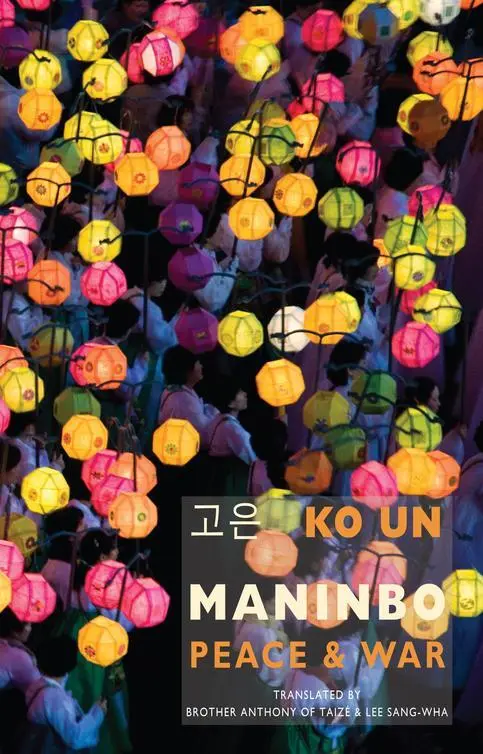
- Название:Maninbo: Peace & War
- Автор:
- Издательство:Bloodaxe Books
- Жанр:
- Год:2015
- ISBN:9781780372433
- Рейтинг книги:3 / 5. Голосов: 1
-
Избранное:Добавить в избранное
- Отзывы:
-
Ваша оценка:
Maninbo: Peace & War: краткое содержание, описание и аннотация
Предлагаем к чтению аннотацию, описание, краткое содержание или предисловие (зависит от того, что написал сам автор книги «Maninbo: Peace & War»). Если вы не нашли необходимую информацию о книге — напишите в комментариях, мы постараемся отыскать её.
Maninbo: Peace & War — читать онлайн бесплатно полную книгу (весь текст) целиком
Ниже представлен текст книги, разбитый по страницам. Система сохранения места последней прочитанной страницы, позволяет с удобством читать онлайн бесплатно книгу «Maninbo: Peace & War», без необходимости каждый раз заново искать на чём Вы остановились. Поставьте закладку, и сможете в любой момент перейти на страницу, на которой закончили чтение.
Интервал:
Закладка:
Became a writer.
Received the Naoki award.
Wrote many novels,
many short stories.
A man desperately devoted to Japan, the exploiting nation.
A man so infatuated with medieval Japan
that he transformed himself into a medieval Japanese.
A man of fiction calling himself a descendant of nobility,
half noble by blood.
For him Korea did not exist.
At fifty-four he died of oesophageal cancer.
A rare fellow…indeed!
Sang-gwon, Only Son
Venus assaulted the moon.
The People’s Army came down.
The South Korean army moved up.
The Chinese forces came down.
The People’s Army came down.
The South Korean army moved up.
The UN forces moved up.
The armistice line was drawn following the 38th parallel.
One village in Maseok, Gyeonggi province, was almost completely deserted.
All that remained were some maize stalks
and an elderly couple.
They had no news of their son Sang-gwon
who had gone off as a volunteer soldier.
He was good at painting playing cards.
When he painted a portrait of President Syngman Rhee
in third year of middle school
he received a commendation from the provincial education office.
When the communists arrived,
during the summer when he was in the fourth year,
his portrait of Kim Il-sung was hung on the wall
of the local office of the People’s Committee.
Sang-gwon didn’t come back.
Even if he had,
since he had painted the portrait of Kim Il-sung,
he could not live.
There was no news,
no news at all,
of their only son.
Ten Days on the Continent
In 1921, the Pan-Pacific Conference was held in Washington DC, USA.
In response, Lenin held the Conference of the Oppressed of the East in Moscow, USSR.
The Korean Provisional Government in Shanghai was stagnant, split into factions.
To escape this gridlock,
some took the Trans-Siberian at Harbin.
But Yeo Un-hyeong, Kim Gyu-sik and others
left from Zhangjiakou, Beijing,
by way of Kulun in Mongolia,
arriving at Kyakhta on the Soviet border.
After twenty thousand anti-revolutionary White Russian Tsarist troops
led by Baron Ungern-Sternberg had been completely destroyed in Outer Mongolia,
the whole of Outer Mongolia, from which the Chinese were banished,
fell under the control of packs of mounted bandits.
The Korean exiles prepared fur clothing, leather clothing,
boots lined with camel fur,
hats made of sheepskin,
overcoats of animal skins,
celluloid glasses
with frames of furred leather,
sleeping-bags made of old sheepskins,
and supplies of dried mutton,
rifles and pistols.
For ten days they traversed the Mongolian desert.
Minus twenty Celsius.
They arrived at their destination after camping out often in the open desert.
Along the way they caught a sheep
and boiled it in an empty oil barrel.
Even without salt it made a feast.
By way of towns in Mongolia
by way of Sapsk and Udinsk,
eating frozen black bread cut with an axe,
and by way of Irkutzk,
they finally reached Moscow on January 7, 1922.
China, Mongolia, and post-revolution Soviet Union too, all were in utter poverty.
They listened to Zinovyev’s speech at the Third International.
They met Lenin,
Trotsky.
Yeo Un-Hyeong emphasised that
the Korean revolution should be carried out
by supporting, encouraging, and correcting the Provisional Government,
and that, since Korea was an agrarian land with no knowledge of communism,
nationalism should be stressed
and the first objective should be reaching the farmers.
Lenin expressed deep interest in liberation from colonial rule.
Somehow it all seemed so simple.
Yi Jang-don’s Wife
On January 10, 1951,
amidst the chaos of flight,
on January 25, 1951,
amidst the final chaos of flight
markets were still open.
So long as anyone was alive
markets opened.
In Seoul, once again in the hands of the People’s Army,
so long as anyone at all was around,
markets were still open.
Here and there in the ruins
rice-cakes,
noodles,
makgeolli were for sale.
And bundles of firewood.
And old clothes taken from empty houses.
Even though the bodies of those killed by strafing
lay sprawled in the snow fields,
a market opened nearby. Chickens for sale.
Three-storey houses,
two-storey houses were bombed,
while low single-storey houses survived.
The People’s Committee of Seoul City
began work
in City Hall.
Yi Seung-yeop,
swarthy and with a broad laugh,
came back and presided.
Rallies were held
on air-raid-free evenings
in the City Hall Plaza,
where pools or rainwater formed in bomb craters.
Henceforth, the heroic People’s Army
will never again make a strategic withdrawal,
and so on.
And during those rallies
here and there around the Plaza,
rice-cake,
noodles,
makgeolli were being sold.
After Seoul was first recaptured
Yi Jang-don’s wife,
a strong woman,
sold rice-cakes in the Republic of Korea;
after the retreat
she sold rice-cakes again in the People’s Republic.
Sure enough, in 1953, after Seoul was secured,
she made her way into Nagwon-dong, Seoul
and opened the Obok rice-cake store.
A woman
who always wrapped her head in a towel.
A woman
who never so much as blinked during air-raids.
A woman
who knew nothing of fear, or of anxiety.
A Birth
On the night of January 3, 1951,
flames rose high
all over Seoul:
flames from burning military supplies,
flames from burning food stocks,
flames from burning documents.
On the morning of January 4,
low-flying aircraft
made an announcement from loudspeakers:
Citizens who have not yet evacuated
should do nothing rash.
Take care.
There was nobody left to hear it.
Seoul was just about deserted.
Maybe sixty thousand remained.
Flocks of crows, an uncommon sight,
had free run of Seoul
At dawn that day,
a baby
had just been born,
one of the sixty thousand.
As day was breaking,
communist soldiers in fur hats
marched through the streets.
The baby
was crying.
The mother with almost no milk
was holding her fatherless newborn.
It was a birth at which none rejoiced,
but nobody said it was a birth
that should not have happened.
The mother will grow strong.
The baby too will grow stronger, little by little.
VOLUME 20
The Present
Our lovely land of rivers, mountains!
Ah, did we have such hatred that we took revenge?
Did we have such resentment that we took revenge
and again revenge?
Since Liberation, Korea has been a land of blood.
Every single nook and cranny of our whole peninsula
has become a cursed place
where one is forced to kill another.
Ended now a thousand years of warm hearts in every village.
After 1945
suddenly
Jeong-tae turned from a boy into a young men.
You too
are no longer yourself
but your enemy’s enemy.
You there, America’s enemy? The USSR’s enemy?
What country are you a descendant of?
Читать дальшеИнтервал:
Закладка:
Похожие книги на «Maninbo: Peace & War»
Представляем Вашему вниманию похожие книги на «Maninbo: Peace & War» списком для выбора. Мы отобрали схожую по названию и смыслу литературу в надежде предоставить читателям больше вариантов отыскать новые, интересные, ещё непрочитанные произведения.








Обсуждение, отзывы о книге «Maninbo: Peace & War» и просто собственные мнения читателей. Оставьте ваши комментарии, напишите, что Вы думаете о произведении, его смысле или главных героях. Укажите что конкретно понравилось, а что нет, и почему Вы так считаете.