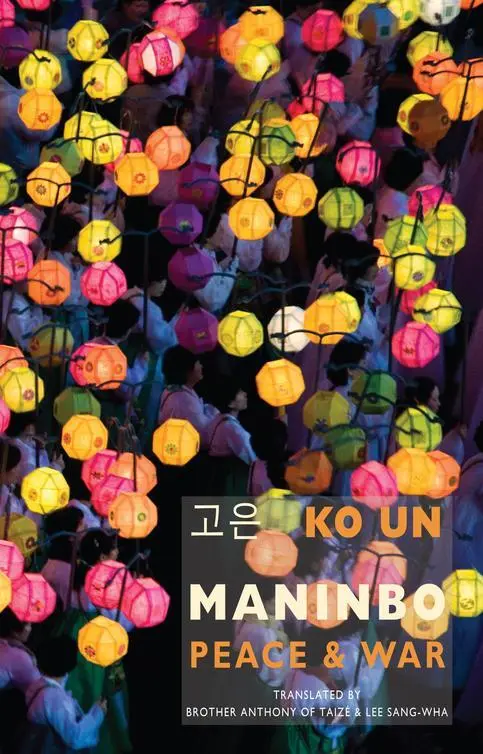
Ko Un - Maninbo - Peace & War
Здесь есть возможность читать онлайн «Ko Un - Maninbo - Peace & War» весь текст электронной книги совершенно бесплатно (целиком полную версию без сокращений). В некоторых случаях можно слушать аудио, скачать через торрент в формате fb2 и присутствует краткое содержание. Год выпуска: 2015, ISBN: 2015, Издательство: Bloodaxe Books, Жанр: Поэзия, на английском языке. Описание произведения, (предисловие) а так же отзывы посетителей доступны на портале библиотеки ЛибКат.
- Название:Maninbo: Peace & War
- Автор:
- Издательство:Bloodaxe Books
- Жанр:
- Год:2015
- ISBN:9781780372433
- Рейтинг книги:3 / 5. Голосов: 1
-
Избранное:Добавить в избранное
- Отзывы:
-
Ваша оценка:
Maninbo: Peace & War: краткое содержание, описание и аннотация
Предлагаем к чтению аннотацию, описание, краткое содержание или предисловие (зависит от того, что написал сам автор книги «Maninbo: Peace & War»). Если вы не нашли необходимую информацию о книге — напишите в комментариях, мы постараемся отыскать её.
Maninbo: Peace & War — читать онлайн бесплатно полную книгу (весь текст) целиком
Ниже представлен текст книги, разбитый по страницам. Система сохранения места последней прочитанной страницы, позволяет с удобством читать онлайн бесплатно книгу «Maninbo: Peace & War», без необходимости каждый раз заново искать на чём Вы остановились. Поставьте закладку, и сможете в любой момент перейти на страницу, на которой закончили чтение.
Интервал:
Закладка:
Young Hong Sa-jun’s novel The Deer
was idolised as a model of proletarian literature.
Writers who came down to Seoul
such as An Hui-nam,
Yi Won-jo,
Yi Gi-yeong,
Bak Tae-won encouraged him, one after another.
On their recommendation
he enjoyed the honor of visiting Pyongyang.
In August 1950
he returned from his visit to Pyongyang.
He turned from being a leftist to a rightist.
Pyongyang had disillusioned him.
I am a rightist.
I saw the reality of Pyongyang.
Tell everyone
that I am a rightist.
I curse what lies beyond the 38th parallel.
After Seoul was recaptured he was arrested as a traitor.
To save him, the writer Kim Dong-ni
visited the police and the prosecutors.
When Hong Sa-jun was imprisoned,
fearful, apprehensive,
he resolved to escape.
While attempting to escape he was killed. He was like a drop of dew.
If he had only held on a little longer,
he would have been released
after investigation.
His writing would have bloomed to the fullest.
After all, the poet No Cheon-myeong, who ran wild under the communists,
she was released.
Gwon Jin-gyu
His Japanese wife died.
Love lost.
Alone he moulded clay
chiseled stone.
The sculptor Gwon Jin-gyu
had a room in Donam-dong, Seoul.
The sculptures were quite at home.
The sculptor
was a guest squatting on the edge of a camp bed in a corner.
One clay figure breathing.
One sculptor gasping.
It seems there are cliffs in art.
Failing to avoid the cliff,
he walked over the edge
and after that, there was nothing.
He ended his life.
Not because he hated the world
Not because he hated himself.
Because art had been driven out.
Lovers
In the winter of 1953
Jiri Mountain was the main objective.
The path to Jiri Mountain crosses many steep mountains.
The Imsil contingent found itself scattered all over the ridges
when it got cut off from the main battleline.
News came that the guerilla unit in Huimun Mountain had been annihilated.
Feet were heavy as they marched on by night.
The Jiri Mountain contingent
were sure to be attacked by the expeditionary forces.
Where could the sixth division of the 102nd guards’ battalion be?
They too must have been attacked.
Each evening they cut arrowroot vines and plaited shelters,
with pine branches to form a roof.
Mount Jang-an was full of expeditionary forces.
Night fell.
Flashlights were moving upward.
The lights of the expeditionary forces.
They ran madly, walked, crawled.
They wedged themselves under rocks.
Nearby
two people were holding their breath and trembling.
In the falling snow
those two were comrades:
a woman member of the contingent, Gang Sun-ok
and a straggler from the People’s Army, Jang Gwan-ho.
Where had the other members of the contingent gone?
We’ve fallen into those bastards’ trap.
It would be a waste of energy
to go on wandering.
Let’s see what things are like here.
Sleep overcame them.
A loudspeaker rang out from below:
You’re surrounded.
Come out quietly with your hands up.
Let yourselves be embraced by the Republic of Korea.
They heard it in their sleep
as day broke.
The two were found lying side by side.
Their hands were blue with frostbite.
Barefoot, for they had taken the wrappings off their feet.
Locked in a tight embrace, they did not move.
Soldiers shook them
but they did not budge.
They had frozen to death in the night.
That girl from the South, Gang Sun-ok,
and the man from the North
must have fallen in love on their march over the mountains.
Loving
then dying,
no rancour remains.
They were not far from the secret hideout.
Unable to make it there
and dying,
no rancour remains.
Im Chang-ho’s Death Anniversary
There were almost no young men left in Jeju Island.
They had all been drafted into the army,
or sent to distant coal mines,
or conscripted to fight in the South Sea Islands.
From every seaside village
twenty
or thirty
had gone off en masse .
In one village
twenty-five gone off
between the ages of eighteen and thirty left.
The girls left to be comfort women.
Once they left
after a couple of postcards
there was no more news.
At the end of the Japanese occupation,
even the houses were requisitioned for the military,
the harvested grain taken to feed the army.
Those remaining,
between the ages of fourteen
and seventy were mobilised.
In the days of forced labour
one or two hundred
were forced to work in canteens.
When Japan surrendered,
some three hundred corpses
were piled up at the workplaces.
Such was Liberation.
Such was Jeju Island at Liberation.
Half the young folk who had been taken away
didn’t come back.
Those who came back
were injured,
were invalids.
A few lights floated on the sea at night
from boats fishing for hairtail.
Im Gyeong-bok
of Bonggae-dong in the hilly regions of Jeju Island
could not find the body of his father Im Chang-ho.
He searched three different forced-labour camps
but could not locate his father’s body
among the corpses.
Weeping bitterly
he burned a set of his father’s clothes
and put the ashes
into the grave mound for his father.
That was on August 17, 1945,
two days after Liberation.
He chose August 15,
Liberation Day,
as his father’s death anniversary day.
‘Father!
Father!’
Returning home
after building the grave mound
he called out toward the horizon.
‘Father!’
That night in a dream
his father came back in a boat.
The Lady Eom
Queen Min, who stood up to the Daewon-gun, her father-in-law,
was a fearsome woman.
On the faces of the court ladies
who slept with her husband King Gojong
she inflicted all kinds of scars,
and added all kinds of harsh punishments.
She was murdered one night by a band of Japanese thugs.
Her dead body was burned,
became a handful of bones
that someone secretly buried.
Later, the Lady Eom,
who had kept her distance from Queen Min, was called
to be the recipient of Gojong’s love.
Lady Eom was benevolent.
The courtiers felt relieved at last.
This wise queen,
separately from the schools of the foreign missionaries
founded Yanjeong School,
Jinmyeong Ladies’ School,
Sukmyeong Ladies’ School with money from the privy purse
and her own resources.
Yangjeong School offered traditional education,
Jinmyeong and Sukmyeong aimed at modern education.
In the end her son Eun, known as King Yeongchin,
was sent away to Japan as a hostage at the age of eleven.
His royal father
and royal mother were broken-hearted.
His royal father
inscribed for him the character  ‘endure’.
His mother, the Lady Eom, died of typhoid fever
before ever seeing again the Crown Prince, her only son.
Yi Hae-myeong’s Wife
During the war, people were less than animals.
Читать дальшеИнтервал:
Закладка:
Похожие книги на «Maninbo: Peace & War»
Представляем Вашему вниманию похожие книги на «Maninbo: Peace & War» списком для выбора. Мы отобрали схожую по названию и смыслу литературу в надежде предоставить читателям больше вариантов отыскать новые, интересные, ещё непрочитанные произведения.







Обсуждение, отзывы о книге «Maninbo: Peace & War» и просто собственные мнения читателей. Оставьте ваши комментарии, напишите, что Вы думаете о произведении, его смысле или главных героях. Укажите что конкретно понравилось, а что нет, и почему Вы так считаете.