Ko Un - Maninbo - Peace & War
Здесь есть возможность читать онлайн «Ko Un - Maninbo - Peace & War» весь текст электронной книги совершенно бесплатно (целиком полную версию без сокращений). В некоторых случаях можно слушать аудио, скачать через торрент в формате fb2 и присутствует краткое содержание. Год выпуска: 2015, ISBN: 2015, Издательство: Bloodaxe Books, Жанр: Поэзия, на английском языке. Описание произведения, (предисловие) а так же отзывы посетителей доступны на портале библиотеки ЛибКат.
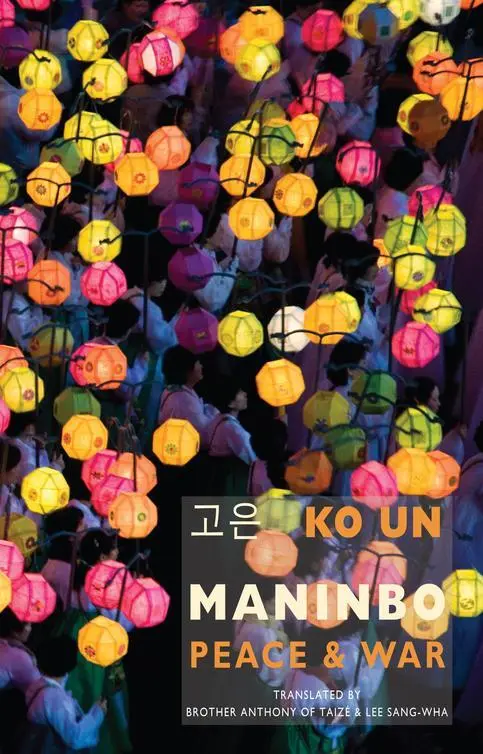
- Название:Maninbo: Peace & War
- Автор:
- Издательство:Bloodaxe Books
- Жанр:
- Год:2015
- ISBN:9781780372433
- Рейтинг книги:3 / 5. Голосов: 1
-
Избранное:Добавить в избранное
- Отзывы:
-
Ваша оценка:
Maninbo: Peace & War: краткое содержание, описание и аннотация
Предлагаем к чтению аннотацию, описание, краткое содержание или предисловие (зависит от того, что написал сам автор книги «Maninbo: Peace & War»). Если вы не нашли необходимую информацию о книге — напишите в комментариях, мы постараемся отыскать её.
Maninbo: Peace & War — читать онлайн бесплатно полную книгу (весь текст) целиком
Ниже представлен текст книги, разбитый по страницам. Система сохранения места последней прочитанной страницы, позволяет с удобством читать онлайн бесплатно книгу «Maninbo: Peace & War», без необходимости каждый раз заново искать на чём Вы остановились. Поставьте закладку, и сможете в любой момент перейти на страницу, на которой закончили чтение.
Интервал:
Закладка:
He spent six years in Daegu jail.
Uncle was a socialist.
Uncle was a revolutionary.
I thought about my uncle in prison.
I stopped playing with Bong-Jin, the local landowner’s son.
I decided to stop thinking about pretty Suk-Nye,
daughter of the village head.
Instead,
I played with Su-Man and Tae-Rang who were from poor families.
I shared my ration of food with them.
I gave them my pencils.
From the age of 15
I was a socialist like my uncle.
Only nobody
knew that I was a socialist.
At night, alone,
I used to tremble.
Uncle Yu Sang-Seop finally died in his fourth prison.
It was the day after Stalin died.
I burned one of Uncle’s books up the hill behind the house.
I cried a lot.
It was where foxes used to cry
but now there were no more foxes.
Lovely Geum-gak
He was such a lovely boy.
It was no surprise that even men,
sighing in admiration,
felt secret passions for him.
Truly,
he was a boy like a spider’s web with fresh dewdrops
like a flower’s stamen with pure dewdrops,
a boy with the spirit of the point of an arrow flying
He was a young old man
such that no one should dare make light of him.
Living in exile high in Mount Paek-un,
Heobong had a little boy, Geum-gak,
as company for his solitude,
By the age of ten he was said to have read most books.
Heobong praised him:
‘You are truly my teacher,
how could I ever be your teacher?’
At eighteen, that boy was dying of lung disease.
‘If heaven grants me a few more years of life,
I would like to read the books I have not yet read
before I leave the world.
What’s the use of praying?
Father, mother, do not cry for me,’
and with those words, he closed his eyes.
Should a life be supposed to be long?
Should a life be supposed to be whole
only when it leaves something behind?
Swallows go south leaving nothing.
Headmaster Shin Jin-seop
The headmaster wore round, black-rimmed glasses.
The moustache below his nose
was always neatly trimmed.
He left a dry cough as a sign of his presence
in places where nobody was to be seen.
He had extra time to care for the flowers,
in the school garden
and in the garden in his official residence.
Coxcombs,
four-o’clocks,
asters,
plantain lilies,
chrysanthemums…
the flowers bloomed in harmony according to the season.
One evening
guerrillas came down from the hills.
When they demanded the mimeograph machine,
he said he could not give it to them
because it belonged to the school.
They said that they couldn’t help but kill him.
He opened the office.
They carried off the machine.
The next day the police took away the headmaster, his hands tied;
he was guilty of helping guerrillas.
He became a traitor,
a red.
His limbs drooped.
He was beaten with clubs
until nearly a corpse.
He ceased being a headmaster,
became a convict and began a ten-year imprisonment.
What he most envied were those convicts who took care of flowers.
Every day,
they took care of flowers –
dahlias and roses.
The cut flowers were sent outside to be sold.
How he longed to take care of flowers,
just like when he was headmaster.
Yi Bok-nam from Geochang
In January 1951, Yi Cheol-su was fourteen.
His grandmother, Yu Bun-nyeo,
his father, Yi Jong-muk,
his mother, Ms Baek,
his younger brother, Cheol-ho,
the farmhand, Mr Bak,
the maid, Cham-rye with the double-crowned hair,
all six were massacred for the crime of being reds.
However,
Cheol-Su and his younger sister Bok-nam survived,
having gone to their mother’s home.
The southern soldiers
dragged ten-year-old Bok-nam off
and drove a nail through her palm
to force her to say she was a red.
‘I’m not a red,
I’m not a red,’
she screamed.
Finally,
she said,
‘I’m a red,’
and fainted.
The world was frozen.
The sky
was frozen
blue,
deep blue.
Her brother, Cheol-su,
afraid of the world,
afraid of the soldiers,
stole away into the mountains.
Inevitably,
he became a young partisan guerrilla.
In 1956,
nurse Yi Bok-nam of the Red Cross Hospital in Daejeon,
a scar in her right palm where the nail went through, was quiet.
Right-handed as a child,
she was quiet now and left-handed.
She was so good at giving subcutaneous injections
that the patients never knew if the needle was in or not.
When she delivered an injection into a vein
nobody felt the least pain.
Im Chae-hwa
Sadder by far to lose his mother at eleven
than at five.
At five, he wouldn’t have known the sorrow.
He grew up on sorrow,
here, on the earth.
Paternal aunt’s skirt,
maternal aunt’s skirt,
maternal uncle’s wife’s skirt,
as he grew, he learned that none of those
was as good as his mother’s.
In lieu of fertile earth,
he put down roots in rock,
so his life was tough.
The leaves that would dance when it rained
withered.
When he was three,
his father had died.
After that the years were all uneasy.
In January 1951 when he was eleven,
his mother was dragged off to Baksan Valley
and died with the other villagers.
She died without learning why she must die.
The noun ‘red’ –
a traitor who secretly collaborated with communist guerrillas –
that was all.
A few shards of human bone
no one could tell apart,
whether they were his mother’s –
who could never tell A from B –
or someone else’s
emerged from the ground.
Twenty-year-old Im Chae-hwa’s eyes grew moist.
This world was all wrong.
Township Head Park Yeong-bo
The official name of the Geochang Massacre of the Innocents
was the CheongYa Operation.
Some six hundred people were brought
into the classrooms of Sinwon primary school.
One officer asked if any were families of military policeman.
A few families came forward.
It was true.
A few more families came forward.
This was not true.
They claimed they were MP families
in order to survive.
Then township head Park Yeong-bo stepped forward,
brazen faced,
with a large birthmark on his face.
He dragged one man out:
‘You’re from no MP family.’
Then he dragged another one out:
‘How can you be from a policeman’s family?’
The six hundred or more townsfolk were bound and taken away.
Gunfire ran out in a gully
beneath a steep hillside.
Then
all was quiet.
Ten years later came the April Revolution.
On the day a cenotaph was to be erected
the families of the victims
went en masse to Park Yeong-bo’s house.
They dragged him a couple of miles
and made him stand before the graves.
He ran away.
People hurled stones furiously.
He fell as he fled.
One year later came the military coup of May 1961.
People were arrested
for the murder of Park Yeong-bo.
The CheongYa Operation is still on. It’s lasted a long time.
A Baby in the 4 January Retreat
Интервал:
Закладка:
Похожие книги на «Maninbo: Peace & War»
Представляем Вашему вниманию похожие книги на «Maninbo: Peace & War» списком для выбора. Мы отобрали схожую по названию и смыслу литературу в надежде предоставить читателям больше вариантов отыскать новые, интересные, ещё непрочитанные произведения.





Обсуждение, отзывы о книге «Maninbo: Peace & War» и просто собственные мнения читателей. Оставьте ваши комментарии, напишите, что Вы думаете о произведении, его смысле или главных героях. Укажите что конкретно понравилось, а что нет, и почему Вы так считаете.