Ko Un - Maninbo - Peace & War
Здесь есть возможность читать онлайн «Ko Un - Maninbo - Peace & War» весь текст электронной книги совершенно бесплатно (целиком полную версию без сокращений). В некоторых случаях можно слушать аудио, скачать через торрент в формате fb2 и присутствует краткое содержание. Год выпуска: 2015, ISBN: 2015, Издательство: Bloodaxe Books, Жанр: Поэзия, на английском языке. Описание произведения, (предисловие) а так же отзывы посетителей доступны на портале библиотеки ЛибКат.
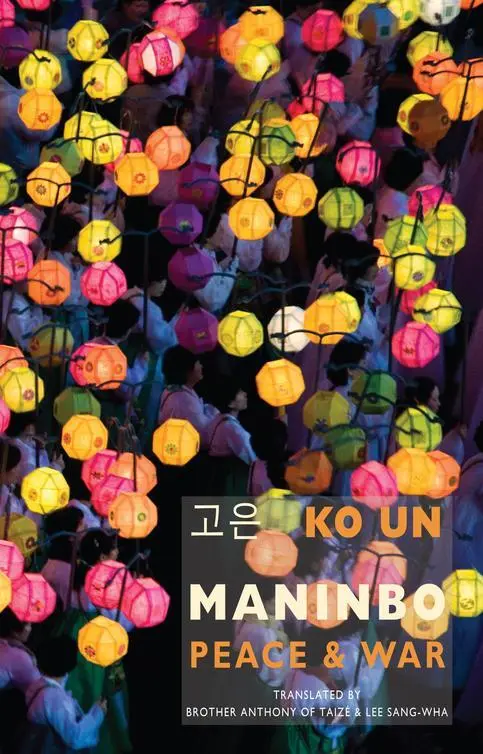
- Название:Maninbo: Peace & War
- Автор:
- Издательство:Bloodaxe Books
- Жанр:
- Год:2015
- ISBN:9781780372433
- Рейтинг книги:3 / 5. Голосов: 1
-
Избранное:Добавить в избранное
- Отзывы:
-
Ваша оценка:
Maninbo: Peace & War: краткое содержание, описание и аннотация
Предлагаем к чтению аннотацию, описание, краткое содержание или предисловие (зависит от того, что написал сам автор книги «Maninbo: Peace & War»). Если вы не нашли необходимую информацию о книге — напишите в комментариях, мы постараемся отыскать её.
Maninbo: Peace & War — читать онлайн бесплатно полную книгу (весь текст) целиком
Ниже представлен текст книги, разбитый по страницам. Система сохранения места последней прочитанной страницы, позволяет с удобством читать онлайн бесплатно книгу «Maninbo: Peace & War», без необходимости каждый раз заново искать на чём Вы остановились. Поставьте закладку, и сможете в любой момент перейти на страницу, на которой закончили чтение.
Интервал:
Закладка:
left carrying bags and bedding.
The old man wept all the way, without shedding tears.
The little girl did not cry.
She stared down at the Soyang River below,
a river she would never see again.
Homecoming
At the end of June 1950
5th-year middle-school student Kim Myeong-gyu enlisted as a volunteer.
His regiment
kept retreating on the pretext of relocating.
While Dabuwon above Waegwan
was captured and recaptured dozens of times,
he survived.
How is it that he survived?
one of just nine survivors in his platoon?
His face was covered with pimples.
After Seoul was recaptured,
he came back home,
carrying his rifle.
His long-widowed mother
and his older brother Se-gyu
had been killed by the withdrawing communists.
The neighbours held a welcoming party for him.
He spent one day
at his mother’s grave
and his brother’s grave.
He even paid a visit to his father’s grave,
whom he had never seen.
Late that night, a shot rang out.
He had killed himself.
A couple of soju bottles lay beside him, toppled over.
Yang Hyeong-mo
Snow drove furiously down
onto the eight-year old.
Where are we?
Where are we?
Fields in a blizzard.
During the 4 January 1951 retreat,
behind a railway station near Pyeongtaek, Gyeonggi province,
double-cropped barley fields were covered with snow.
Some eighty refugees wrapped in straw sacks
huddled on the ground in snowdrifts.
Among them
were Hyeong-mo, his father and mother,
with his two younger brothers.
How lucky they were to have survived together,
all the family.
How lucky they were, starving together and
eating together.
Toward nightfall, Hyeong-mo left to get firewood.
Boom!
A shell fell, fired in error.
The eighty went flying, vanished.
Hyeong-mo came rushing back.
Father,
mother,
brothers, gone.
Baek Seung-bok’s family, too,
who came south with them,
all the way from Jinnam-po, in South Pyeongan province.
Around the pit made by the shell
were a forearm,
a shoe,
a severed head,
a pair of glasses,
a corpse that was groaning then stopped groaning.
After that, Hyeong-mo, wrapped in a tattered blanket,
followed an orphan’s path, with no direction,
no north, south, east or west.
The blizzard stopped.
He shouted up at the frozen sky,
calling for mother, for father.
He called for his brothers, too,
Hyeong-jin!
Hyeong-ryeol!
The Old Widower
In winter 1955 the whistles of Seoul-Busan trains could be heard faintly
in a remote village in Yeongdong, North Chungcheong province.
If there were train whistles to be heard,
the world was still the same world.
The hills were all bare together,
they would shiver at night.
Bare, the hills all looked the same,
no telling which was which.
Ocheon Mountain,
Mireuk Mountain,
Chotdae Peak,
the hill in front,
the hill behind Ssangbong village,
no telling which was which.
What the children drew were
always
bare, red hills,
hills of red clay.
Even the bellowing of oxen
was a red bellowing.
Over the ridge of one such hill, as the sun was setting,
a person was coming, slow and weary.
Who could it be?
Who other than a man
half insane,
half in his right mind?
Wife
and two children were killed
together by a mortar shell,
one ox was also killed.
He alone survived,
Yi Jong-su, a fellow with thick hair.
He had a high-pitched voice
like a wild goose.
Several millions died in the course of three years of war.
Among the dead
were Yi Jong-su’s family.
In the empty stable
all he could say was:
‘Hey Wife, hey Wife!’
and then
‘Jang-seop!
Cha-seon!
Cha-seop!’
Shin Hyeon-gu
Why do you know of nothing but your home village?
In Onjeong-ri, across from Daegwanbong village,
on the southern slopes of the Myeorak Mountain Range,
in Pyeongsan County, Hwanghae province,
out of forty-seven inhabitants
nine left with the People’s Army.
Onjeong-ri was a village with one mule,
five dogs,
and twenty-three rabbits.
Lots of mice, too.
Wild cats and badgers would appear by turns,
and a family of three wild boars used to come down
and trample the potato fields.
Sometimes a stately flock of ravens would alight.
When the mule neighed,
the chimneys that sent the suppertime smoke
soaring, soaring high
would listen to the mule’s neighing.
Fifteen-year-old Shin Hyeon-gu kept having mishaps.
He would get scratched bloody by holly leaves,
or hurt his hand while cutting wood.
He hoped one day to become a monk.
For that fifteen-year-old Shin Hyeon-gu,
the village he’d grown up in grew suffocating.
He was like a mule, like a baby wild boar,
that suddenly goes wild.
Luckily the war spared the village.
In his dreams, wings sprouted from his shoulders.
On a bitterly cold night
when ice nine centimetres thick was cracking,
hordes of Chinese volunteers
surged across the Yeseong River
after crossing the Yalu,
the Cheongcheon,
and the Daedong.
On that night Shin Hyeon-Gu
swam across the Yeseong River downstream from the ferry,
carrying two of his mother’s rings.
Her ancestor had been one of the leaders of the Donghak Uprising.
Air came through his nostrils, and water, too.
After fifteen minutes,
he reached Saemal on the other bank.
He pulled on the clothes he had rolled up and tied to his body.
They were clothes of ice.
When he turned around he seemed to hear his mother’s voice:
‘You alone at least
must live.
Off you go.
Off you go.’
Her words remained in his ears.
Mother!
He called out in the direction of the village he had left.
Decades of Armistice passed after he left home like that.
He was 63, had two sons, three daughters, and seven grandchildren.
One daughter was divorced, one not married.
In the darkness at the crack of dawn, those old rings,
at daybreak, those rings alone remaining from the past,
were the only strength left to him.
At heart he was always crossing rivers and going over mountains.
The Refugee Camp in Songtan
It was called a refugee camp
yet had not so much as an iron fence.
It was
simply a place, beyond Sut Pass,
where people put up second-hand tents
or built shacks with pieces of plywood,
to keep out the wind and rain.
We heard that Chinese troops would soon be coming
like a swarm of locusts.
We had to move again, from Songtan
to Jochiwon or to Daejeon.
Could be we might end up in Busan, the provisional capital.
Amidst all this confusion
Yu Byeong-cheol’s wife, from Sinanju in the North,
gave birth to a son.
Huddled in ragged quilted clothes, Yu Byeong-cheol
had it seems held on to a scrap of artistry.
He exclaimed with a laugh, ‘A migrant bird’s been born,’
and rejoiced, drinking a quart or more of cheap soju .
Yi Jeong-sun’s Spirit
Over at last: the three months of the People’s Republic.
Читать дальшеИнтервал:
Закладка:
Похожие книги на «Maninbo: Peace & War»
Представляем Вашему вниманию похожие книги на «Maninbo: Peace & War» списком для выбора. Мы отобрали схожую по названию и смыслу литературу в надежде предоставить читателям больше вариантов отыскать новые, интересные, ещё непрочитанные произведения.








Обсуждение, отзывы о книге «Maninbo: Peace & War» и просто собственные мнения читателей. Оставьте ваши комментарии, напишите, что Вы думаете о произведении, его смысле или главных героях. Укажите что конкретно понравилось, а что нет, и почему Вы так считаете.