Ko Un - Maninbo - Peace & War
Здесь есть возможность читать онлайн «Ko Un - Maninbo - Peace & War» весь текст электронной книги совершенно бесплатно (целиком полную версию без сокращений). В некоторых случаях можно слушать аудио, скачать через торрент в формате fb2 и присутствует краткое содержание. Год выпуска: 2015, ISBN: 2015, Издательство: Bloodaxe Books, Жанр: Поэзия, на английском языке. Описание произведения, (предисловие) а так же отзывы посетителей доступны на портале библиотеки ЛибКат.
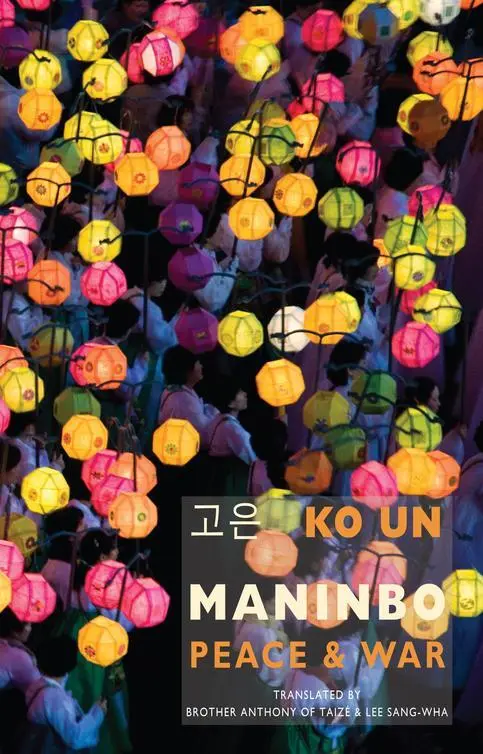
- Название:Maninbo: Peace & War
- Автор:
- Издательство:Bloodaxe Books
- Жанр:
- Год:2015
- ISBN:9781780372433
- Рейтинг книги:3 / 5. Голосов: 1
-
Избранное:Добавить в избранное
- Отзывы:
-
Ваша оценка:
Maninbo: Peace & War: краткое содержание, описание и аннотация
Предлагаем к чтению аннотацию, описание, краткое содержание или предисловие (зависит от того, что написал сам автор книги «Maninbo: Peace & War»). Если вы не нашли необходимую информацию о книге — напишите в комментариях, мы постараемся отыскать её.
Maninbo: Peace & War — читать онлайн бесплатно полную книгу (весь текст) целиком
Ниже представлен текст книги, разбитый по страницам. Система сохранения места последней прочитанной страницы, позволяет с удобством читать онлайн бесплатно книгу «Maninbo: Peace & War», без необходимости каждый раз заново искать на чём Вы остановились. Поставьте закладку, и сможете в любой момент перейти на страницу, на которой закончили чтение.
Интервал:
Закладка:
When John Foster Dulles came a-visiting
in the time when the Liberal Party ruled,
and after that
when Henry Kissinger came,
and in 1979 when Jimmy Carter came,
the Korean Ministry of Home Affairs
rounded up every last beggar
on the streets of Seoul
and locked them up in a camp in Nokbeon-dong.
No beggars here.
Beggars with only one leg,
beggars with only one arm,
beggars pretending to be deaf and dumb,
beggars so sick
there was no telling when they would die,
and beggars unable to get fifty won in a day,
or the opposite,
beggars who threateningly thrust out a wide open hand
glaring as fiercely
as did wounded veterans in the streets in the 50s,
all such beggars were swept away.
No beggars here.
Human nature comes in two varieties,
that of a thief or that of a beggar.
A day without beggars is a day for thieves.
Carter,
I hope you and your mysterious, beguiling smile
scamper back to Washington quickly.
VOLUME 16
Seung-ryeol’s Tomb
If the Soviet guards catch you, you’re done!
That evening
it was raining steadily.
A few families, escaping southward,
inched across the mountains, holding their breath.
At last they reached the 38th parallel.
If the Soviet guards catch them, they’re done for!
As they crossed the line
a baby started to cry.
Its mother muffled the sound
swaddling the baby in a blanket.
Finally they were safe.
The guide, once paid, vanished.
On the sodden ridge, scratched by the brushwood,
they all sighed with relief in the rain.
We’re alive, they gasped.
We’ve made it,
The blanket muffling the baby was unwound.
The one-year-old
was dead, suffocated.
The mother shook her dead baby.
She shook it
and wailed.
‘Seung-ryeol, Seung-ryeol, Seung-ryeol… Seung-ryeol.’
The father, having no spade, dug a hole in the earth with his bare hands.
He snatched the baby’s body from her arms and buried it.
Seung-ryeol,
Seung-ryeol,
Seung-ryeol…
Elena
She was born in early spring 1940
near a fresh green barley-field, skylarks soaring.
Her mother lacked milk so went round the village with her infant,
and she survived thanks to the milk other mothers gave grudgingly.
So her life began as a baby beggar.
From the age of six
she started doing night work, keeping her mother company.
So she set out on a wearisome life as a child labourer.
After the war
she was sixteen, quite beautiful.
When she smiled the slightest smile
dimples appeared on both her cheeks.
Desolate times though they were,
some bright angel seemed to have alit upon her eyes.
In the summer of 1956
on her way home from evening classes
she was raped
by two US soldiers in a jeep.
She wanted to die.
She wanted to die.
Even heaven no longer existed.
And her hometown was no refuge;
it was a place of pointing fingers.
Weeping
she left home and,
as fate would have it,
became a whore outside a US base in Songtan, Geonggi province.
Sunja turned
into Elena.
In a drunken fit she killed a US private
who was hitting her, refusing to pay.
Sentenced to life,
Elena
turned back into Sunja.
She was sent to Suwon prison,
then to Gongju prison,
then to Suncheon prison.
Never once did her lips speak the word ‘love’.
When everyone around the world was talking
about Eisenhower being elected president,
she remained silent for a whole day.
Mute. And in her heart, a clot of ash.
Others’ Eyes
That war
took away the greetings we used to exchange even with strangers.
It took away customs of speaking slowly,
gently.
Words became faster
and sharp.
That war took away the clarity in the eyes
of people in autumn’s cool wind.
Gradually,
not only the eyes of people
but of cows and horses in the stony fields
grew bloodshot and fierce.
In front of Daejeon Station
a gum-selling kid
was clearly beating another kid to death.
Not one spectator
intervened. The wind stirred up the dust.
Not one
had the friendly face of villagers back home.
Two Rivers
Of a sudden
shortly before the Armistice
the fierce fighting on the western front
stopped.
No sound of gunfire,
anywhere.
Was that an illusion?
Once again the sound of gunfire
filled the space between enemies.
Rain began to pour down.
Illusion?
That night
Byeon Ju-seop, a youth from Pyeongsan, Hwanghae province,
crossed the Yeseong River in the rain.
Bare-footed,
he kept on, heading over mountain ridges.
Finally, more than exhausted, he crossed the Imjin River
oblivious of the pain of his bleeding feet, their cracked soles.
When the boy reached the southern bank of the Imjin River,
his constant dream for several days,
he called out repeatedly, Mother! Mother!
his whole body shivering,
upper and lower jaws
trembling each on their own.
The rain kept on.
Mother was in the North now, son in the South.
His voice changed.
His face was full of freckles.
Now he was alone.
He would be alone when he begged,
when he filched.
He would be alone when he delivered restaurant food.
Alone, oblivious of a future in which he would father eleven children.
He had a triangular face.
He cried wildly, calling, Mother! Mother!
The division of North from South
divided one from one, one from another, individuals.
After that day the youth no longer wept.
His brows were bushy.
He did not weep even when, much later,
in a printing shop, his finger was severed by the cutter.
Old Sim Yu-seop
War widows need their smokes.
When you miss someone, you have to have a smoke.
When the person you miss has disappeared,
you have to have a smoke.
Widows, and widowers must develop a taste
for tobacco.
Friends separated forever from friends
must develop a taste for tobacco.
One nation was divided into two.
The moment of division,
the two became enemies.
Naturally,
inevitably,
absurdly,
war broke out.
For a few months the front line moved ever farther south.
It engulfed even the west of South Gyeongsang province.
The American fighter planes changed abruptly:
one moment, Second World War propeller-driven Grumman Hellcats;
the next, jet-propelled Sabers.
Then the front line shot up northward.
More and more North Korean troops retreated.
At first, the North’s advance had been unhindered,
now the advance by the South was unhindered.
The whole country was turned into scorched earth
from carpet bombing by the US Air Force.
Who among us had wanted scorched earth?
Was it ruins
we so ardently desired?
While the fighting moved up
and down,
the rice was ripening
in the fields round Jochiwon, South Chungcheong province.
Sixty-five year-old Sim Yu-Seop,
having given his paddy fields a triple summer weeding,
was waiting wordlessly
for the autumn harvest
His heart was entirely given over to his two sons.
Читать дальшеИнтервал:
Закладка:
Похожие книги на «Maninbo: Peace & War»
Представляем Вашему вниманию похожие книги на «Maninbo: Peace & War» списком для выбора. Мы отобрали схожую по названию и смыслу литературу в надежде предоставить читателям больше вариантов отыскать новые, интересные, ещё непрочитанные произведения.







Обсуждение, отзывы о книге «Maninbo: Peace & War» и просто собственные мнения читателей. Оставьте ваши комментарии, напишите, что Вы думаете о произведении, его смысле или главных героях. Укажите что конкретно понравилось, а что нет, и почему Вы так считаете.