Ko Un - Maninbo - Peace & War
Здесь есть возможность читать онлайн «Ko Un - Maninbo - Peace & War» весь текст электронной книги совершенно бесплатно (целиком полную версию без сокращений). В некоторых случаях можно слушать аудио, скачать через торрент в формате fb2 и присутствует краткое содержание. Год выпуска: 2015, ISBN: 2015, Издательство: Bloodaxe Books, Жанр: Поэзия, на английском языке. Описание произведения, (предисловие) а так же отзывы посетителей доступны на портале библиотеки ЛибКат.
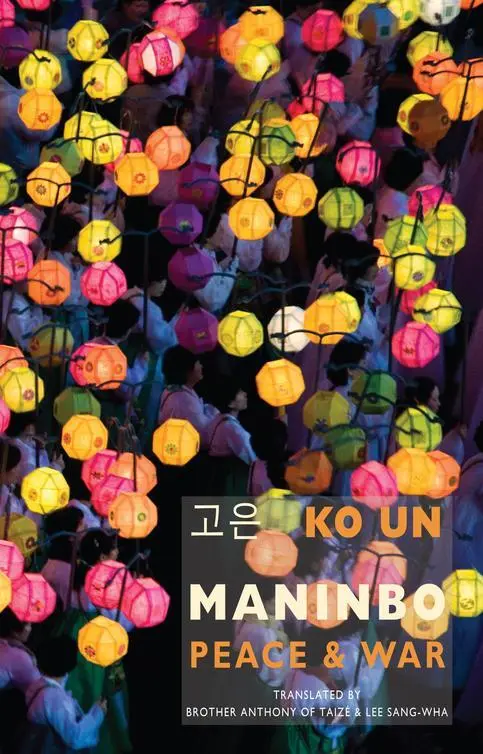
- Название:Maninbo: Peace & War
- Автор:
- Издательство:Bloodaxe Books
- Жанр:
- Год:2015
- ISBN:9781780372433
- Рейтинг книги:3 / 5. Голосов: 1
-
Избранное:Добавить в избранное
- Отзывы:
-
Ваша оценка:
Maninbo: Peace & War: краткое содержание, описание и аннотация
Предлагаем к чтению аннотацию, описание, краткое содержание или предисловие (зависит от того, что написал сам автор книги «Maninbo: Peace & War»). Если вы не нашли необходимую информацию о книге — напишите в комментариях, мы постараемся отыскать её.
Maninbo: Peace & War — читать онлайн бесплатно полную книгу (весь текст) целиком
Ниже представлен текст книги, разбитый по страницам. Система сохранения места последней прочитанной страницы, позволяет с удобством читать онлайн бесплатно книгу «Maninbo: Peace & War», без необходимости каждый раз заново искать на чём Вы остановились. Поставьте закладку, и сможете в любой момент перейти на страницу, на которой закончили чтение.
Интервал:
Закладка:
Those widows worshipped spirits:
the spirit of the ground outside in the backyard,
the home’s guardian spirit inside the house,
Old Granny the kitchen spirit,
the spirit of the outdoor privy,
the Jade Emperor of Heaven and the King of the Underworld in the men’s quarters.
Spirits everywhere:
The Jade Emperor of Heaven,
The Granny spirit of childbirth,
The Mountain Spirit,
The Farming Spirit,
Wonsa spirits of Wishes,
Joseong Daegam spirits of buildings,
Jeseok spirits of Indra,
Songaksi spirits bringing disaster,
Mimyeong spirits of clothing,
spirits everywhere…
Blind as a Bat
King Sejo of the Joseon era left behind six dead ministers,
and six living ministers.
Kim Si-seup,
one of the living,
became a mendicant monk
wandering the countryside.
Yi Maeng-jeon,
another of the living ministers,
went back home to Seosan, South Chungcheong,
and pretended to be blind,
spending the rest of his life like that,
thirty years,
with a blind man’s staff.
Then there was Cheong Rong who pretended to be deaf.
Gwon Jeol too,
after Sejo’s bloody coup,
pretended to be deaf.
He even used signs to communicate with his family.
Nam Hyo-on
and his son Nam Chung-seo
pretended to be insane.
If the weather was bad, they laughed: hee hee hee .
Even before the weather grew bad they would smack their lips: hee hee hee .
When swallows perched on the washing-line,
laughing hee hee hee , they sipped wine.
Ten Eyes
The man with ten eyes,
with twelve eyes –
when the moon rises
he looks up at the moon,
at the stars…
He looks up at this star
and that,
even the darkness between the stars.
He can never focus on any one thing,
O Gil-hwan
with his yellowish eyes.
If someone asks:
Hey, Gil-hwan, what did you see last night?
Ummm, I saw everything,
saw everything,
so I don’t know what I saw.
A Kkokji Beggar’s Values
Gangs of homeless beggars always had a leader, a kkokji .
Kkokji had five values to maintain.
Above all,
the gang should not beg from
widows,
widowers,
homes that had lost parents early.
That was called Benevolence.
If a family that has been generous with food loses someone,
the gang should help carry the bier.
That was called Righteousness.
Gangs should not covet each other’s territory.
That was called Trust.
If the kkokji died
the gang should observe three years of mourning.
That was called Decorum.
The last was called Sense of Shame:
feeling shame at the sun setting in the west
when they stop being beggars and close their eyes.
In the late Joseon period,
the very last, rotten years of Joseon,
it was a poignant task
to rule the world as the beggars did.
So, was putrefying Joseon
destroyed by the Japanese?
Ninety percent of the work was done before they arrived.
Twin Prison Guards
That prison’s white wall was so high
that no matter how good you were at flying leaps
or running leaps
or jumping
with a wet blanket
spread wide,
it was absolutely absurd to hope to vault over it.
Twin guards,
Yi Gi-yeol and Yi Gi-sun,
Gi-sun with a birthmark,
spent long years inside that wall
working three shifts,
sometimes only two.
Inside that wall from their 20s through to their late 40s,
surely they were lifers too.
All those years, the older twin, Gi-yeol, beat convicts,
while the younger, Gi-sun,
snatched noodles the convicts had bought.
On each anniversary of their father’s early death,
one twin would be on night duty,
the rites attended by his wife and kids alone.
Apart from that anniversary,
Gi-sun stayed in prison most of the time,
but somehow he had three daughters and
two sons, one already lost
in a traffic accident.
Idlers
Outside Yongin town, in Yongin county, Gyeonggi province,
runs a powerful range of mountains
and there, in the valley below the tomb of Jeong Mong-ju,
spring had never a thought of coming.
In Seoul,
and along the banks of the Hantan River above Seoul
the forsythia was already in full bloom
Yongin, however, often known as ‘Posthumous Yongin’,
was always ‘Late Yongin’.
The cold spring winds
had an icy edge.
The loudspeakers of the New Village Movement
pestered the village of Mansuteo
from early morning,
while just two people,
Jin Su-mun and his wife Gang Hye-ja,
exhausted
after making love that morning,
slept on,
shhh
shhh ,
stretched out with bare stomachs,
though the sun was high in the sky.
Then Jin Su-Mun was bitten by a centipede.
Damn it!
It bit me in the privates.
Damn it!
Damn it!
Notorious as a couple of idlers,
they had never received a New Village loan,
yet they were carefree and could always be heard shouting,
Damn it!
Walking Sticks
On the grounds of Buseok-sa temple in Yeongju, Sobaek Mountain,
there is a tree that grew
from a walking stick
planted by the great monk Uisang.
In Songgwang-sa temple in Suncheon, South Jeolla,
there is a tree that grew
from a walking stick
planted by the deeply revered monk Bojo, of the Goryeo dynasty.
The trees have lived long lives,
two thousand years,
one thousand years.
Nearer us, there’s a maple tree on Jungdae peak of Odae-san
that grew from a stick the Venerable Hanam
rested on
then planted.
It put out leaves and branches,
the leaves turning red in autumn.
One poet during the Yushin period in the 1970s,
sat beneath such walking stick trees
on Odae-san’s Jungdae
and in Jogye Mountain’s Songgwang-sa temple
while confined there by the intelligence agency.
Before him sat the elderly police detective, his keeper,
who said: ‘Well, thanks to you
I’m enjoying life as a mountain hermit,
the cicadas singing by day,
the Scops owl by night.’
Replied the poet:
‘Hey, since you walk about
with a stick,
you should plant it when you leave.
Who knows?’
The Yu Brothers, Grave Robbers
The world is so full of robbers
that there is no rest
even for graves.
Come to think of it,
surely a poet is a robber of birdsong,
robber of the sound of streams,
of the colour of flowers, of willow leaves.
A robber who dug up graves
was known in days past as a ‘grave-digging thief’,
writ using difficult Chinese characters
by those sporting a nobleman’s hat and gown.
The graves of rich families’ ancestors
were laid out ceremoniously, following ancient rules,
so when they were dug up,
those graves of great-great-grand parents,
of great-grandparents,
of grandfather,
of grandmother –
even if they held no treasures –
when told that a skull or bones had been dug up,
the family had to produce a wad of money,
as much as the robbers asked,
to get back the sacred remains.
Читать дальшеИнтервал:
Закладка:
Похожие книги на «Maninbo: Peace & War»
Представляем Вашему вниманию похожие книги на «Maninbo: Peace & War» списком для выбора. Мы отобрали схожую по названию и смыслу литературу в надежде предоставить читателям больше вариантов отыскать новые, интересные, ещё непрочитанные произведения.












Обсуждение, отзывы о книге «Maninbo: Peace & War» и просто собственные мнения читателей. Оставьте ваши комментарии, напишите, что Вы думаете о произведении, его смысле или главных героях. Укажите что конкретно понравилось, а что нет, и почему Вы так считаете.