Ko Un - Maninbo - Peace & War
Здесь есть возможность читать онлайн «Ko Un - Maninbo - Peace & War» весь текст электронной книги совершенно бесплатно (целиком полную версию без сокращений). В некоторых случаях можно слушать аудио, скачать через торрент в формате fb2 и присутствует краткое содержание. Год выпуска: 2015, ISBN: 2015, Издательство: Bloodaxe Books, Жанр: Поэзия, на английском языке. Описание произведения, (предисловие) а так же отзывы посетителей доступны на портале библиотеки ЛибКат.
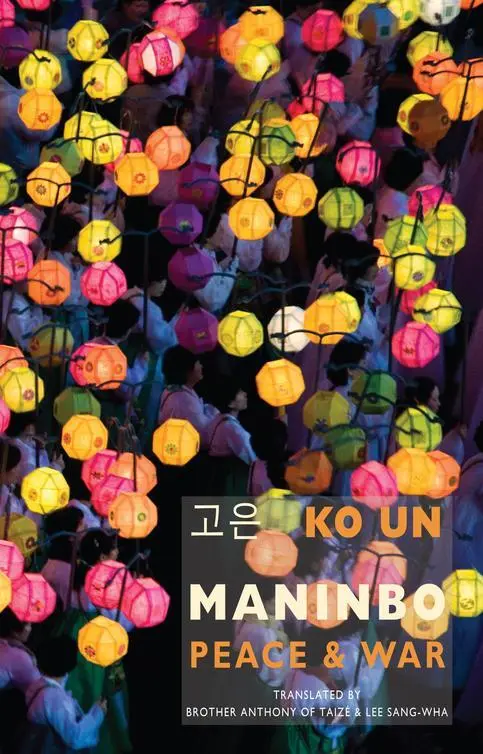
- Название:Maninbo: Peace & War
- Автор:
- Издательство:Bloodaxe Books
- Жанр:
- Год:2015
- ISBN:9781780372433
- Рейтинг книги:3 / 5. Голосов: 1
-
Избранное:Добавить в избранное
- Отзывы:
-
Ваша оценка:
Maninbo: Peace & War: краткое содержание, описание и аннотация
Предлагаем к чтению аннотацию, описание, краткое содержание или предисловие (зависит от того, что написал сам автор книги «Maninbo: Peace & War»). Если вы не нашли необходимую информацию о книге — напишите в комментариях, мы постараемся отыскать её.
Maninbo: Peace & War — читать онлайн бесплатно полную книгу (весь текст) целиком
Ниже представлен текст книги, разбитый по страницам. Система сохранения места последней прочитанной страницы, позволяет с удобством читать онлайн бесплатно книгу «Maninbo: Peace & War», без необходимости каждый раз заново искать на чём Вы остановились. Поставьте закладку, и сможете в любой момент перейти на страницу, на которой закончили чтение.
Интервал:
Закладка:
Its master, Kim Jeong-hui,
got more than a little drunk,
wept,
buried the inkstone
and performed memorial rites before its grave
the following year.
‘You left this world ahead of me.’
Countess Yi Ok-gyeong
In the Joseon Era, women had no names.
One girl from the Hong family
was adopted as Emperor Gojong’s niece.
Her lips were red as well-ripened boxthorn berries.
The girl grew up
and became the wife of Yi Ji-yong
who was leaving for Japan as Special Envoy;
She accompanied him using the name Gyeong.
She adopted her husband’s family name Yi
so she was known as Yi Gyeong.
Her flesh was like white jade,
her teeth like snowy jade
so she was called Yi Ok-gyeong.
Ok means ‘jade’.
Once in Japan, on receiving a bribe of ten thousand yen
her husband signed the Korea-Japan Protocol,
then concluded the Offensive-Defensive Alliance for the Russo-Japanese War,
allowing the Japanese to use Korea as a military base.
In reality, the whole of Yongsan in Seoul,
some 940 acres,
had served as a base for foreign forces
ever since Japanese forces captured it
during the Imjin invasion of the 1590s.
Finally Korea fell to Japan.
Even a gisaeng such as Sanhong refused
to become a concubine of one of the five ministers
who betrayed the nation,
saying that although she was a gisaeng
she could never live as the concubine of such a man.
Yi Ok-gyeong, however,
not content with her husband,
had relations with the officials of the Japanese legation:
Hakihara
Kuniwake
Hasegawa.
Her domestic servants used to take her photo
and thrust at the crotch with a stick,
saying, This is a hole for Japs.
A hole for Japs.
Reading the Maecheon Yarok *
I lingered a moment at this part.
* Maecheon was Hwang Hyeon’s pen-name, Yarok means ‘an unofficial history’. Hwang Hyeon later committed suicide when Joseon fell to Japan.
Together with Pastor Jeong Jin-dong
A young woman like very fresh young greens,
like young greens
newly washed three times in a flowing stream,
one such young woman,
having dropped out of middle school,
came and sat down in the chilly office
of the Cheongju Urban Industrial Mission.
The room grew even quieter.
Her job was to help a pastor
as bland as long-stored buckwheat jelly
or cold bean curd.
No end in sight once over the edge of the cliff.
Endless days of service.
On her face clean like young greens
appeared a freckle then another and another
like birds singing early in the morning
keeping each other company.
Writing petitions,
writing letters of complaint,
copying out manifestos,
drawing up agreements,
she also had to make visits here and there,
taking long-distance buses over bumpy, dusty roads.
With her face, which never knew make-up,
she devoted all her youth to service
and her laugh was always as it had been
a thousand years before.
No need to know her name.
Kim of Geumho-dong
He has no shoulders.
Shoulderless, he sits
on a rocky ridge in Geumho-dong.
He gazes across the river
at the newly erected apartments in Apgujeong-dong.
Talking nonsense is his job.
Once evening comes,
the lights in the apartments across the river shine bright.
He gazes across at those lights.
He tries to rise,
but his legs have grown stiff, so he has to sit down again
on rocks that have neither blood
nor tears.
An out-of-season mosquito whines
but it has no strength to bite
and he has no blood to suck.
The two of them are in the same state,
Kim of Geumho-dong and the mosquito.
However,
Kim’s son
has the best shoulders in Geumho-dong,
a young tough who gives petty thieves a hard time.
Nothing like his father. Nothing.
King Jicheollo
He was first to be given a posthumous name, Jijeung.
He was first to be given the title Wang (King)
instead of Maripgan .
Jicheollo, the 22nd king of Silla,
had Kim as his family name;
his given name was Jidaero or Jidoro.
This king’s prick was said to be well over one foot long.
Unmarried,
he sent agents all over the country
to find him a wife.
At the foot of an old tree in Muryangbu
two dogs
were fighting and biting each other
over a gigantic turd the size of a big drum.
The agents wanted to know whose it was.
They discovered that one village girl
had produced it in the woods
while doing the washing.
As might be expected, that girl was over seven feet high.
She became the wife
of the bachelor king,
a heaven-sent spouse.
The candle was never put out
night after night.
They had two sons
and son Beopheung inherited the throne.
King Beopheung
and his queen both became monks.
Weol-san the Seon Master
A broad-minded fellow
travelling through Manchuria during Japanese rule,
one day he heard the Diamond Sutra being chanted
and became a monk.
Forming an association with other monks,
such as Cheongdam, Seongcheol, Hyanggok,
he sat in the full lotus position
in Bongam-sa temple in Mungyeong,
not lying down to sleep.
With his tall stature he played a major role
in founding the Jogye Order,
then he withdrew into the mountains.
No brilliant poems,
no dazzling sermons.
He simply sat unspeaking, keeping his mind focused,
inside the sound of the wind among Mount Toham’s pines,
yesterday,
today,
tomorrow.
Sat upright,
back sheerer than a cliff,
stunning.
King Gyeongmyeong of late Silla
Everything was in decline.
All the lights were going out,
no way things could be put right.
So King Gyeongmyeong in the last stages of Silla
had nothing to do but sit and drink.
Earlier, a dog in a wall painting in the Temple of the Four Heavenly Kings barked.
Monks recited sutras
but again it barked.
Then the bow-strings of the five guardians in the temple snapped.
The dog jumped out of the wall painting, barked,
jumped back into the painting.
The seven years of King Gyeongmyeong,
the three years of King Gyeongae
were years of collapse and nothing else.
King Gyeongmyeong asked, Am I a king or a scarecrow?
Drunk,
he took off his heavy crown
and gaped at Mount Namsan in the distance,
which came into sight then disappeared
At night his only care was for one lady of the court, a newcomer.
VOLUME 15
Six Generations of Widows
Among the eighteen sons of King Sejong the Great of the Joseon era,
the fifth, Prince Gwangpyeong,
like his father
mastered the Chinese classics by fifteen,
music and mathematics, too,
but died at the age of twenty.
The son he had fathered likewise died young.
Yi Won-hu, the sixth generation descendant of Prince Gwangpyeong,
married at fifteen,
and in addition to his wife,
so also his mother-in-law,
his grandmother-in-law,
great-grandmother-in-law were all widowed young.
Читать дальшеИнтервал:
Закладка:
Похожие книги на «Maninbo: Peace & War»
Представляем Вашему вниманию похожие книги на «Maninbo: Peace & War» списком для выбора. Мы отобрали схожую по названию и смыслу литературу в надежде предоставить читателям больше вариантов отыскать новые, интересные, ещё непрочитанные произведения.












Обсуждение, отзывы о книге «Maninbo: Peace & War» и просто собственные мнения читателей. Оставьте ваши комментарии, напишите, что Вы думаете о произведении, его смысле или главных героях. Укажите что конкретно понравилось, а что нет, и почему Вы так считаете.